In unit one and two I wrote extensively on other artists who inspire me. Here my intention is not so much to discuss artists who inspire me, but to get to know other artists who are defined , or define themselves as installation artists, and at the same time incorporate a fictional element – this may be fiction as usually understood as the ‘narrative or story’, or it may be fictioning as defined by Burrows and O’Sullivan (2019) – imagining a future trajectory that disrupts the trajectory we are on currently, with the idea that how we think about the future makes a difference i.e. fictioning has a political/change agenda.
I have not yet found any artists who use fictioning with installation (perhaps Zoe Beloff might be said to do so in some of her works), but I found a number of artists who take a narrative approach to installation. Here I briefly discuss the work of Iris Haussler, Sunny Allison Smith, Zoe Beloff and Ilya and Emilia Kabakov.
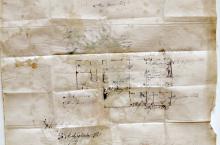
Iris Haussler is a Toronto based aritst whose installations are based around the lives of fictitious characters, and whose stories are fleshed out with documents or by a tour guide, often Haussler herself. An example is ‘He Named Her Amber’ which takes place in a 19th century house called the Grange, set up in the Ontario Art Gallery in Toronto. Visitors are told that a diary belonging to a butler who had worked there recorded the story of an Irish maid, called Mary O’Shea, who had secretly made and buried various objects, including a long wax cone, and a blob of clay throughout the building. In the darkened Grange basement the visitors find an archaeological dig in process complete with yellow tape, danger warnings and containers full of soil and rubble. Haussler’s characters often live on the fringe’s of society. The map showing where the objects were hidden was drawn by Henry Whyte (who I believe is the butler):
Another example of Iris Haussler’s work are the Sophie La Rosière and Florence Hasard installations. Both are fictitious 19th-century French painters whose work and life unfolds over a series of site-specific immersive installations and gallery-shows since 2016. Her abandoned and recently reconstructed studio from 1918 allows us a glimpse into her creative, yet mostly reclusive life and tells about her passionate relationship with Florence Hasard. Her series of paintings, obscured with blackened beeswax, activated international investigations beyond the subject matter into the museum’s restoration practices and artistic authorship.
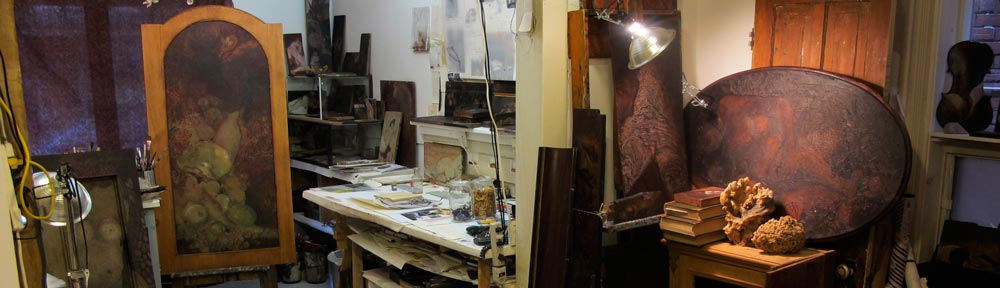
Florence Hasard involves a number of different installations. For example, the one below called ‘Apartment 5’ is a studio reconstruction representing the late body of work of French immigrant Florence Hasard after she moved from Wisconsin to New York in 1942. ‘Her legacy reveals the life of a reclusive artist living in exile and isolation, and the mind of a woman traumatized and obsessed with her experiences during the first World War.’
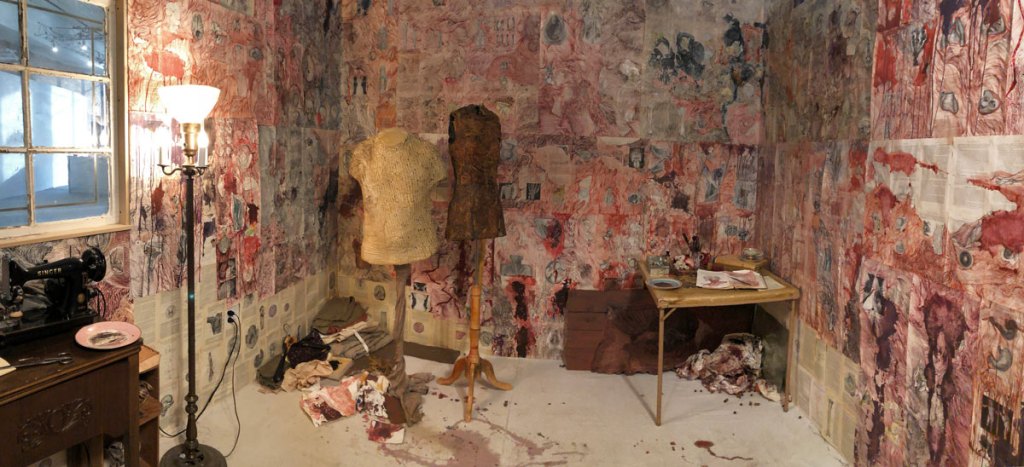
Wallpaper made from pages of Gray’s Anatomy.
Book paintings in Gray’s Anatomy 1942 edition.
My work was created to be experienced as historic fact, as a method for a direct and personal involvement of the visitor. It creates an experience that is not filtered by the categories of contemporary art that we would normally apply to such a tour, it provides a participatory sense of discovery. This principle has been called “haptic conceptual art“, a practice that deals with deep questions of the human condition, but initiates them through direct experience, rather than through theoretical discourse.
Although my work at first glance seems to have developed for a very different reason to Iris Haussler’s, in fact there are similarities: we both set out to create an experience that questions ‘the human condition’ – in my case the human-animal condition. It is useful to read that Haussler sees direct experience as perhaps more valuable for questioning the human condition than theoretical discourse. I too am interested in how I can use installation and fictioning as a method for direct personal involvement of the visitor. I have not come across the term ‘haptic conceptual art’ before and this seems a useful term to explore further. A main difference of course is that Haussler sets the work/viewer in the present, and imagines historical narratives, while I imagine the future, and from that future stance, look back with my visitors, on today . Another major difference is that the past imagined by Haussler is fictional (although based on similar events in the past) , while in my work the future curator/visitor looks back on the ‘reality’ of today. Crucially, In Haussler’s work the visitor may feel tricked to discover that the ‘reality’ they thought they were learning about is in fact fictitious, while the visitor to my installations know they are in a fictionalised world because it is set in the future.
Sunny Allison Smith, Dean of Fine Arts, California College of the Arts, is interested in story: both stories from American history, but also fictional narratives. She says of her work:
Motivated by a sense of accountability for harms caused by my ancestors, I have spent many years investigating the cultural phenomenon of historical reenactment as the ritualized performance of unresolved trauma. Haunted by the past, my activism takes form in a queered materiality that summons the ghosts of history/herstory/hxstory, tracing alternate lineages, transmitting different storylines, offering hopeful re-workings. Through apprenticeships with culture bearers across craft traditions, I create sculptures with curative potential, serving as keys for time travel and the possibility of healing past, present, and future generations. Photographs taken at open-air living history museums—from Skansen in Stockholm to Colonial Williamsburg, Virginia—are digitally edited, printed on linen, and fashioned into functional textiles. Moveable set walls provide a space for reflection, deep listening, acting out. Candlestick, slotted spoon, cornhusk doll, besom broom, mobcap, featherbed, snare drum—my objects present as scarecrow-like, silently vibrant, seen and unseen, hiding in plain sight. —Sunny A. Smith, 2019
https://sunnyasmith.com/s-t-a-t-e-m-e-n-t
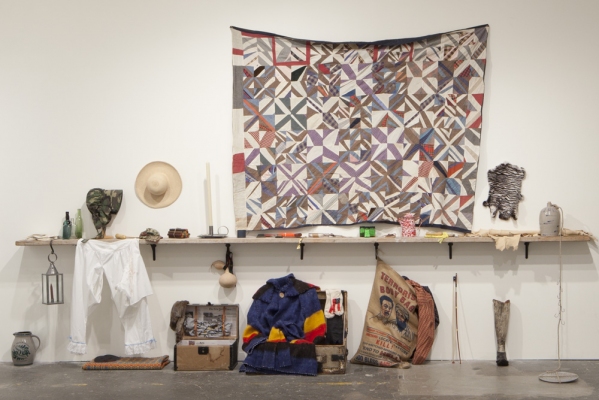
I really like the idea behind this installation and so have copied in full below what Sunny says of it:
For this commission for the Wattis Institute, I proposed to recreate the detailed inventory of objects listed by Huck Finn in Chapter 9 of Mark Twain’s famous novel, “lots of things around about on the floor” of the house that he and Jim found floating in the flooded Mississippi river. This compelling list of material objects or props suggests multiple narratives, metaphors, and meanings. Most importantly, though, these are the things that surround the dead body of Huck Finn’s abusive father, the reality of which he is temporarily spared thanks to the protective discretion of Jim. Huck’s detailed observations stand in contrast to his blindness toward the corpse, almost as if he is distracting himself (or Twain is distracting the reader) from the truth. It is in this chapter that a bond begins to form between Huck and Jim, and Jim is revealed to be both a caring family man and a compassionate friend to the young Huck. Although Huck’s narration is upbeat and even humorous at times as he and Jim loot the house, the undertone is ominous, the context of a floating house resonating with media images of the aftermath of Hurricane Katrina.
For this piece, I was thinking about “historical reproductions” and as such, I wanted to blur the line between objects that could be read as old or new, handmade (by me) or commercially produced. I gathered the objects while traveling up the Mississippi River from New Orleans to Chicago during the summer of 2010.
Since the ‘found object’ and the ‘made object’ (by me) is as yet unresolved in my own work I was particularly interested to read the sentence above, “I wanted to blur the line between objects that could be read as old or new, handmade (by me) or commercially produced”. I would really like to know which of the objects in the installation above fit in each category.
Here is another example, also inspired by the writing of Mark twain ( I did not know that ‘Mark Twain’ was the pseudonym used by Samuel Clemens. It is called ‘By the by and by and by’.
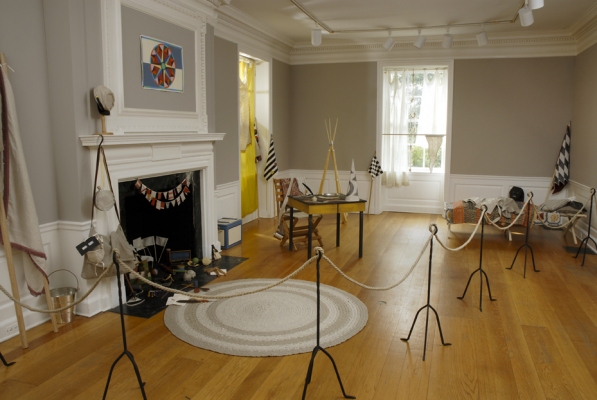
What most interests me in Twain’s writing is his use of time travel as a way of holding the past up to the present, explaining in a sense “how we got here” but also reminding us that we make our world. Twain takes extra care in describing the costumes, “props” and interiors in which the action of each story plays out. There are also many references throughout his work to trades, crafts, and the pleasures of manual labor. Twain delights in role-play, and provides many an object lesson on the performativity of identity, and especially the way masculinity and nationalism are performed. As the saying goes, “the clothes make the man,” and Twain’s stories are filled with accounts of mistaken identity and the use of disguise. These performative accounts serve to elucidate deeper concerns: walking in the shoes of others in order to understand injustice, or exploring feelings toward war and the role one plays in it, for example. Twain’s protagonists navigate through complex social realities in playfully mischievous ways, often doing the “wrong” thing in order to do the right thing. In his stories, he often creates a sticky situation, or a test, asking the reader to grapple with questions that don’t resolve into a single easy answer.
Sunny A. Smith. https://sunnyasmith.com/p-r-o-j-e-c-t-s/by-the-by-and-by-and-by/1
Zoe Beloff, professor of media studies, Queen’s College, CUNY, is another Artist who works in different mediums, but includes installation and narrative in her work. She describes herself as follows:
Zoe is an artist, filmmaker, writer and rootless cosmopolitan based in New York. She aims to make art that both entertains and provokes discussion. With a focus on social justice, she draws timelines between past and present to imagine a more egalitarian future. Her projects often involve a range of media including films, drawings and archival documents organized around a theme. They include proposals for new forms of community; The Coney Island Amateur Psychoanalytic Society and its Circle 1926 – 1972 and The Days of the Commune, projects that explore relationships between labor, technology and mental states in The Infernal Dream of Mutt and Jeff and Emotions go to Work. She recently completed a trilogy of movies, based on ideas for films proposed by never realized by radical artists; Eisenstein’s scenario Glass House, Brecht’s A Model Family in a Model Home and James Agee’s The Tramp’s New World.
It is interesting that Beloff too focuses on social justice issues, and that she incorporates paintings, films, drawings, found objects and documents into her work. Her work incorporates fiction in the sense that she imagines alternative scenarios for varous public figures (e.g. Freud) as well as making films that she imagines Eisenstein or Brecht might have made. Perhaps her work is closest to the notion of ‘fictioning’ rather than fiction than the other two artists considered so far (because her work is focused on alternative scenarios for social justice and equality). Although this is not the case in the work I show below which is rather less about narrative than some of her work.
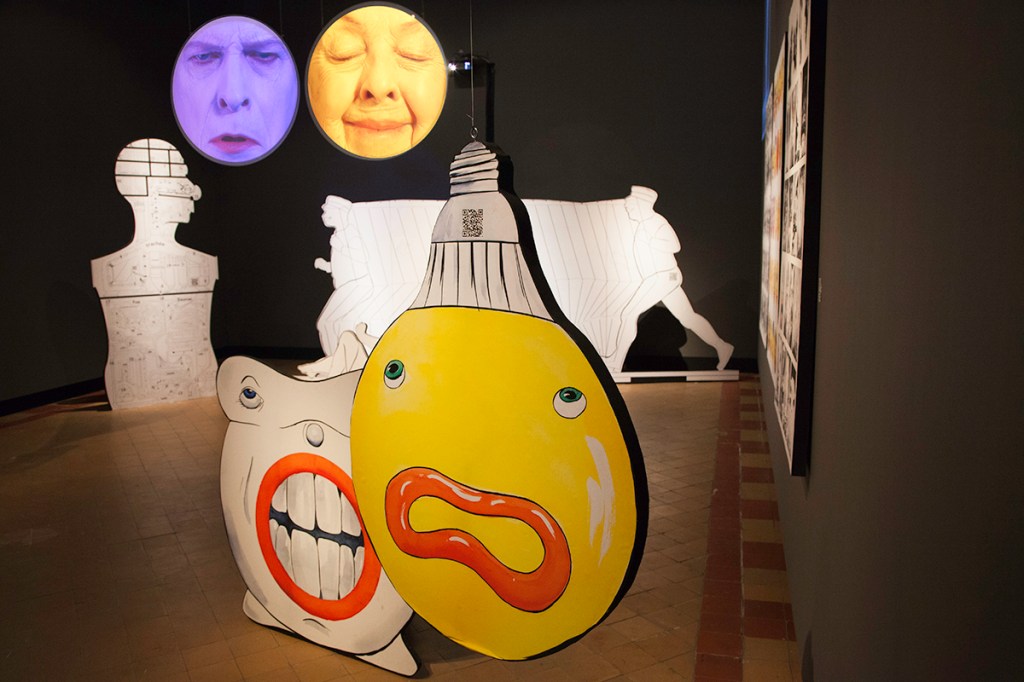
Beloff: Emotions Go to work. A gallery installation that includes five films, and numerous objects (2016)
Beloff writes: An installation that investigates how our emotions and feelings have been turned into commodities and instrumentalized by global corporations. It asks what does the future hold in store for a world where people are treated more and more like things, while the billions of gadgets that make up the internet of things are increasingly anthropomorphized, granted agency.
I am particularly interested in this installation because it is so close to the work I was attempting to explore before I joined the MA on The Machine Stops (The Machine Stops by E.M. Forster).
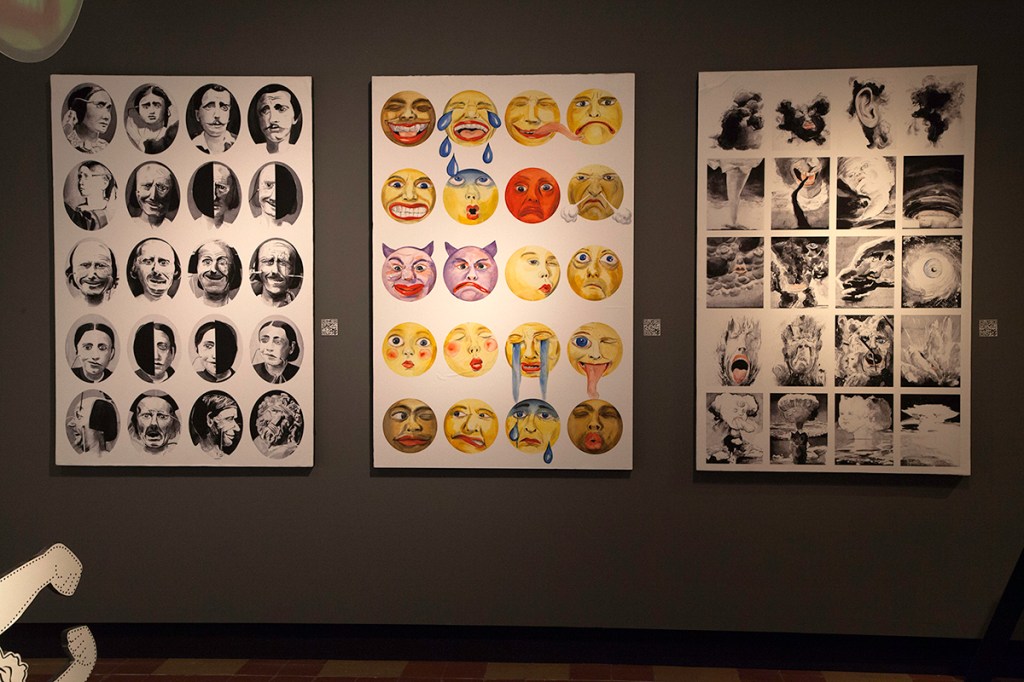
A better example of her fictional work is a series of works created around her imaginary early 20th century Coney Island Amateur Psychoanalytic Society and its “founder,” Albert Grass, exhibited in London in 2010 which blurs the line between truth and fiction. The films and book that mostly add to the archives of the pshchoanalytic society are for example, short silent films that Beloff has made of the dreams of imagined patients, or of gatherings of the society itself.
‘A world redrawn’ is an installation in which Beloff looks at the ideas of Sergei Eisenstein and Bertold Brecht, both Marxists, who lived in Los Angeles in the 1930s (Eisenstein) or 1940s (Brecht). This exhibition too, blurs fact with fiction by for example including archival documents, and fictional films in which Beloff imagines Eisenstein and Brecht in Los Angeles today and plays with the idea of interviewing them.
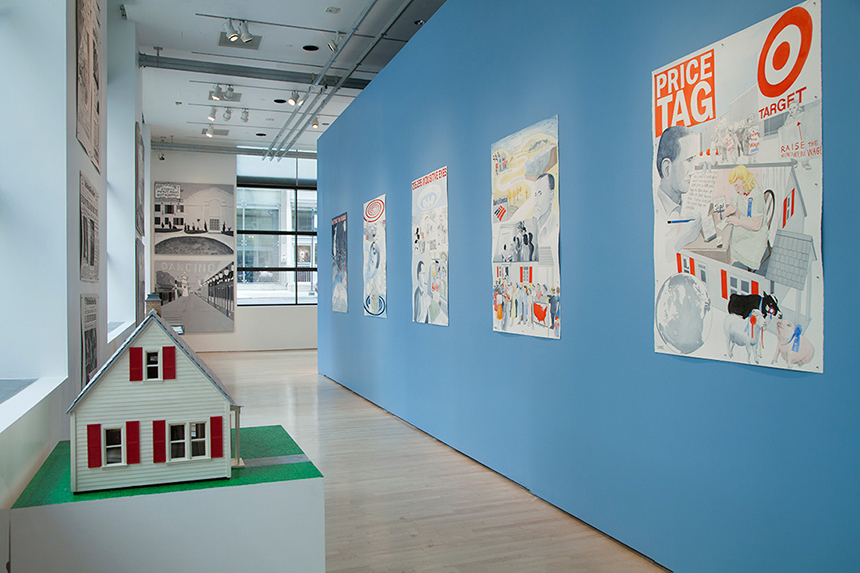
Ilya and Emilia Kabakow were both Russians who moved to the USA in the 1980s. Much of their work explores the relationship of capitalism and communism.. See link to their web sit here: http://www.kabakov.net/portfolio
The kabakov husband and wife team (Ilya died In May this year) spent their lives imagining Utopia, which is in fact what I am also imagining (although the details of Utopia are not clear to me yet)
In the link below they discuss how drawing leads to installation:
In it they write:
Since the late eighties the acclaimed conceptual artists Ilya and Emilia Kabakov have created fantastical spaces that they call ‘total’ installations inviting viewers to immerse themselves in stories about utopian dreams. The use of common objects – things which help to create an atmosphere of memory – is a key instrument in their work; they incorporate such objects in their walkable room installations, which become something like a personal museum for the “little man”.
Ilya and Emilia Kabakov. Taken from the web site address above.
In fact Illya Kabakov’s installations are most clearly linked to the practice of drawing, of all artists discussed here. The installations are all accompanied with drawings that often form part of the installation. See an example of an installation below:
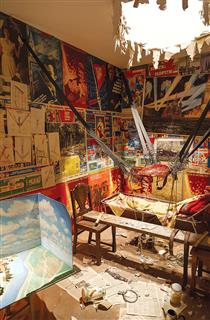
In summary, this short review of artists who are using installation and narrative, or fiction in some way was made after I decided to use these methods myself because I thought they were useful for exploring social justice issues. This look at Iris Haussler, Zoe Beloff, Sunny Allison Smith, and Ilya and Emilia Kabakov (all residing in the North America) has inspired and given me confidence that working in installation and fictioning is an excellent way to approach the critical study of our relationship with other animals – allowing an approach that can draw on many different mediums inclufing film, archival material, found objects, drawings, painting, scultpure and even performance. Whether the idea of the museum gets in the way of this, I don’t know and have to do more thinking about/installation work. Beloff uses a lot of film including fictional interviews – I was thinking before reading about Beloff, for example of making a film of interviews with men and women whose fictional babies were grown on a metal plate in the gallery on ‘clinical labouring’ . Or filming a performance in which a group of people meet together to discuss their emotional response to having a xenoplantation after the Giant Rupture (when it is illegal). The film would be used in the biocapitalist gallery, or a corner of it on xenotransplantation. I think that installation allows for an interactive experience – the visitor is part of the installation as soon as they step into it. It also allows for an analysis and critique of dominant perspectives. Fiction and/or Fictioning both also encourage stepping outside the position we occupy currently, to imagine that things could be different. They could change. They could be better.
References
Burrows, D. and O’Sullivan, S. (2019). Fictioning. Edinburgh University Press.
 Drawing As Critique