Critical Reflection
I will keep this reflection to the three questions:
- What have you identified as successful
- What have you identified as problematic
- What are the next plans for research and practice?
What have you identified as successful?
Crucially, for Art as research, new understanding outlined below, arises from making, thinking and reading to inform the work.
1a. I have kept a focus on my main research question this year from the outset:
What can I learn about how artistic interventions can interrupt the iconography of oppression, objectification, invisibility (as subjects) and discourses of violence, in our society; specifically toward ‘other’ animals?
Learning has included that installation is a useful way to challenge discourses of violence toward other animals (of course, these discourses about other animals also normalise violence to other people), because in conceiving the installation, the maker must focus primarily on imagining the viewer’s experience, and because this experiences encourages dialogue about the issues. Added to this, fictioning adds a second useful dimension by removing the viewer from the here and now to the future. Because of this fictioning/speculative imagining is a device that allows us to step outside of the ‘world-as-is’ and critique it, rather than merely describe it (and in describing it, mirror and corroborate it). Crucially this device is hopeful because it fictions a world in 2063 where human violence has ended. One person at the summer show commented:
‘Setting it in 2063 allows me to look back at the world as it is today and to look at my own behaviour in a slightly detached way that allows me to see it more clearly.”
I have written more about why I think both installation and fictioning are useful in work focused on social justice issues in the theoretical part of this unit three blog.
Importantly, I think the installation is successful in making visible normalising violent practices that are generally invisible.
1b. Related to this is the, perhaps unexpected, focus on schooling as a site for violence, as well as showing dissection in a biology class as an aspect of how violence is normalised in schooling. In our anthropocentric cultures, we perhaps think of violence, as relating to war or physical assault. We tend to overlook the smaller violences at the heart of human cultures. I hope the installation raises questions about how we regard violence and what we tolerate, and even take to be normal in our societies.
1c. With regard to the quote from Derrida at the top of this page, I have managed to focus this work on the other animal looking at the human, rather than the human objectifying the other animal. For example, a ceramic frog challenges the boy holding the scalpel. This is fundamental to the work, and it reminds me of Kahlon’s (in Tali, 2022) refusal to include stereotypical images in her work (see discussion in 2d below). Similarly I am at pains to exclude images of other animals being treated violently in my work. The drawing of the dissected frog comes close, but it is a fictional frog rather than say, a photograph of an actual frog being dissected.
1d. The idea of making the booklets a ‘take-away’ was successful in the sense that many people took one. I printed 40 and all would have gone on the night of the private view had I not held back 10 (which, bar two, subsequently went quickly on the following days). When I asked for the last two to remain, several people said that they would like one, if I planned to print more. One turned up on the Wednesday following the private view in someone else’s MA illustration installation – the subject of which was leaflets, pamphlets and newspaper cuttings focusing on capitalism and consumption. I don’t know whether it was accidental or deliberately placed there by the artist – but was glad to see it.
1e. I have moved toward one of my overarching research questions (for all my work):
How can I bring my drawing into the public sphere and move toward a dialogic practice (Kester, ‘Conversation Pieces’ p. 23: dialogic art necessitates a shift in our understanding of what art is – away from the visual and sensory (which are individual experiences) and toward discursive exchange and negotiation)
I noted that quite a lot of people who saw the installation were keen to talk about it. Their questions were thoughtful and showed engagement with the work. for example:
‘Who am I? Am I a human or a robot?’
I particularly enjoyed this question because it is a question I asked myself when I was making the work. If I set the installation 40 years in the future, are my visitors themselves humans or robots and do I need to decide this? How might it make a difference to how I present the installation?
‘Are you vegan?’
I am glad that for some viewers it was clear that my work extended beyond frog dissection in a descriptive way, to questions about normalising violence to other animals generally, and by association, to the expectation that I would have considered my own behaviour in relation to this. The question lead to a lengthy discussion with the questioner and her sister about veganism and the difficulties they experienced relating to becoming vegan.
‘Where do you come from?’
I thought this was an interesting (first) question from one visitor who wanted to interview me. It lead me to talk about coming from generations of farmers. Her next question in the interview was:
‘What is most important to you?’
Again, I thought that this was a thoughtful question and it caused me to ask myself, again, what really is most important to me? I think that the fundamental answer is that most important is to question and challenge the dominant discourses and ideologies that are taught us, and lead to abuse, constraint, and exploitation and/or death of human and non human life.
1f. I have moved, in this work, more than other work during the year, toward one of the overarching questions for all my work:
How can drawing be used as a research method that contributes to new knowledge (rather than draws on knowledge already in the public sphere) (Simoniti, 2021)
This is the question that has caused me most problems during the last nine months. I have learned that the methods of installation and fictioning are useful artistic interventions in social justice issues, and I think I have something to contribute regarding knowledge about this (see theory sections on installation and fictioning). I also think that I have learned something about how to refer to this violence so that others can engage with it rather than turn away from it – through framing the violence as having now ended. I argue that this fiction allows for rather less judgement and criticism of our current actions, and does not make people feel attacked. Fiction also allows for the perspective from a future in which the beings of that world look back on this violence with horror.
I realise, through writing this critical reflection, that I also have some knowledge to contribute relating to learning violence itself – the focus for the installation.
This new knowledge arises from making the booklet that accompanied the exhibition. I spent time analysing how we learn violence in school, and partly as a result of drawing that violence, I identified and labelled nine ‘violent’ and normalising practices that I think are very damaging to children and to adults. The practices that I identified: objectifying, naming, erasing, dividing, controlling, competing, conditioning, privileging, and constraining, are briefly described in the booklet, illustrated with the drawing, and with a poem about each, written in the style of the song by Tom Paxton, ‘What did you learn in school today?’ I changed the lyrics but kept the style because it is consistent with the subject. From my knowledge of literature about schooling (gained from being an MA Education programme leader for many years) I am quite sure that these nine practices, have not been identified in quite this way before as key devices of schooling, and nor have they been labelled as normalising violent practices. The booklet itself, therefore, represents an important research outcome, and remind me that I can retain the element of analysis in my work going forward.
My understanding of ‘violence’ could be challenged. But I believe there is a strong argument for emotional and spiritual harm resulting from the practices identified, and that I could find substantive arguments in the literature to back me up. There could also be disagreements about the difference between ‘violence’ and ‘harm’. The National Institute of Health, for example offers this :
Violence is defined by the World Health Organization in the WRVH as “the intentional use of physical force or power, threatened or actual, against oneself, another person, or against a group or community, that either results in or has a high likelihood of resulting in injury, death, psychological harm, maldevelopment or deprivation
This definition emphasises that a person or group must intend to use force or power against another person or group in order for an act to be classified as violent.https://www.ncbi.nlm.nih.gov/pmc/articles/PMC2652990/#:~:text=An%20overarching%20definition&text=This%20definition%20emphasises%20that%20a,from%20unintended%20actions%20and%20incidents.
1g. I have paid attention to another overarching question for my work:
How can I synthesise social critique with emotional experience?
I hope that emotional connection was achieved by the fact that every single one of us has experience of school. I was surprised too, by how many (very young) people had experience of dissecting other animals. Several retold stories of their own experience. For example, two young technicians who had recently finished their BA – one from the North of the country and one from the South, told me that they had dissected other animals in biology – one a sheep’s heart, and one a rat. The both talked about feeling that this was a violent, and, in their view, unnecessary experience. Another student told me of her experience of dissecting an eye ball.
I think that the choice to make ceramic frogs, as well as the drawing of the frog on copper was engaging. For example, I spotted one adult male stroking the top of one frog’s head. Another visitor studied the drawing of the frog for some time and commented that he had not appreciated how beautiful frogs are before.
1h. The choice to focus on Biology itself was, in my view, successful, because Biology is at the heart of many contemporary discussions about human-other nature relationships. Indeed Biology , and science more generally, has been identified as problematic in supporting the privileging and supremacy of humans over the rest of the living world.
What happens when human exceptionalism and bounded individualism, those old saws of Western philosophy and political economics, become unthinkable in the best sciences, whether natural or social? Seriously unthinkable: not available to think with. Biological sciences have been especially potent in fermenting notions about all the mortal inhabitants of the earth since the imperializing eighteenth century. Homo sapiens – the human as species , the Anthropos as the human species , Modern man – was a chief product of these knowledge practices. What happens when the best biologies of the 21st century cannot do their job with bounded individuals plus contexts, when organisms plus environments, or genes plus whatever they need, no longer sustain the the overflowing richness of biological knowledge, if they ever did? Haraway, 2016:30
1i. Other successful aspects include that the concept of the Museum of Human Violence is itself a useful and broad idea within which to site my ongoing practice. It has many possibilities for development. I like the idea of conceptualising it rather like a Russian doll – with the actual installation being a tiny corner of one ‘spot’ within one conceptual space, within one gallery, within the whole museum.
2. What have you identified as problematic
2a. I would like to be much clearer about the world of 2063. For example, I’m imagining that it might be a world in which AI has gained power over humans. But I’m seeing this as a benevolent AI that has brought about the end of violence. However, I’m not totally sure of the relationship between human and AI, and I’m not sure whether this is a divided world between AI and humans or a cyborg world. Reading the post humanist literature on Cyborgs, and AI take-over would be useful in regard to clarifying my position.
Similarly, someone asked me “What happened in the Giant rupture?’
I have deliberately not decided and I replied by asking them what they thought might have happened.
I need to be clearer about this fictional world because it might impact my decisions about what to include in the installation and how I frame it (even if the decisions themselves are not shared, which I don’t think they should be – leaving space for engagement/ interpretation).
2b. Authorship is the big issue and was immediately picked up in my group crit – who made the frog drawing and why was it there? In fact I decided to leave out the second drawing below after this question was asked during installation:
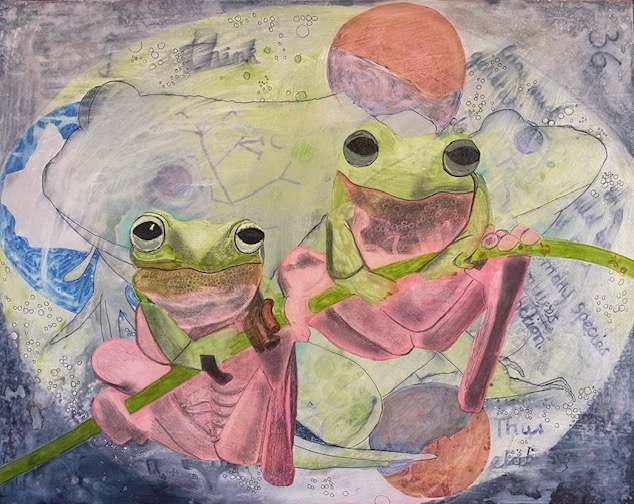
NB. I also like the negative of this drawing (photoshop – layer – adjustment – invert)
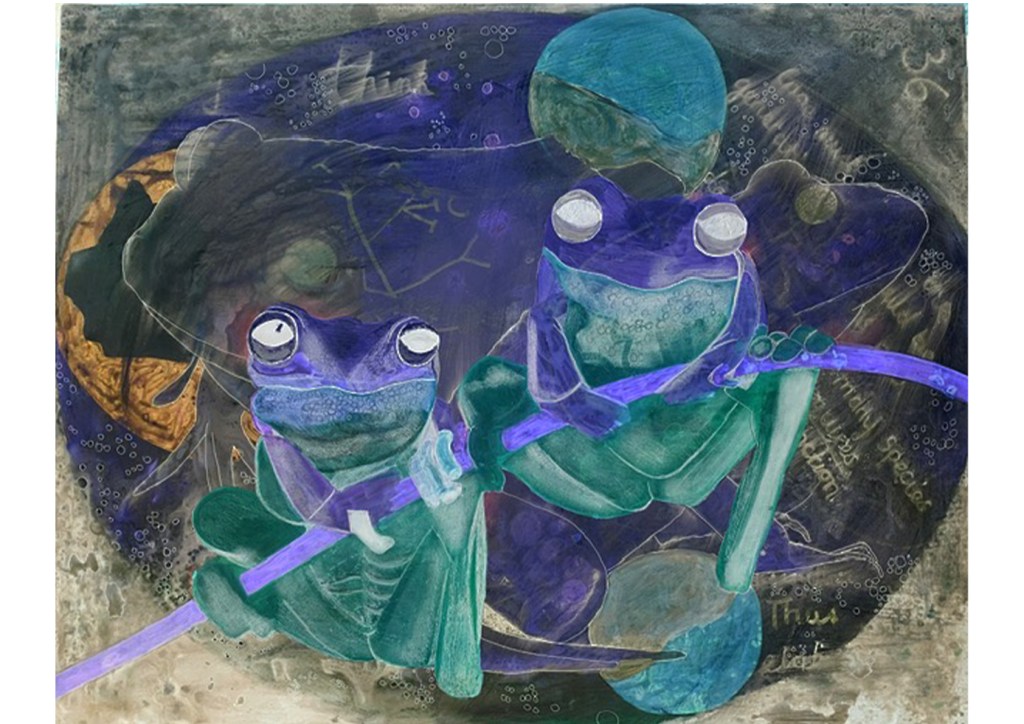
I had a strong sense of incoherence relating to both frog drawings beforehand. I should have taken this awareness more seriously. I need to urgently sort out the question of authorship before I embark on the next installation. The question is ‘What are these drawings doing in a fictional, curated museum about learning violence and who drew them?’ (asked in the context of a museum curated by AI or a cyborg or a an AI/Human collaboration. )
The frog drawings are the most obvious concern but the question of authorship could equally be asked about the ceramic frogs, the paper mache boy and the drawings in the booklet. Even if the answer is that these are found objects chosen to exemplify the issues by the curator, still it’s a stretch of the imagination to explain the drawing, titled ‘I Think’, above. The copper drawing can just about be explained in relation to the curator wanting to show an image of a frog, since they are now extinct (in 2063). I also think with time I could probably rationalise the second drawing – but I didn’t have time and therefore withdrew it.
In fact the drawing started with a focus on evolution and the differing explanations between the (competitive) Darwinian explanation and the (interdependent) symbiotic Margulis explanation, but developed as a way of challenging the anthropocentric view that only humans are intelligent (Braiditti, 2013) ( returning to this 24 hours later I believe I could have used the drawing with a curatorial note pointing to the anthropocentric belief, pre giant-rupture, that only human life was intelligent – these frogs ‘think’. This would have added an important dimension).
2c. I like making things. This was pointed out in the Group Crit too. At this point I don’t know how to resolve this tension – directly related to the point above about authorship. A museum is a collection of found objects, not a collection of found objects, alongside objects made by the curator. I don’t want to stop making things, and was in fact thinking before the problem became clear to me, that the concept I have come up with, of the Museum of Human Violence, gives me licence to make things using any method I choose. And this felt very positive. Now I’m faced with the dilemma that possibly the concept means I cannot make anything!
2d. The concept of a Museum is perhaps a double edged sword. On the one hand it has all the advantages identified above, in relation to providing some distance and also providing a device for being critical of current practices; on the other it could be suggested that I should meet the conventions of the contemporary Museum (of which I am critical). Museums today, as Marten Snickare, Professor of Art History and Co-ordinator of Research at Stockholm University, talked about, are in large part colonial institutions, that present stolen objects in an exoticising form behind glass, where they are distanced and objectified and observed as ‘different’ (I wrote about this in the report of my attendance at the research week in Stockholm in January 2023). This is not want I want for my museum. In fact Professor Snickare wondered aloud whether Museums should be shut down , and everything in them given back. I suggested in the conference that they should not be shut but renamed as memorials to colonial violence, and that the objects could be cloned, and originals returned. In fact it is this suggestion that gave me the idea for my work. One way around the associations formed from my using the word ‘Museum’ could be to change the language I use to ‘Memorial’ (but I find myself hesitant to do so).
Interestingly, on 12 July, in the midst of writing this reflection, I came across a similar suggestion in the work of Rajkamal Kahlon, who explored racist imagery in her exhibition ‘Staying with Trouble’ at Weltmuseum, in Vienna (2017-18). Her encounter with the book ‘Die Volker Der Erde’ (1902) by zoologist and biologist Kurt Lambert prompted her to investigate methods of anthropology and scholarship, including methods of categorisation and classification created in the Western world (p. 95). Amongst other questions raised for her was the one of which photographs can be shown and which hidden away, as unethical. Kahlon also proposes that Western museums should be seen as holocaust museums, not as sites of ‘scientific’ exploration, but as museums of crimes against humanity (I’d make the same argument about zoos – but in their case, centres of crimes against other animals). She refuses to reproduce old stereotypes embedded in historical images and introduces a critique of museums into her work. She also subverts the ways Western museums customarily present colonial subjects and objects by NOT placing them on glass shelves, behind glass cases or keeping them ‘at a safe distance’ (Tali: 2022 p. 101, in Hartle and White).
2e. I should mention the audio. This is a recording of the response from Chat GPT when given a brief outline of the plan for the museum. I thought it had got the tone exactly right, but on reflection I think it is slightly too didactic, slightly confusing, and also too long and that it would be better edited down to about half the length. (I have put an edited version together with the video, and I think it works better). I also had trouble with the speakers – they would not charge. I need to invest in a better speaker system.
2f. I rushed into videoing the installation without looking at my camera phone settings, and consequently it is recorded in portrait format, and I wish I had checked the frame rate. I need to think more carefully about recording my work.
2g. Related to (f) above is the problem of recording and presenting the work here even with good quality video. An installation focuses on the experience for the visitor, which cannot be recorded through photographs. Nor can the total experience be captured through individual works. An installation is a temporary work made up of the relationship between items in it, and individual items make no sense (and have no value) out of context.
3. What are your next plans for research and practice
3a. I intend sticking with the two methods for practice: installation and fictioning.
3b. I would like to keep with the idea of the Museum of Human Violence.
I therefore need to think about, and resolve, the 3 three key problems identified above and possible 4th key problem (which I identify as a strength of this work, but could easily become a problem):
- clarity about the relationship between the human and AI in 2063, including exactly who is curating the museum.
- authorship and making things for the museum (making things is directly linked to authorship).
- circumventing expectations about museum display (linked to calling my work a museum).
- depending on my choice for the next ‘gallery’ – avoiding stereotypical, and unethical images of actual, living animals being treated violently (for example, this problem comes up when I think about a ‘gallery’ examining learned violence inherent in entertainment using other animals).
3c. Relating to the first problem , above, during the summer holiday I will become more familiar with posthumanist theory, particularly the post-anthropocentric thought of Rosi Braidotti, as well as writing on AI -human intersections. I need to position myself in relation to the latter in order to clarify my fictional world.
I need to find a way of resolving the question of authorship and making things for the museum. Currently I can see no way around this, except by only using found objects, apart from continuing with a fictional approach, for example I rationalised the drawing of the frog (on copper) being present in the installation with a curatorial note saying that the frog was drawn on a fictional date, pre-rupture, by a hepatologist-artist who noted this was a drawing of the last frog she ever saw.
Regarding expectations about museum display. I am wondering whether I can build in a critique of museums themselves. The idea of The Museum of Human Violence is already complicated. I have conceived a ‘Russian doll’ space within a space within a space. To add a critique of the violence of museums themselves seems a step too far. But I will think more about this, including whether or not to change the word Museum to Memorial.
In fact, returning to both the problem of authorship and conventional museum display, I’m struck that ‘Fictioning’ might present the solution to both problems. I am sure there must be a way I can use Fictioning to suggest that in 2063 both artistic production and museum display are not what they were in 2023! i.e. AI curation of museums changes the way that artefacts are both produced and displayed. Artefacts from the past can be produced by AI to mimic human creations almost instantaneously! In 2063 Museums are no longer violent colonial institutions that objectify and exoticise other beings, but memorials to colonising violence: they therefore do not show objects in conventional, former, ways.
The way around reproducing images of other animals being treated violently seems to be to approach it always from the imagined perspective of the ‘other’ animal: what is the human doing? e.g In a gallery on ‘entertainment’, instead of showing a bird, killed with a shot, showing a terrifying man with a gun. Or, if I feel it is important to include the other animal, making sure this is always an image of the ‘free’ unharmed animal. Or, if I feel it is important to include direct reference to the harmed animal , making this harmed animal in clay, paper mache, fibre or animation. Another way might be to focus on the colonising objects of violence e.g. the ‘bit’ and ‘whip’ as objects of violence in horse racing.
3d. There are various alternatives for the next subject for the museum:
- continue working on ‘erasure’ and the biology class and build on the work produced here. For example, I could work on the blackboard drawing/writing and I could add more elements to this installation. As part of this I could expand on concepts in biology including ‘categorisation’ and ‘evolution’.
- continue working on ‘Learning violence: schooling’ but take another concept from the booklet e.g. ‘competition’.
- work on a different ‘gallery’ in the museum e.g entertainment or food systems.
- add a new, overarching, gallery (one not already mentioned on the poster) that focuses specifically on the violence of the anthropos itself (see Braidotti), perhaps exemplified with a specific example, eg how our anthropocentric thinking allows us to rationalise our treatment of the horse, or more generally, to think that caging/constraining other beings is acceptable (this might enable me to make links with post-humanist work on AI-human intersections, and previous work on The Machine Stops).
e. Whatever I work on next – continue to think about how violence is normalised while at the same time, invisiblised, and how to go beyond merely describing or ‘showing’ it (remembering that ‘pointing out’ something that is normal does not change it, but corroborates it).
f. I would like to develop some of the earlier work -Think about how other work made during the year of this project can be brought into The Museum of Human violence e.g. miniature drawings of objects of violence; cell drawings (perhaps in the gallery on human exceptionalism); collages (also the gallery on human exceptionalism? Possibly a ‘spot’ on empathy?)
nb. My mother, a farmer’s wife, and daughter, like me, of generations of animal farmers, commented on my work, “Other animals are violent.” I take this to imply that violence is somehow innate.
My response to this is:
- It is not my responsibility to question the ethics of a different species. It is my responsibility to question my own ethics and the ethics of my species.
- The violence of my own species leads to the death of 23.3 million non-human animals daily in the USA alone. It has directly been responsible for the deaths of millions of humans. It has the propensity to lead to the future deaths/extinction of all animal life.
- Many humans seek to avoid the use/abuse/killing of other animals. Therefore this behaviour is not innate, but a learned, cultural, choice, and different choices can be made (this in itself would be an interesting focus for the museum).
References
Braidotti , R (2021) Posthumast Feminism. Cambridge: Polity Books.
Derrida, J. (2008) The Animal That Therefore I Am. New York: Fordham Press.
Haraway, Donna,J. (2016). Staying With The Trouble: making kin in the Chthulucene. Durham and London: Duke University Press.
Tali, M (2022) Imperialism, Empathy and Healing in Rajkamal Kahlon’s artistic activism. Chapter 5, in Hartle, S. and White, D. (2022). Visual Activism in the 21st Century: art, protest and resistance in an uncertain world. London: Bloomsbury Visual Arts.
 Drawing As Critique