In this research blog I touch on:
- The abuse of other animals in ‘art’. I suggest that art normalises violence to other animals and that visual art is littered with the corpses of other animals with regard to making art, and that other animals are objectified in visual images.
- Visual Artists who specifically challenge human violence toward other animals.
- Inspirational fiction (novels and film) that challenges cruelty to other animals
- Visual artists who focus on other social justice issues and whose processes and content I am inspired by.
- Writers, and filmmakers who explore and critique discourses of power and control ( because my work is focused on the idea of drawing as a critique of dominant discourses of other animals)
1. Abuse, exploitation and invisibility/objectificaton of other animals in the art world.
Visual Art is heavily implicated in the normalisation of violence and cruelty to other animals. Other animals are, at the same time, both everywhere in visual art; as well as marginalised and invisible. They are usually treated as objects, and in service to humans. For example, in taxidermy, the bodies of other animals are stuffed and used to make a point about/and for humans. Or their body parts are used in the manufacture of art materials, for example, in ivory white paint, bone black paint, squirrel hair brushes, rabbit skin used in glue, casein treated paper for metal point, gelatine use in sizing paper, varnish made from insects – the list is long. Many of the artists we revere have used products of cruelty in their work. Although we might argue that in the past they had no alternatives, in fact that is not the case (Alio, 2015). I believe that if we agree that art should work for the ‘good’ of the living world, it should not collude in cruelty, and we should refuse to use materials made from cruelty in our work.
Below are some examples of how the objectification of other animals is normalised in art.
The painting is typical of the ‘animal’ genre – it is not a work I am presenting as an inspiration for my own work, although it is a beautiful work of art and should be viewed both in its own context and in our own.

In the painting above it is difficult to know what was Bonheur‘s intention, but it’s important to ask how the viewer might perceive what is happening in the painting (as it is whenever other animals are used in visual art). Does the viewer admire the aesthetics of the work? Do they notice how the colours are sombre and conjure a stormy scene? Do they notice the skill of the artist in depicting movement, and the physicality of the horses. Do they perhaps think what wilful and violent creatures these horses are? Or do they rather notice the violence of the Humans – the man in blue on the bay for example who is about to whip the horse across the head. Or the man to the far left who forces the grey horse to his will (as all the humans do). Does the viewer notice the fear in the eye of the grey on the right? Do they feel anger that these beautiful sensitive creatures are being rounded up from their wild existence to be sold at the fair. They are commodities – things. Do they empathise with the horses? How do they feel about the men?
Below is a more contemporary work by an artist whose work is generally an inspiration for me, and many others: Francis Bacon. I admire his ability to evoke strong emotion, through both colour and size and subject.
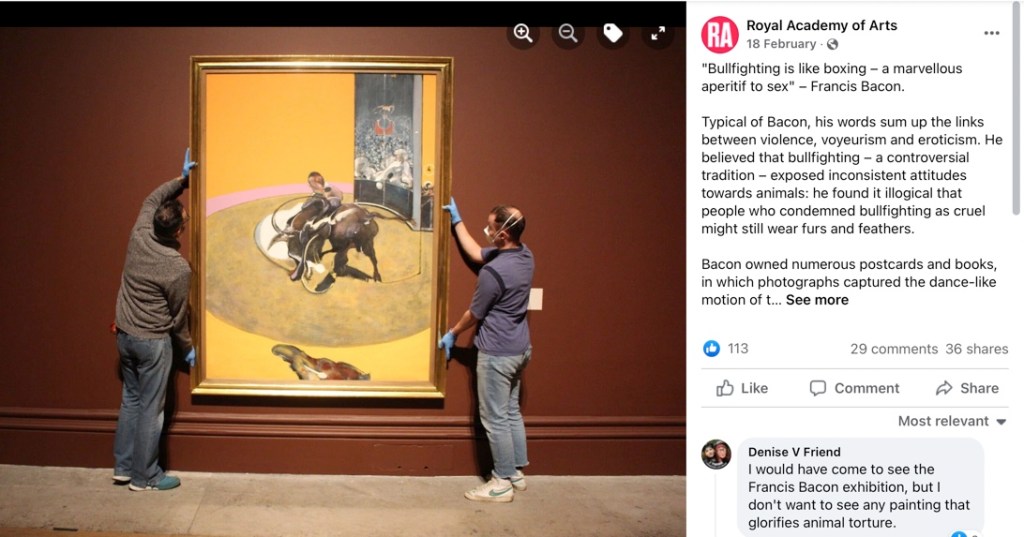
Francis Bacon, The Bullfighter, 1969. Downloaded from the RA social media site with comments.
It’s hard to tell with Bacon whether his comment about bullfighting being a marvellous aperitif to sex is ironic. The comment goes on to say that he found it hypocritical that people who wear fur and feathers condemn bullfighting. However, because people are undoubtedly hypocritical does not justify normalisation of objectification and violence – hypocrisy of others does not make cruelty acceptable. I agree with the comment of Denise Friend, above: I do not want to see any painting that glorifies animal torture either.
We cannot paint cruelty to other animals to draw attention to the cruelty (although I don’t think this is Bacon’s intention). Drawing attention to cruelty in a culture where that cruelty is normalised does not critique the cruelty. It compounds it. (I learned this fact when I used to teach about objectification of females to boys and men).
I have a similar view on the work of Maurizio Cattalan and Damien Hirst. Taxidermy is widespread in contemporary art (as it was in 19th C museums). The image below is taken from a 2016 USA exhibition called ‘Dead Animals‘ . (I see there were no dead human animals).
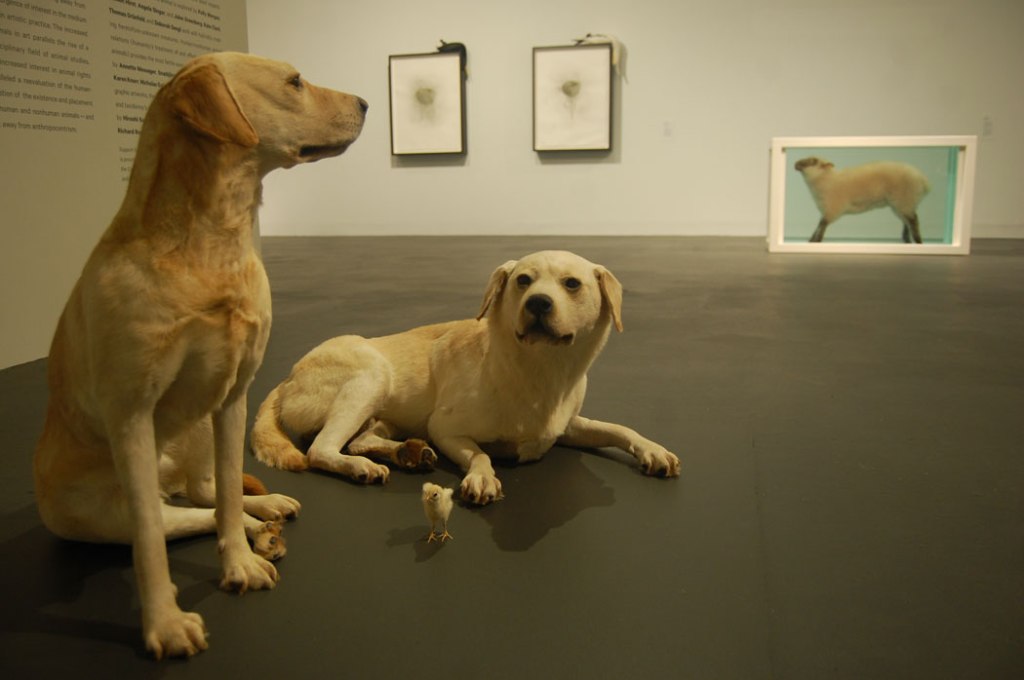
Although, in my view, Cattelan and Hirst have made some fantastic work (e.g. Cattelan ‘Charlie Don’t Surf‘ and Hirst, Black Scalpel City Scape series), their cruelty and speciesism in using taxidermied dead animals is inexcusable. I also wonder whether the sheep and chicken, particularly, were killed especially for this cruelty. Here other animals are again used as objects, purely as a SPECTACLE. Their dead bodies are used to entertain other, human, animals. If an artist wishes to make a point about death by using a cadevore, I suggest they use a dead human, who gives permission for their body to be used in this way prior to their death (as the philosopher Jeremy Bentham did for his body to be on permanent display at UCL). Using other animals in this way is unethical and disrespectful. I recognise that there is an alternative view of taxidermy in contemporary art, and that much has been written on this subject. For example by Poliquin (2008) and Bacon (200&). These writers seem to recognise, but ignore the ethical issues involved and instead argue that the use of taxidermy in art galleries unsettles and challenges us to think differently about our relationship with other animals in our ‘post-modern’ world. I doubt this myself, but have come across one example of taxidermy that I think is productive and worthwhile (see the next section)
Finally in this category, I turn to the work of William Kentridge. Kentridge, like Francis Bacon, is inspirational. I admire his work critiquing discourses of Racism and colonialism in his native South Africa. l also admire his use of charcoal, the size and ways that he develops his drawings, for example, into animation. He is an artist I will continue to study and learn from. However, some of his works are speciesist. To begin with I thought the work was ambiguous, but in fact there is clear evidence for Kentridge NOT recognising the importance of the lives of other animals.
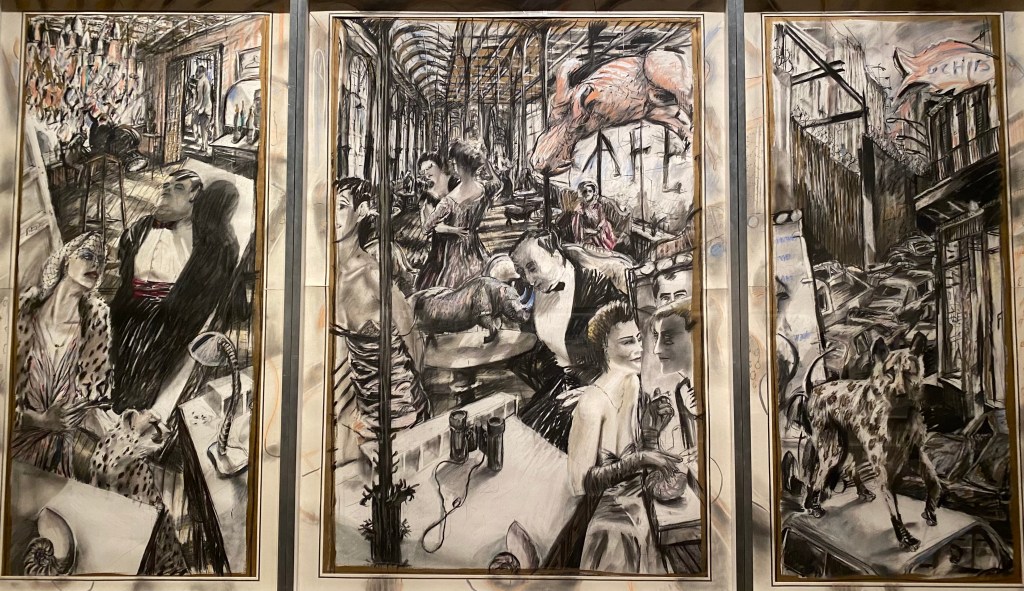
For example, in ‘The Conservationists Ball’ above it seems that he is critiquing the hypocrisy of rich people who are more concerned about conservation, than racism. It could be too, that he is suggesting they are not really concerned about conservation because they are in a room full of dead animals. However, the wall label clearly indicates that he used the hyena as a metaphor for the white man. It is clearly problematic for humans to project their own negative qualities onto other animals. Additionally (as with the point made about Bacon above) it is not acceptable to point out hypocrisy while being hypocritical oneself (in relation to exploiting other animals – see later point about use of mohair in tapestries). Below is another example:

Above is one of a series of landscapes, (this one titled ‘Hunting the wild spur goose’) that critique colonisation by Europeans of African Land. I am also critical of colonising the land in other parts of the world for exploitation and abuse by rich Western over-developed nations. However, the point I am making here is that it seems unlikely that Kentridge is critiquing BOTH colonisation of land and people by those from rich developed Nations, as well as the colonisation of all land and all animals by Humans. In fact I just read the RA notes online that accompany the exhibition and they specifically mention a critique of white supremacy that allowed colonisation, with no seeming awareness of human supremacy toward all living things, that allows humans to build a hierarchical relationship with all life – and once having done so – for those at the top of the hierarchy to abuse all lower in the hierarchy. I don’t think when we are speaking of normalised colonising discourses that we can afford ambiguity and (though I recognise ambiguity and ‘writerly’ approaches in art are generally welcome – I don’t think ambiguity where social justice is involved is something to promote).
A final point that seems to evidence Kentridge’s lack of insight into intersectionality and cruelty to other animals relates to the tapestries. I thought these were phenomenal, until I saw that they use mohair – so again he is making a point about colonisation/racism while himself being speciesist. (It is of course entirely possible that Kentridge made these tapestries at a point before he woke up to animal cruelty. If this were the case, I’d expect a note in the exhibition to say so. I find it very problematic that curators frequently ignore sexism, racism, speciesism in exhibitions if the artist is considered ‘one of the Greats’). The tapestries use the labour of local women – I know the outsourcing of labour to make ‘art’ is common. I would have thought that in works that challenge white supremacy, at the very least the works would be attributed to multiple authors and the names of the makers would be there alongside the name of Kentridge.
2. Visual Artists who specifically challenge the supremacy of the human animal over other animals.
Work in this category is still relatively sparse. There is, as I write above, much visual art that uses dead animals and their parts, (see above) to make a point about death or violence. But, as I wrote above, my view is that this work objectifies and uses other animals (if not downright kills them), to make a point about the human condition, rather than the condition of the animals whom they terrorise and kill (although see below – I found a project using taxidermy that I find more acceptable).
There is also a growing ‘body’ of work in Fine Art that focuses on Animal Nature. I already, briefly, critiqued the scientific project generally in my entry on Critical Animal Studies and Post-Humanism. Much of the Animal Nature research is a fine art/science collaboration (As is the Science Friction exhibition, see below). My view is that this art/science collaboration, while criticising anthropocentrism, studies other animals from an Anthropocentric perspective, (by attempting to understand other animals within a rational humanist world view). It is NOT POSSIBLE to understand other animals from this limited and limiting perspective. It is not something I am interested in becoming involved in. It can be compared, for example, to the ethnographic study of other ‘tribes’ by researchers in the early 1930s by Margaret Mead. This work was accused of ‘cultural relativism’. If we cannot understand the cultures of other people, except from our own standpoint, we certainly cannot understand the habits of other animals (see Derek Freeman, 1983. Margaret Mead and Samoa: The Making and Unmaking of an Anthropological Myth). My goal is not to UNDERSTAND other animals. My goal is to stop being cruel to them, stop using and abusing them. I do not need to understand them in order to do so. I need to understand myself, and change how I behave. I need to develop empathy, kindness and sensitivity . I need to accept that other animals feel pain. I do not need to research to ‘prove’ this – I have the evidence of experience/common sense to show me that other animals will avoid pain wherever possible, and will scream in pain/terror, as a human animal will.
I thought a starting point might be the exhibition ‘Becoming Animal, Becoming Human, Animal Perspectives.’ (http://becoming-animal-becoming-human.animal-studies.org/html/perspectives_artists.html). 24 artists took part in this. I looked at each of their web sites. Several also use dead animals. Two of them painted horses. I thought that only the photographer Julia Schlosser was exploring the human-animal relationship. Her photographs focus on her relationship with her companion cat, including the scratches she (the cat) inflicts, and the time Julia takes in caring for the cat (eg dressing her wounds). I liked these photographs for the reason that they focus on the mundane (the cat is not in sight), for example, bandages on a black background, and make me think about the care so many are prepared to give to other animals in their home. In general, though, I have no idea why the exhibition had the title it did.
I also looked at the artists in an exhibition on at the moment (autumn 2022) in Bilbao, called Science Friction (https://www.azkunazentroa.eus/en/activity/science-friction-life-between-companion-species), which examines critically the idea of human supremacy over the living world, from both a scientific and visual art perspective, drawing on the ideas of writers like Donna Haraway. I’d expected some of the artists would focus on our belief in the supremacy of the human over other animals, but again I drew a blank – the artists solely explore human supremacy over the Land.
I then looked at the USA 2019 exhibition, ‘Anthropocene Island: Colonization, Native Species and Invaders.‘ Again the title suggested to me that other animals would get a mention – again I ALMOST drew a blank. Suzanne Anker, Pam Longobardi and Sarah Olson (I love Olson’s drawings but they do not connect to my theme, and Kathleen Vance all make work about the land and the ways that human behaviours are re-ordering the ‘Natural’ world as we know it. Much of this work is interesting, but it is not focusing on my subject. Surely other animals, (many species of whom are also becoming extinct), deserve space in the massive ecoart movement? Because it seems they do NOT, it makes me question the whole ECOART MOVEMENT – which, although it questions the anthropocentric version of the world, nevertheless seems to me to mostly focus on ecocide because it threatens the Human way of life. This in itself is Anthropocentric. I thought for a moment that Christy Rupp’s work on bird extinction might be inspirational, but then I discovered that she makes the skeleton’s of extinct birds from the bones of murdered chickens. I find this level of cognitive dissonance disturbing.
Of the artists in the Anthropocene Island the one I am most interested in (I note they are all women) is Peggy Cyphers. Wikipedia describes her work as follows: ‘Cyphers finds her primary inspiration in the natural world and Charles Darwin’s theory of the interconnectedness of all beings. She is interested in techniques found in Chinese landscape painting, Indian sand painting and Surrealism to create her highly original hybrids which critique dominant culture’s over-consumption of the environment.’ She also writes, on her website about her connection, communication and ‘channelling’ of other animals. For example, these paintings called ‘Animal Spirits.’ Generally someone who claims to channel other beings might be considered crazy in our culture. Personally I have never channelled anyone or anything, but I absolutely believe that very sensitive people can communicate with other animals.
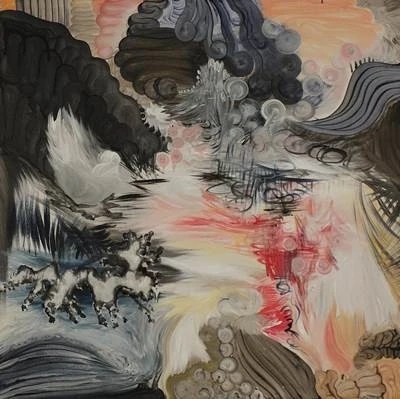
(My understanding is that Charles Darwin did not invent the theory of the interconnectedness of all beings, but the theory of human evolution, which is a rather different thing. Von Humbolt wrote his study on the interconnectedness of beings in 1845).
Next I looked at artists mentioned by Giovanni Aloi (2015) in his writing about animal studies and art. Sue Coe is an English printmaker and painter, and the first artist I have found who sets out to explicitly critique our abusive relationship with other animals. ‘Her work is in the tradition of social protest art and is highly political.’ (wikipedia). She writes of being influenced by Kathe Kollwitz and Chaim Soutine, both of whose influences I can trace in her work. (Kathe Kollwitz is also a favourite of mine). The themes that Coe explores include factory farming, meat packing, apartheid, sweatshops, prison-industrial complex, AIDS, and war. She describes herself as an artist-activist and sells her works to raise money for animal rights organisatons (if I were so lucky as to sell a work I would also give this money to an animal rights organisation).
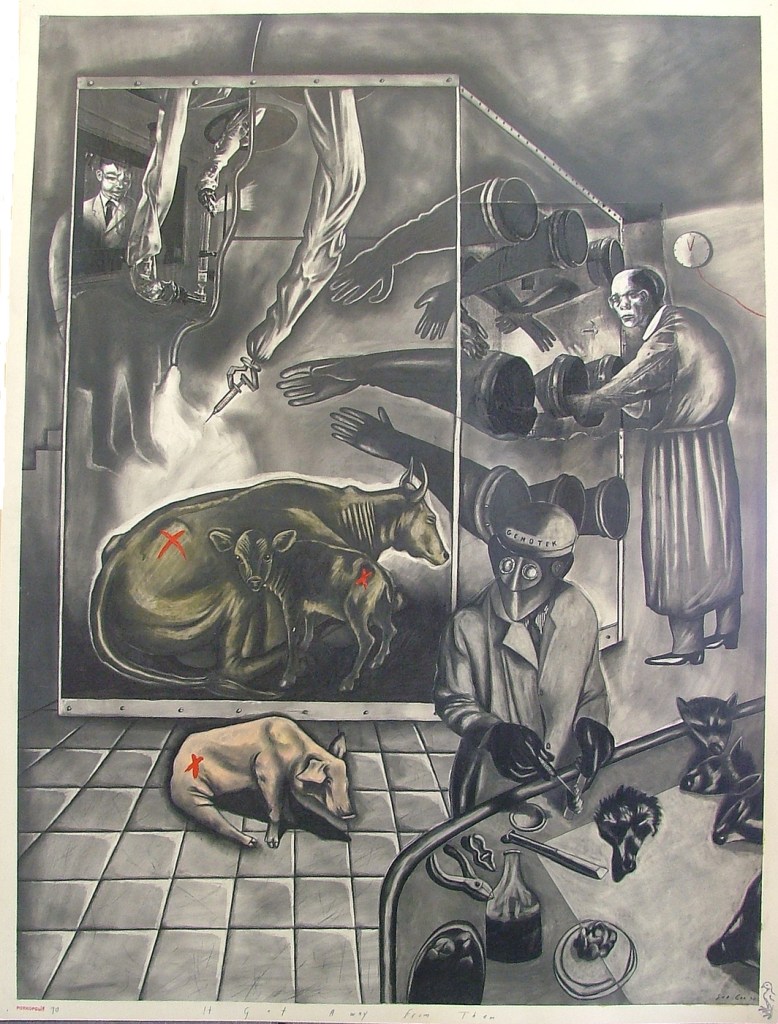
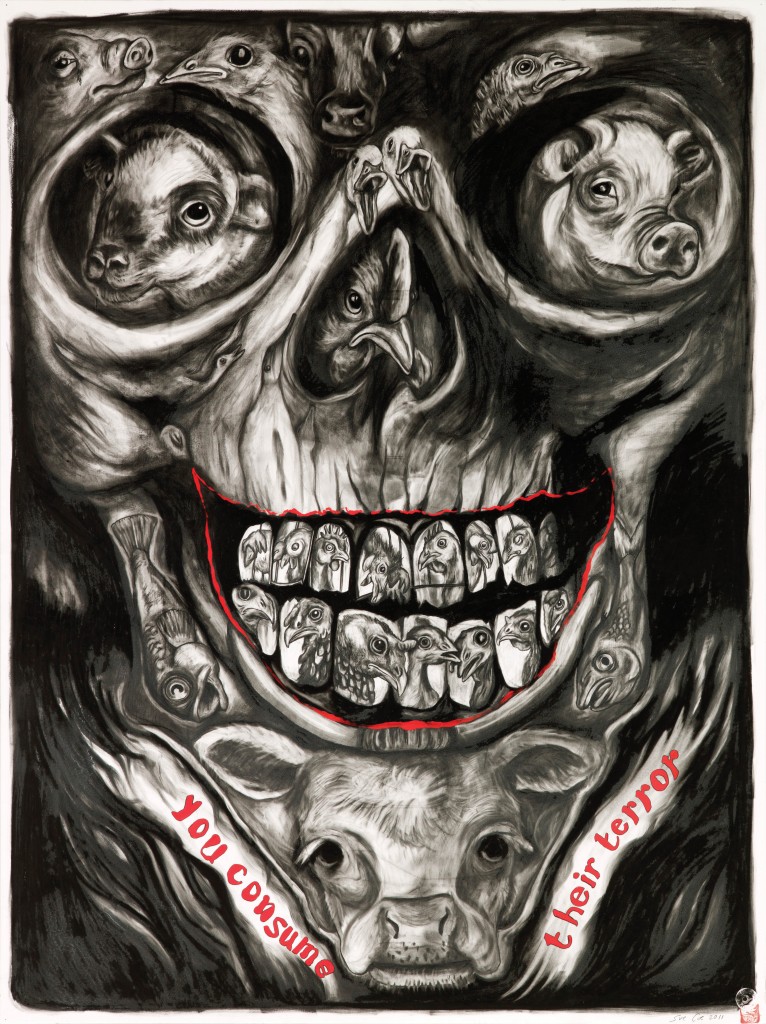
Coe has been accused of ‘audience positioning’ by Slowik (2007) and of using stylistic sentimentality to elicit a specific response from viewers (Kuzniar, 2011).
My understanding is that audience positioning is a media theory proposed by Stuart Hall. It seems to me similar to the idea of Barthes about the readerly/writerly text, and relates to how any media product seeks to position their audience . Hall suggests that every media text has a preferred reading. The audience may fully accept the preferred reading, partly accepts the reading but intrpret it depending on own experiences and interests, or reject the reading because their situation is oppositional to the dominant code. This is fundamental to my work, and an issue I am struggling with. I obviously do not want to give an ambiguous reading of cruelty to to other animals. My preferred reading is clear – I want people to accept my reading and stop being cruel! On the other hand I recognise that it’s good for the message not to be either too clear or too didactic because active engagement with the work is only going to happen when we are interested enough to work to interpret it. I also believe that showing cruelty, when it is normalised in our culture, is unlikely to change people’s views, especially in the arts. This is a bit of a conundrum. However, I disagree that Coe uses ‘stylistic sentimentality’. Her works are in no way sentimental and I wonder whether Kuzniar (2011) would say the same about, say, a painting showing people murdered in a war? Would Goya’s ‘Disaster’s of war’, say be accused of sentimental cruelty, or is this comment another example of speciesism?
I found an extremely interesting article about visual art and animal oppression written by Cronin and Kramer (2018). In it they draw attention to the work of Rocky Lewycky (artist-activist). At this point I felt I was getting somewhere. This exhibition by Lewycky, was held in the Santa Cruz Museum of Art and History in 2014. In the image below we can see quotes on the back wall by famous thinkers, for example, ‘Until we stop harming other living beings we are still savages.” said by Thomas Edison. We see hundreds of ceramic animals lined up on crates according to ‘kind’ – reminding us of the many ways humans have insisted on categorising and classifying other animals, as well as commenting on large scale industrial farming practices . Across the crates we read, ‘Genocide: Is it necessary?’. We read on the museum web site that each day a man enters carrying a swiss army backpack. He chooses a ceramic animal and places it on a gold-leafed plinth. He takes a hammer out of his backpack and smashes the animal. The animal is white on the inside but inside it is blood red.
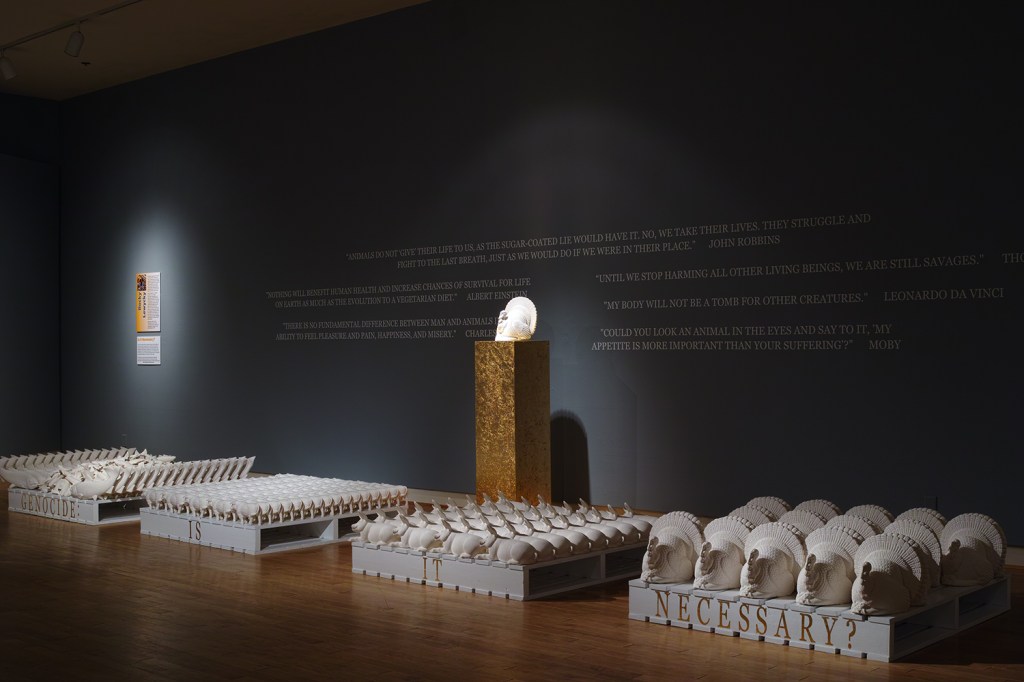
What I like so much about this art performance is that Lewycky has combined his skill as a maker, with aesthetics (the ceramic animals are beautiful. He has used gold leaf) with time and attention – both in the making, but in continued involvement with the work AFTER it is installed. The installation works as it is, and it has the added shock of the violence of the act. I have previously written that I do not want my work to be violent, because there is already so much violence toward other animals. However, in this case the artist is prepared to do violence against his own creations in order to make the point that violence to others is not acceptable. Viewers were also invited to save a ceramic animal by making a donation to an animal charity. I really like the idea of combining a made material object with performance, and the idea that both should work independently of the other. I also like the idea that the performance is repeated and I like the idea that a ceramic animal could be saved with a donation to the Humane Farming Association. Cronin and Kramer (2018) comment on the importance of distance in both Lewycky’s work and in Banksy’s work on ‘Sirens of the Lambs’ (in which he toured New York with a repurposed slaughter truck filled with large stuffed animals, crying out in pain). They comment that had either artist used real animals ‘few would seek out the spectacle as it unfolded’ (page 86). Using stuffed toy animal or ceramic animals allows a safe space in which to explore animal cruelty (not to mention that the artists have not been unethical themselves!)
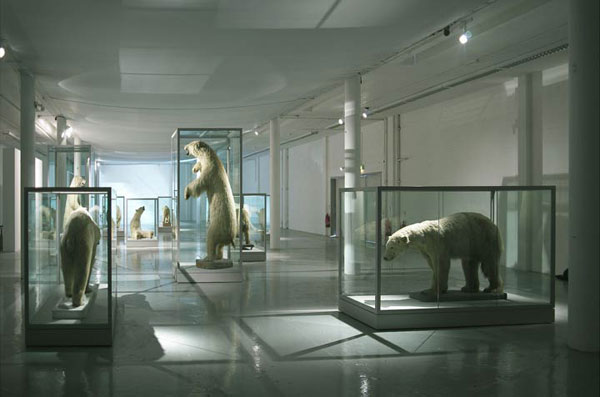
I came across another contemporary art project, this time focused on taxidermy, that I find moving, coherent and inspirational. This is the work of Snaebjornsdottir and Wilson, who tracked down and photographed in situ all taxidermied polar bears in the UK. They found 34 bears (some in museums, some in private collection, some in pubs). They followed this research by transporting all bears that were in a sufficiently stable condition to ‘spike island’ in Bristol – a contemporary art gallery. Here they were displayed alongside detailed biographies about where the bear was caught or shot, how , where and by whom they came to their last location in the UK. Here they represent not only a narrative of global warming and arctic melting, but also must provoke sadness, fear, empathy, anger, and all kinds of other emotions and thoughts. I have written above about my abhorrence for taxidermy in contemporary art. Here I have a different reaction. It is abhorrent that the bears were killed and stuffed in the beginning, but Snaebjornsdottir and Wilson did not do the killing and stuffing. In fact for me their work only underlines the cruelty and violence of the humans. The difference in contemporary taxidermy is that the ‘artist’ is doing the stuffing, and the animals being stuffed have died or been killed only recently (some for their ‘art’): the ‘artist’ is objectifying and exploiting other animals, while Snaebjornsdottir and Wilson are pointing out this objectification and cruelty. Having said this, I would not go to visit such an exhibition – it is too sad and makes me too furious. I don’t actually need to see stuffed polar bears to understand human cruelty to other animals or that the arctic is melting and they are at risk of extinction (see Cronin and Kramer’s (2018) point about the importance of distance, above) . I guess what I like best about this project is the research element – seeking out and photographing the bears and putting together their bibliography seems an excellent idea – then showing the bears together in the museum – a less good idea to me. Is unsettling and disturbing people the best way forward for examining our relationship of abuse toward other animals?
Cronin and Kramer (2018) suggest that it is photography that has the most impact on both reinforcing and challenging cruelty to other animals. They mention the work of Jo-Anne McArthur who founded the ‘We Animals’ project and documents human relationships with other animals.
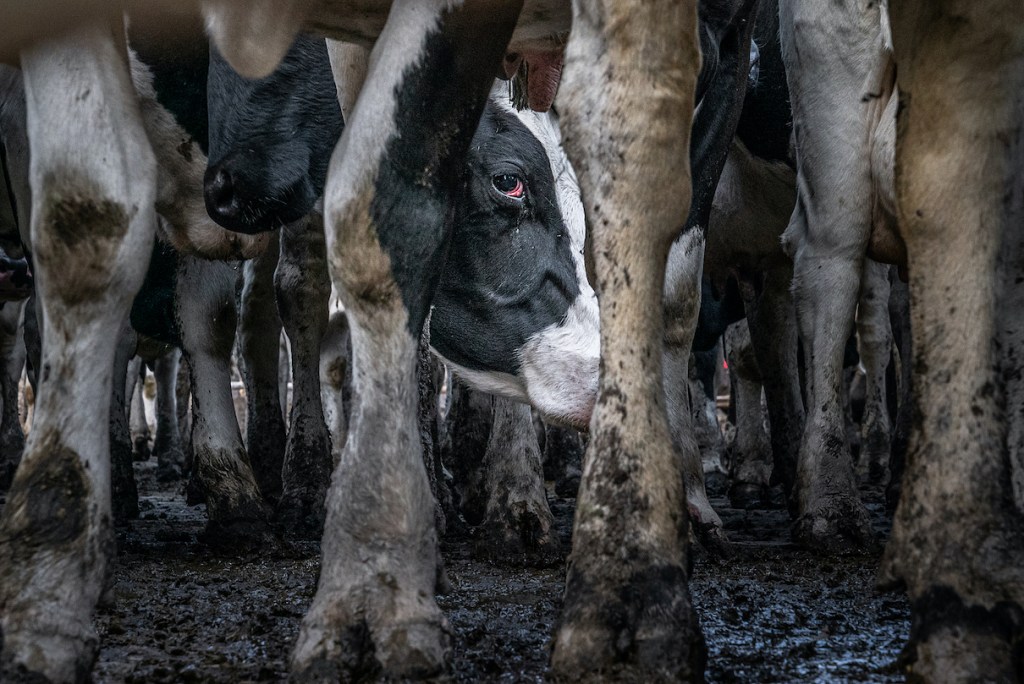
The comment about photographs above makes me reflect on why I am using drawing/fine art to explore oppression of other animals. Wouldn’t photography be a better medium? Photography allows us to report on animal cruelty. We can use drawing to report too (as does Sue Coe, above). Perhaps a drawing of cruelty is more powerful than a photograph because it also says something about the artist thinking this subject is worthy of sustained time and attention whereas a photogarph is taken in an instant (this is not to disparage photography in any way, and on the contrary it could be argued that a photograph shows ‘reality’ while a drawing may be a figment of imagination). Fine Art generally goes beyond reporting to imagination, as in the work of Lewycky and Banksy above (and Chagall and Marc below). I must think about this. In what sense am I using my imagination and broader creativity to respond to animal oppression rather than reporting it. I don’t think that I am currently.
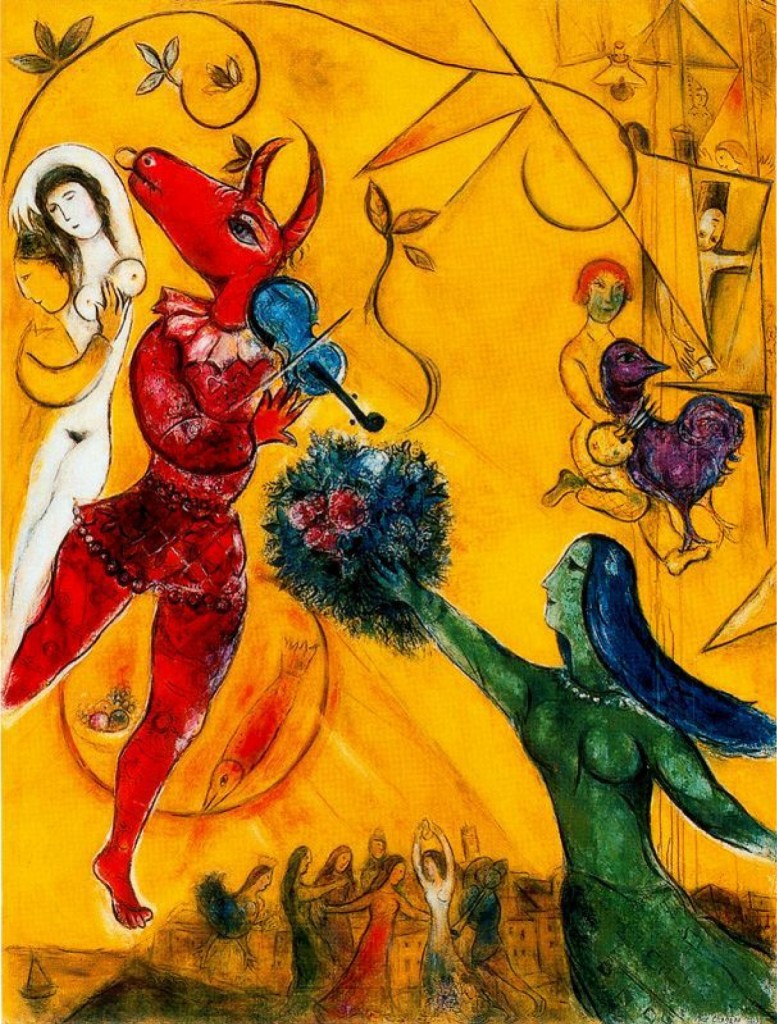
I’d argue that the visual art of some of the expressionists challenge the idea of human supremacy. For example, many of the paintings by the Jewish-French artist Marc Chagall (1887-1985). I love these paintings. Their colour is vibrant, and they are celebratory. The relationship between human and non human seems equal. Other animals are portrayed as existing for themselves, not for the human. This painting is shown again, below, on the cover of the short stories by Isaac Bashevis Singer.
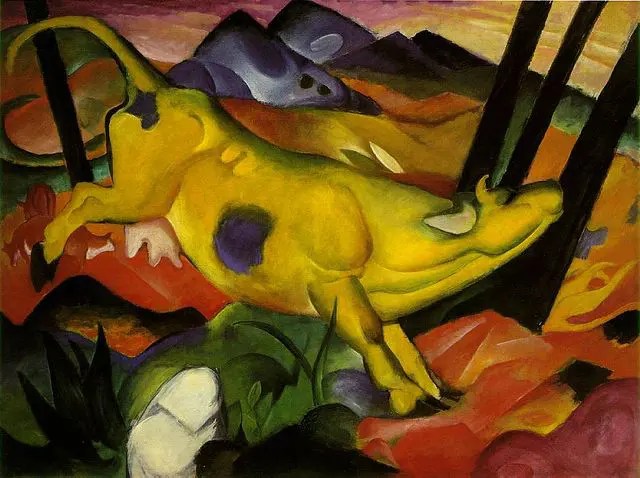
The Yellow Cow, by the German expressionist Franz Marc, cruelly killed at a very young age in the First World War, has similar joyful and celebratory qualities. This cow belongs to itself. The colours are stunning. In fact the colours in each painting are very similar.
nb. I note that the works I am most drawn to are expressionist.
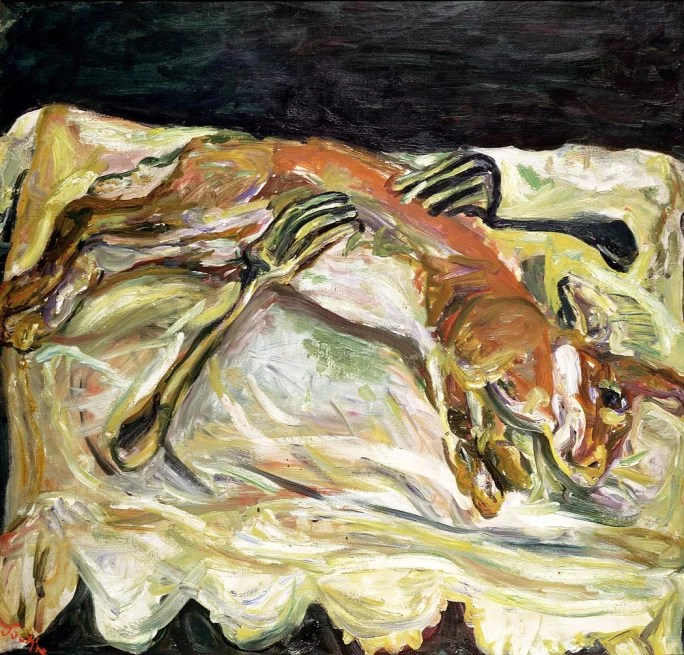
In fact, another Jewish expressionist painter, Chaim Soutine, was an influence for Sue Coe. Although I have written above that I think pointing out cruelty does not question it in a society where it is normalised, I do in fact think that Soutine’s paintings, by their rawness and brutality, make us stop and question – for example the Hare below, has not been skinned or cooked, and seems alive, but lies passively on the plate, fully formed, to be eaten with two forks! The forks look very like fingers about to tear him apart. Chaim did not eat meat.
this section can be much expanded on in unit 2 by summarising the work of the phd student who wrote her thesis on CAS and did her practice based work on materials used in art. Also by summarising the two books I bought this week from Whitechapel art gallery: animals; and the book on vegan art. Also look in more detail at Indira’s Net exhibition as well as Science Friction.
Following this review, I find I respond most positively to the Chagall and Marc paintings showing joy in, and love for other animals. In relation to ‘protest art’ I think that Soutine and Lewycky’s work is the most effective in challenging our treatment of other animals.
2. Inspirational fiction (novels and film) that challenges cruelty to other animals
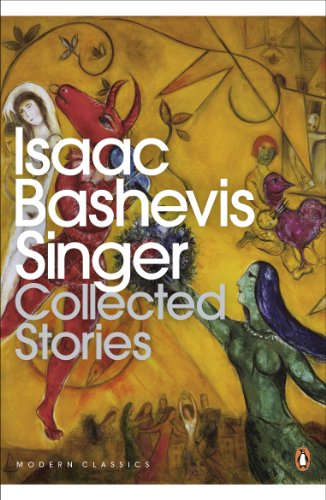
An important writer in this respect is Isaac Bashevis Singer, a Polish Jew (1904-91), winner of the Nobel laureate, who writes with compassion about other animals. For example, in the collection above, a survivor of the Holocaust, living in isolation in a room, cares for a mouse, and reflects:
‘What do they know-all these scholars, all these philosophers, all the leaders of the world-about such as you? They have convinced themselves that man, the worst transgressor of all the species, is the crown of creation. All other creatures were created merely to provide him with food, pelts, to be tormented, exterminated. In relation to them, all people are Nazis; for the animals it is an eternal Treblinka.
Singer, The Letter Writer.
The book cover for Singer’s collected stories, is from the ‘The Dance’ by Chagall, also a Jewish artist, that I discussed above.
J. M. Coetze, interestingly also winner of the Nobel Prize for Literature, is also known for his stance against our violent treatment of other animals. In Elizabeth Costello a whole chapter is devoted to the fictional protagonist’s (a fiction writer herself) talk as an invited guest at a conference. This chapter entitled ‘The Animals’ is an argument against the supremacy of reason. The quote below the image is taken from near the end of this chapter, as Elizabeth, growing old, reflects on her sense of disbelief about the behaviour of the people she is surrounded by in terms of how they treat other animals: a quote I chose because it’s exactly how I feel. Being a vegan in a non-vegan world gives the sense of living with insanity.
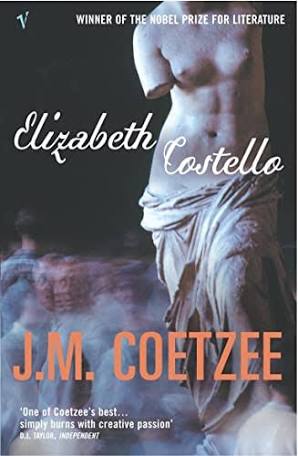
“It’s that I no longer know where I am. I seem to move around perfectly easily among people, to have perfectly normal relations with them. Is it possible, I ask myself, that all of them are participants in a crime of stupefying proportions? Am I fantasizing it all? I must be mad! Yet every day I see the evidences. The very people I suspect produce the evidence, exhibit it, offer it to me. Corpses. Fragments of corpses that they have bought for money.
Said from the perspective of the protagonist, Elizabeth Costello.
perhaps add Black Beauty. Watership Down. maybe Chicken Run and Leafie (there are many animations looking at the world from the perspective of other animals- I wonder if, say, the makers of Chicken Run went home after work and ate chicken?).
3. Artists who focus on other social justice issues and whose process and content is inspirational.
In this category I am particularly interested in artists who focus on social justice issues. The first is Marlene Dumas, who in an interview specifically talks about ‘Bearing witness.’
Dumas’s choice to paint from photographs is political, an act of both bearing witness to contemporary life and making contact through the reworking of mediated images
https://www.moma.org/artists/7521
I see my work as bearing witness too. I also work from photographs. I also seek to ‘make contact’.
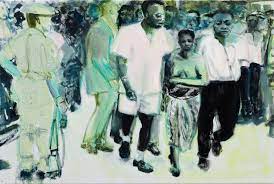
Another artist whose work I am very interested in is Catherine Anyango. She, like Dumas, draws people who are dead, or missing, and she works from photographs or CCTV footage. Her series ‘Last Seen’ is a homage to people who were last captured on CCTV before disappearing. She writes with great sensitivity about the act of ‘bearing witness’and about the ethics of drawing people who are dead or disappeared:
The ethics here are blurred, the rights of who owns these images debatable, and I hope by drawing them to elevate the photographs into something beautiful at least, a homage to the victims. Some are well known, others are anonymous
Catherine Anyango. http://catherine-anyango.com/#/violentcrimes/
I too am struggling with the ethics of drawing people and other animals from photographs, who are dead, or about to die, and like Anyango I am justifying this by the wish to draw attention to their bravery and beauty – to pay homage as she says.
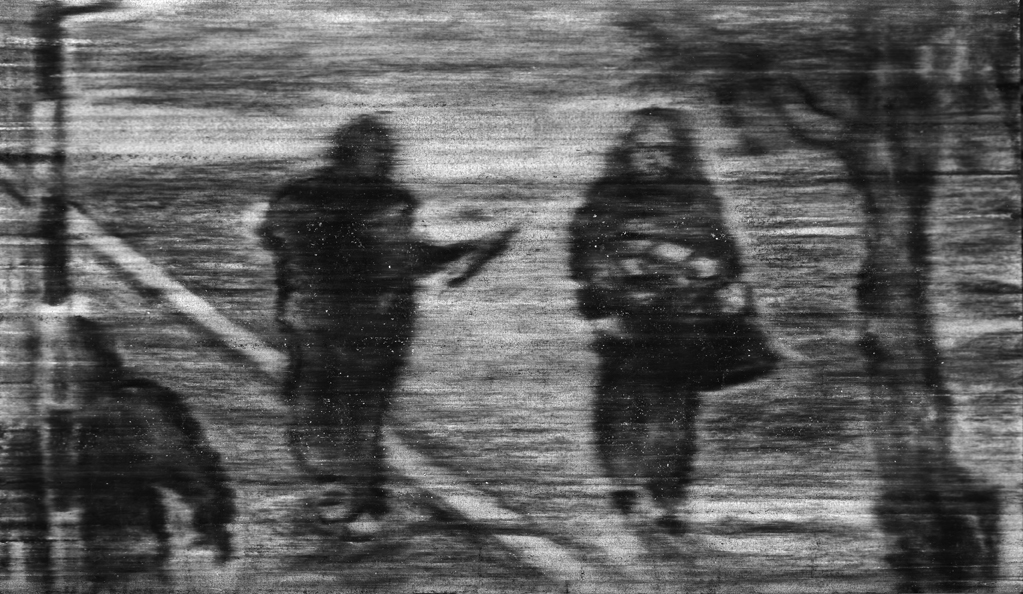
Other work by Anyango includes an animation about Mike Brown, shot by police in the USA and left for four hours dying on the pavement. She also writes on her web site about her process of ‘embodying ‘ the violence depicted in these works through a physical process of working and reworking the surface of the drawings until they are damaged. This reminds me of the work of Frank Auberach, and particularly his charcoal drawings. For example his self portrait is worked, erased and reworked until a physical hole has been made in the paper. I am considering embodying violence but feeling a reluctance to do so. The human and non human animals I intend drawing have already suffered extreme violence and I don’t wish to inflict any further violence on them. On the contrary I want to treat them with gentleness and precious care.
The American artist, Shaun Leonardo , also bears witness to black men shot and murdered by the police in the USA. His work, ‘The Breath of Empty Space’ was controversially cancelled by the Cleveland Museum of Contemporary Art early in 2020. Later the same year it opened at the Masachusetts Museum of Contemorary Art before moving in early 2021 to the Bronx Museum of the Arts. The cancellation was in part based on the complaint from the mother of one of the subjects of the drawings: a 12 year old boy shot dead. However, subsequently the Museum’s executive director publicly apologised to Leonardo before resigning. I write about this in detail here because the ethical issues surrounding the death or disappearance of anyone who is then drawn and exhibited are contentious, as I discuss in my proposal. Interestingly Leonardo, like Anyango, and as I have chosen myself, draws in black and white:
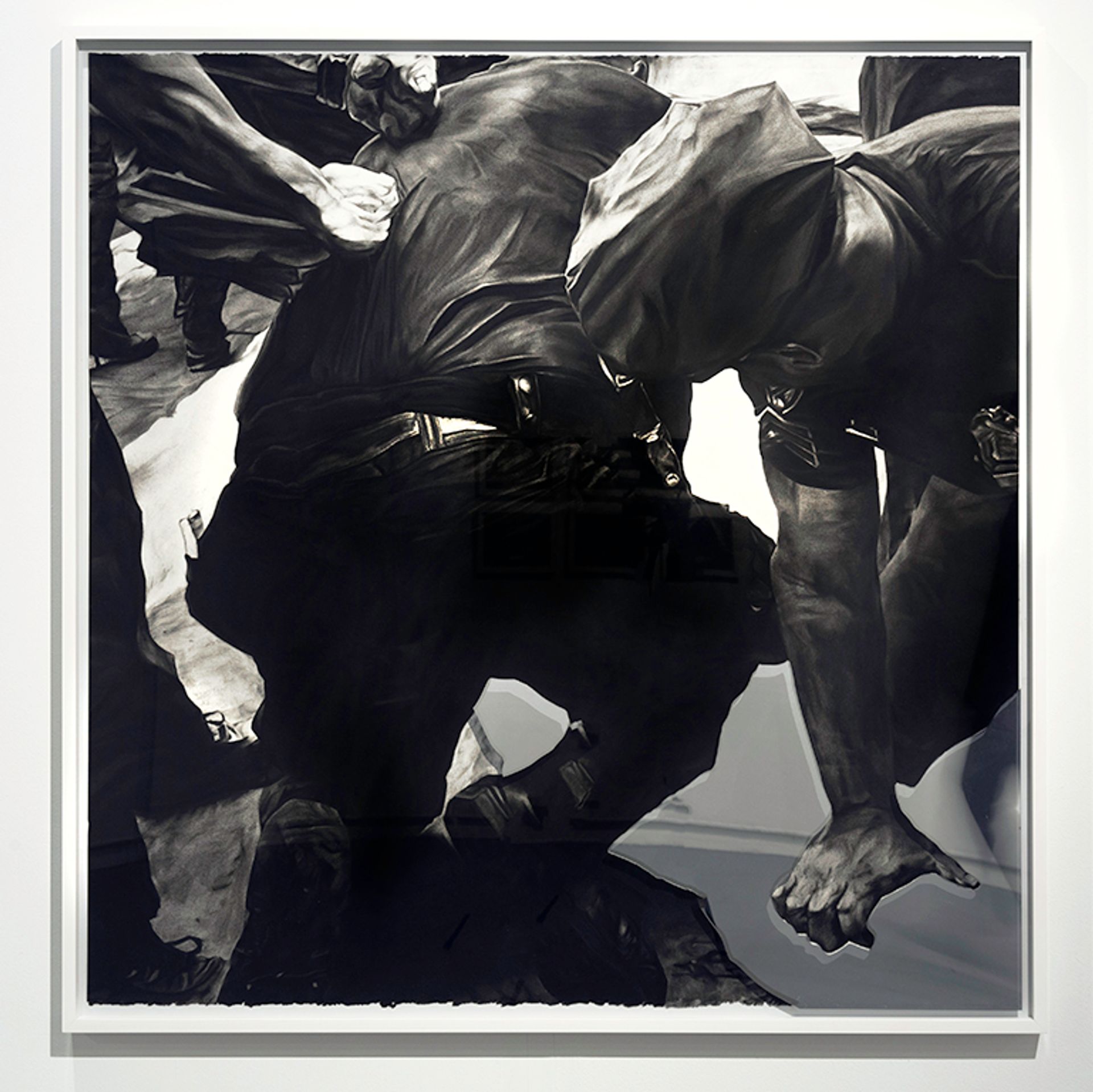
Shaun Leonardo, Freddy Pereira (3 of 3), 2019, charcoal on paper with mirrored tint on frame
I am not sure what the mirrored tint on frame changes – it is not possible to tell from the drawings. But it seems that Leonardo’s drawings are powerful, and charged with emotion, and that this is achieved through the tonal contrasts, as well as body positions and much use of stark black. Like Dumas and Anyango, Leonardo uses images from witness photos or videos, as well as policy body cameras. Leonardo is an interesting artist who has done a lot of performance work, for example one of the museum events that he organised was a discussion by performers about gun violence, with no talking. His black and white works exploring black masculinity and sport are also highly effective in highlighting racial stereotyping, and pressures on young black men to be physically dominant. One of the reasons I have chosen to write about him here is that he manages to combine the personal and the political. His work is not only about exploring his identify as a man of colour, but it is also about institutional racism and importantly, the impact of racialised social conditioning and expections/pressures on his identity . I am seeking to combine a focus on the political as well as personal in my own work.
Another artists who uses phographic portraiture to draw attention to loss and death and cruelty in life is the French photographer, of Jewish heritage, Christian Boltanski. His work is described by the Jewish Museum as follows:
In 1985, Boltanski began his Monuments installations, currently grouped under the title Lessons of Darkness, focusing on vernacular photographs of children as the means to convey the transience of life and awaken a collective consciousness of the dead. Here, childhood assumes a vanitas role, representing temporality and an irrevocable loss reclaimed only by memory.
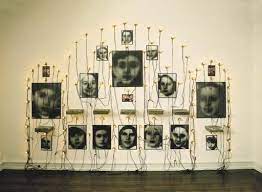
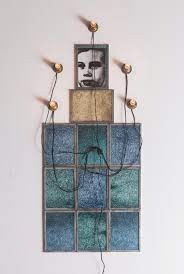
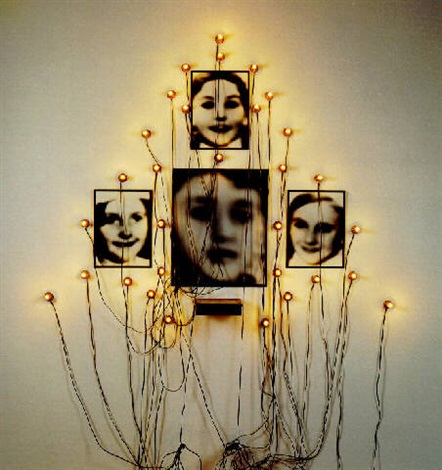
I feel that my learning from this work is mainly related to how he chose to curate the photographs. On the left and right he chooses a pyramidal structure, with photographs of different sizes. This makes me think that my portraits of human and non human animals do not necessarily need to be the same size. There is also some kind of box structure attached to the wall in all three of the works – I could use this to put my commemorative plate, bowl or jug. I wonder if a bowl would work better than a plate and if it could hold something precious, e.g. a crystal or fruit.
An artist who responds to tragedy and loss is Anselm Keifer who often focuses on the Second World War. I have included the second work below as a reminder that I intend using text in my work. Kiefer’s work is on a grand scale, and particularly interesting for its materiality, e.g. use of lead. straw and heavy distressing. (I can possibly draw on these ideas in the images of the Amazon).
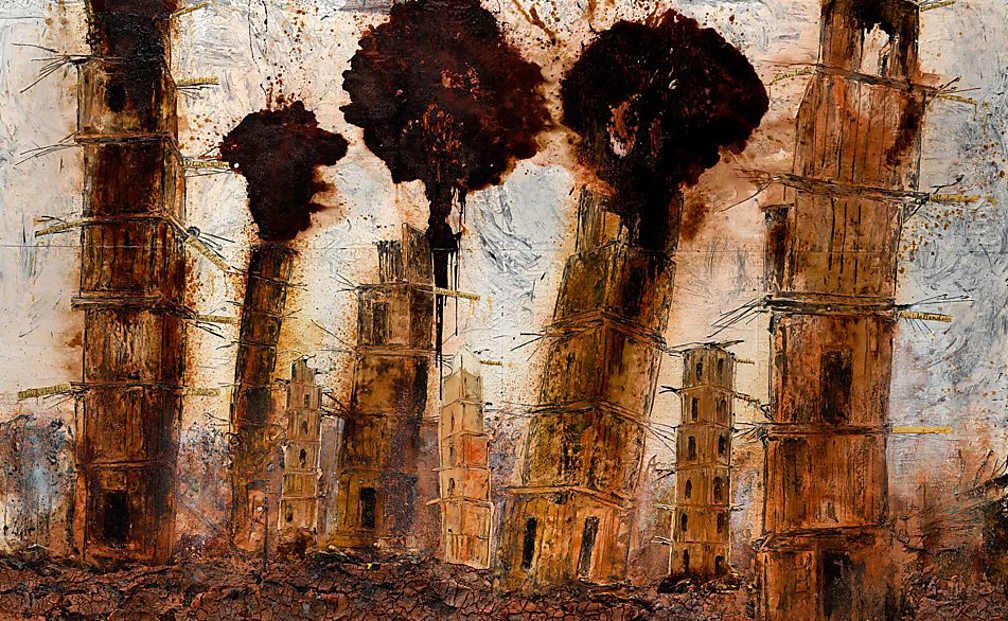
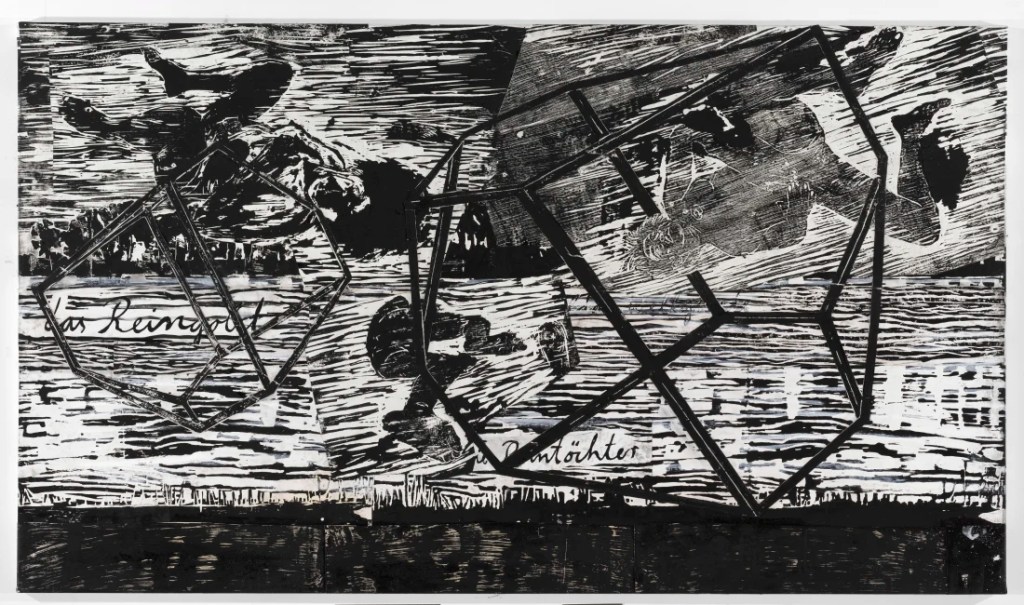
190 x 330 x 5.5 cm
Finally in this section, I include mention below of Dryden Goodwin’s work, ‘Breathe 2’, 2022. I include this because of its focus on Protest Art, and its consistency and coherence. I also like its simplicity. The work draws attention to the people in Lewisham who protested for clean air after a child in the Borough died from an asthma attack caused by polluted air. I saw Goodwin’s drawings at the exhibition, ‘In The Air’ at the Welcome Gallery, London in August 2022. They are very small – perhaps 5 in x 2.5 inches. The series I saw included drawings of about 6 activists for clean air, breathing in and breathing out – about 6 drawings of each activist at different stages of breathing. The drawings were also enlarged and shown on the side of buildings and in advertising boards across Lewisham. I can learn from this about keeping ideas simple and remembering that discursive art is not designed for individual, passive attention in the art gallery, but to promote conversation and action.
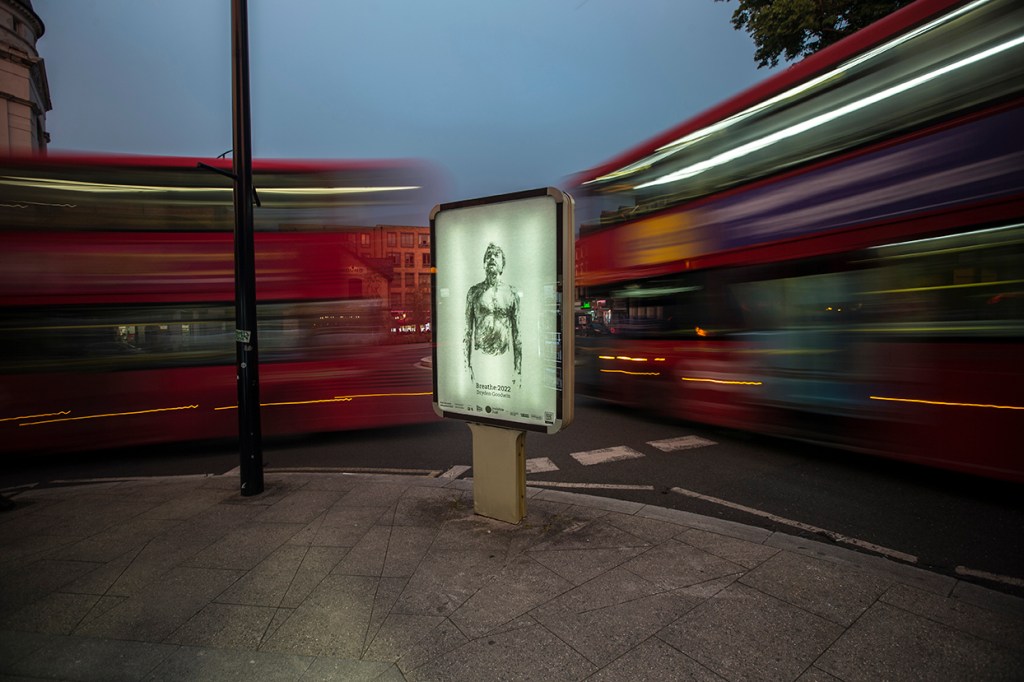
5 Writers, and filmmakers who explore and critique discourses of power and control
I am interested in using drawing to critique dominant discourse. I use the term ‘discourse’ in the Foucauldian sense to mean the sign and symbols, including text, that are used to construct our experience of the world and to manipulate and control us. In this regard I am inspired by Critical Discourse Analysis Theory (Fairclough, 1995) and by many fiction writers, and films. A key author in this regard, is George Orwell, particularly his seminal dystopian science fiction story, 1984 in which ‘Newspeak’ is the main technique of control. Below is a still from the film, 1984, (1956).
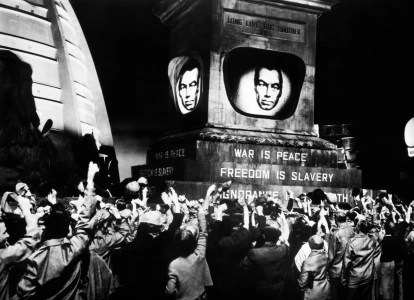
The main protagonist in the novel, Winston, is not brainwashed by the discourse and prepared to resist, to his cost.
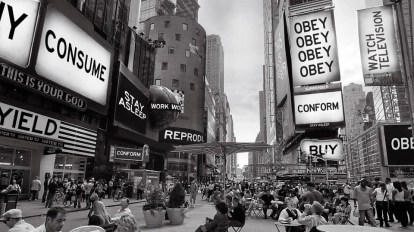
Many other films explore manipulation of Human perception. ‘They Live’ , for example, is a 1988 science fiction horror story, directed by John Carpenter, and based on the short story ‘Eight o’clock in the Morning’ written by Ray Nelson in which the ruling class are aliens who conceal their appearance and manipulate people to consume, breed and conform. (Just as the ruling class manipulate and control people through consumption, drugs and conformity in Brave New World ).
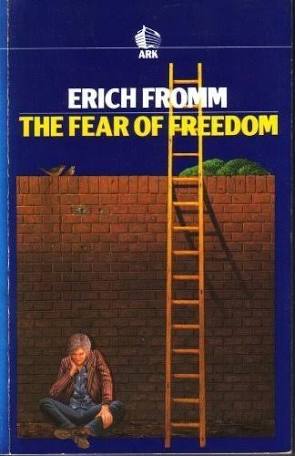
The idea of speaking out, and being your authentic self, is the main theme of much of Erich Fromm‘s writing. He argues, in ‘Fear of Freedom’ that human’s fear freedom because being our authentic self is likely to separate us from our peers – and humans like many other animals, are essentially social beings living in packs. Fromm wrote Fear of Freedom in 1942 as he attempted to make sense of why the majority of German people supported fascism.
I propose that the ideas of both Orwell and Fromm are just as relevant today.
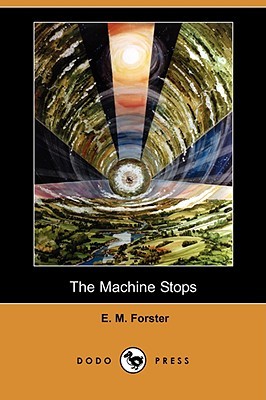
Other Dystopian fiction that I am inspired by includes Brave New World, written by Aldous Huxley in 1931, and the Canopus in Argos Series written by Doris Lessing. The Machine Stops, 1909, by E.M. Forster is a major influence on my recent drawing. He explores the way that Humans have become over-reliant on Technology and the idea that they will become subservient to Technology. The idea underpins the computer generated collage I made and put at the top of my Home page. However, I am not examining human subservience to ‘The Machine’ here, but Human perception that their species is the superior species to all the rest of the living world, and therefore entitled to use and abuse the rest of Nature, including other animals.
It may be, at this point, be unclear how these works on dystopian futures relate to my focus on colonising discourses of other nature. Or it may be clear that I am suggesting that Discourses, and specifically colonising discourses, are taught to us from birth, have been for thousands of years, and that underpinning these discourses are issues relating to consumption, conformity, freedom and control of both people and other Nature.
Key Reminders/Clarifications.
- My portraits bear witness and honour other animals and human animals who help them.(I can learn from Anyango, Dumas, Keifer in this respect).
- I can learn from Boltanski about how to curate these works – they do not need to be the same size (but if not the same size I don’t want to suggest one portrait is more important than another). Lights and shelves might be incorporated. But this assumes gallery exhibition, and note my interest in discursive art shown in a public space outside the art gallery (in this regard, learn from Goodwin).
- I might make commemorative vessels that hold something precious. These could rest on the shelves. They could include gold leaf and hold myrrh and francincense or alternative plant based food.
- My critical discourse work should include critique of abuse of other animals in visual art itself.
- Remember Hope and Joy – Marke and Chagall are important in this respect.
- Remember my intention to use text in my work. Montserrat and Kiefer are useful here.
- Don’t forget the primary intention is to challenge dominant colonising discourses and interrupt iconography that objectifies other animals (bear in mind 1984, Brave New World and The Machine Stops). My intention is NOT to examine other animal nature, or to make studies of the physique of other animals. My focus is the study of Human animal behaviour toward other animals, rather than study of other animals themselves.
- As a follow up to this initial work in unit 2 I can do more research into artists who challenge our abuse of other animals. The Whitechapel art gallery book: Animals, and Tommy Kane, ‘Vegan Art: a book of visual protest.'(both of which just arrived as I got to the full stop in the last sentence). Also have any other artists focused specifically on the animal agriculture industry? Also look at artists who imagine a different food production system e.g. Agnes Deynes cornfield in New York. Hydoponics. City Gardening. Look again at Demos (2016 and 2017). Finally search for other artists that challenge Normalising discourses of other animals and people, e.g. Louise Reynolds.
References
Aloi, G. (2015) Animal Studies and Art: Elephants in the room. Antennae. https://www.academia.edu/11409007/Animal_Studies_and_Art_Elephants_in_the_Room (Accessed 8 dec 2022).
Bacon, S. (2000). The Postmodern Animal. London, Reaktion. p. 11.
Cronin, J. K. and Kramer, L. (2018) “Challenging the Iconography of Oppression: Confronting Speciesism Through Art and Visual Culture.” Journal of Animal Ethics 8 no. 1 (Spring 2018): 80-92.
Demos, J. T. (2016) Decolonising Nature – Contemporary Art and the Politics of Ecology. Sternberg Press.
Demos, J. T. (2017). Against the Anthropocene: Visual Culture and Environment Today. Sternberg Press.
Kuzniar, 2011. “Where is the Animal after Post-Humanism? Sue Coe and the Art of Quivering Life”. The New Centennial Review. 11 (2): 17–40.
Poliquin, R. (2008). The Matter and Meaning of Museum Taxidermy. Museum and Society. Vol. 6. No. 2. p. 123-134.
Slowik, Mary (October 2007). “The Ethics of Audience Positioning in the Paintings of Leon Golub and the Prints of Sue Coe”. Narrative. Ohio State University Press. 15 (3): 373–389.
Snaebjornsdottir, B. and Wilson, M. (2006) Nano: Flat out and Bluesome: A cultural life of polar bears. London: Black Dog.
http://becoming-animal-becoming-human.animal-studies.org/html/perspectives_artists.html.
https://www.azkunazentroa.eus/en/activity/science-friction-life-between-companion-species/
https://www.birds-richard.xyz/news/anthropocene-island-colonization-native-species-and-invaders
 Drawing As Critique