One of my research Aims for this work is to Examine how I can synthesise the critique of dominant colonising discourse with emotional experience. This is because I think political critique alone could be cold and intellectual. The dominant discourse I have identified for critique is the Human belief in their supremacy over ‘Other Nature’. (This is associated with post-humanist critique. However, the idea that Humans are privileged and superior has been challenged by many writers before the rise of post-humanism in philosophy – see the Contextual Studies section).
I was nonplussed about how to bring personal/emotional experience to this work – until I remembered I am a Farmer’s daughter, and grew up on a mixed dairy/sheep farm in the North Yorkshire dales, and that my family have been farmers on both sides for the last 1000 years (another family member has traced this history). I therefore have a lot of karma associated with owning, using, exploiting, killing and eating other animals. (And its strange that this was not the first thing that came up for me in this work)
My niece now farms the farm that my father farmed, and before him, his father. We have been tenants on the specific farm where I grew up for approximately 100 years and before that my ancestors farmed in the nearby area.
I think it is important to incorporate my experience of growing up on a farm, because my question about how I can use drawing to identify and critique dominant discourse about ‘Other Nature’ (specifically other animals in this body of work), must include, in my view, how we learn the dominant discourse in the first place and how the dominant discourse of human supremacy impacts our capacity to empathise with other beings. For me, growing up on a farm is implicated in my dissociation from the pain of other animals.
A second issue is how my choices about food and clothing and household products impacts my relationships with my family. As I wrote about in the ethics section of my proposal, it is easy to be critical and judgemental of others, and to forget that my conversion to veganism is comparatively recent. It is also important to remember that many of my family members rely on selling the excretions and flesh from other animals for their livelihood. The differences in lifestyle choices and beliefs/values are problematic in my family, especially on celebratory occasions – and this could become a focus for this strand of my making.
The North Yorkshire Dales are very beautiful. I began by writing a poem that I superimposed on a drawing made in ink and gouache:

Mouton
Mouton, Norber, Erratics, Oxenber, Limestone pavements, cairns,
Crummock, Feizor Nick, Austwick, Wharfe, Castlebergh. Giggleswick.
Scar, crag, klint, gryke, becks, stallegnite, stalagtite,
Sinkholes, potholes, caves, karst, Ingleborough, Pennyghent,
Whernside, Malham tarn, Malham cove, fells, moors, pastures,
meadows, dry stone walls, copse, – the language of childhood.
I grew up in the Craven area of North Yorkshire
‘Craven’ is generally understood as cowardly,
But the explanation for this naming of the region
Is thought to come from the Welch for garlic.
The ground in front of my cottage is covered in wild garlic.
In spring the air is rich with its scent.
I went to secondary school in Settle. Up beyond Castlebergh, sinkholes
And potholes open to swallow sheep. Victoria, Albert
Attemire caves are high up in Langcliffe scar. Their passages
Snake underground; and bones of bear and elephant,
Roman coin, jewellry, Even the remains of a chariot found by the excavators.
Further West in Ingleborough cave, stallegnite and stalagtite grow.
The river Ribble can rise suddenly and rush down
from Ribblehead, where the 24 arch viaduct crosses Batty Moss
and 100 men, living in the shanty town, lost their lives
When it rains the river is brown and foamy
In dry weather it burbles gently over rounded stones.
In October, Atlantic salmon leap up the rapids to spawn
I was born in Austwick; a cottage, built for farm workers by the council
At 7, On a nature walk from primary school we walked up Norber to see the erratics;
enormous granite boulders left behind in the last ice age
I remember watching my feet in their brown Clark’s sandals
Tread through the turf on the way down, feeling purely happy.
The village lies in a typical glacial valley.
Beyond, Mouton rears up; its back carved out by the limestone Quarry.
Earlier lead mining, weaving and cotton spinning industries flourished.
On top of oxenber are klints and grykes, with rare plants
holly-fern Polystichum lonchitis, whortle-leaved willow Salix myrsinites,
stone bramble Rubus saxatilis, green spleenwort Asplenium viride,
globe-flower Trollius europaeus and rock sedge Carex rupestris.
As children we followed our brother, running across the flat limestone pavement,
jumping from klint to klint.
The treeless fells are purple with heather in late summer
In the valleys narrow becks full of minnow meander across green pastures,
Carved up hundreds of years ago by dry stone walls, where sheep and cows graze.
Meadows are lush with tall grass waiting for harvest, when the smell of hay
Wafts across a dry June and we pack hampers of cold tea and fruit cake
For the Workers hurrying to get in the crop before rainfall.
In the pastures buttercups turn the field yellow,
and we search for four leaf clover. We pick rosehips for syrup,
that we take to school in exchange for half a crown.
We search for mushrooms that we sell on the roadside.
And make wine from the elderberry flowers. The back garden
Is rich with rhubarb, gooseberries and blackcurrents.
We build a pit at the top of the front meadow, lined with coal and twigs
To roast fish. Father drags a door from the barn and we hoist it with
Rope to build a tree house. Oak, Beech, Ash, and elm grow in the copse.
The woods are blanketed in bluebells in Spring, and ferns my horse must not eat.
Hazelnuts line the narrow roads on the horse-back ride I often take
To see my grandparents at Armitstead Hall farm.
***********************************
Here I describe the landscape that formed me.
A landscape that is wild, ancient, enduring and that I love; a designated National Park
So that its beauty can be conserved. Yet beneath all this ‘natural’ beauty
That we see and admire, human ‘nature’ enforces a cruelty that I did not see as a child:
I was not taught to see it, as were not my parents and their parents for 1000 years.
This is the cruelty of the farming practices that form the livelihood of
My family and the families of all the children I went to school with.
We knew, yet we did not know, that shearing the sheep, castrating the
Lambs, cutting off their tails was violent and harmful.
We saw, yet we did Not see, the sheep and cows crying out in terror when their children
Were dragged away to death.
We ate the flesh of the lamb that we had hand reared from birth.
We drank the milk that the raped cows produced each year for their child.
We played with the kittens that were later gathered up and drowned in a bag in the trough.
We rode the horses that my father ‘broke’ with terror and whippings.
We petted the calves in their stalls as they waited to be driven to slaughter.
We gathered the eggs and fed the hens that had their wings clipped.
We were taught that the beings on the farm, that we knew were gentle
And kind, were in fact objects. They made money for us. They were
Our means to survive. We learned to dissociate. We learned to be cruel.
We learned it was perfectly acceptable, in our human culture, to be violent.
Below are quick sketches of the area:
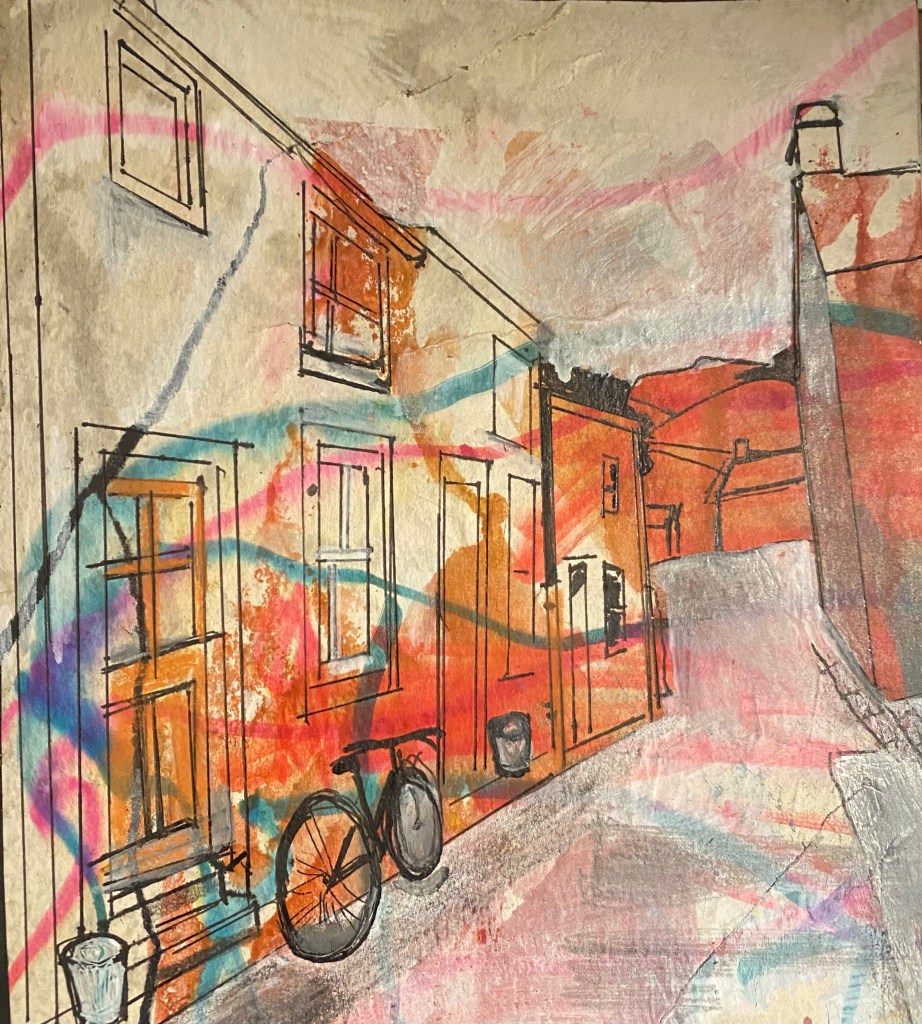

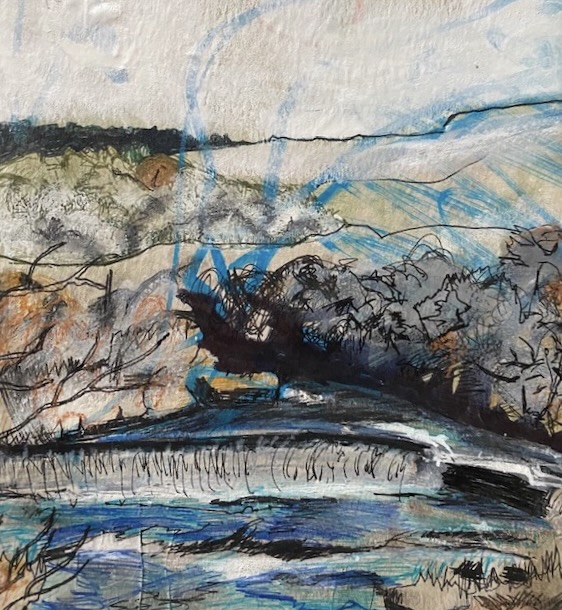

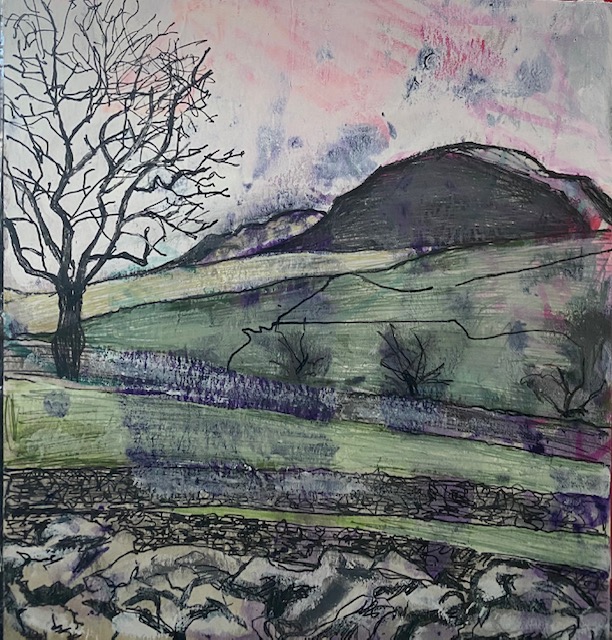

Possible installation
I’ve been thinking about my experience of going to the Farmer’s market with my Father when I was a child, and the possibility of an installation. I have been looking at the dates for a local market that I used to visit with him and it is still held regularly. I will visit to take some photographs. Meanwhile here is a possible idea. Then men on the left are from photographs taken last time I went, which is about 8 years ago. A key memory is obviously sitting in the ring and listening to the auctioneer (it would be good to record him), but also the cafe – sawdust on the floor and, key, Coleman’s Mustard on the table, and oilcloth tablecloths. I could make me in paper Mache, life size (at the age of say 10), wearing a blindfold, mouth open, ears covered. Could be with hands or could be with ear phones. The menu could be the end verse from my poem. Or it could be a critical discourse analysis of a body part that I saw for sale (see below). The basic idea is how we learn not to see.
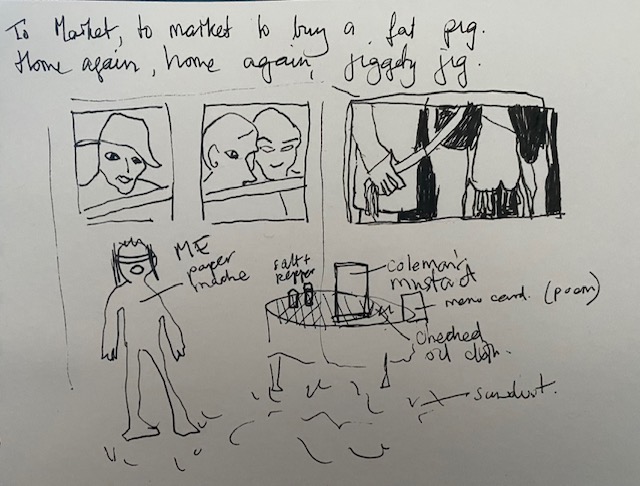
Possible ‘menu’ idea:
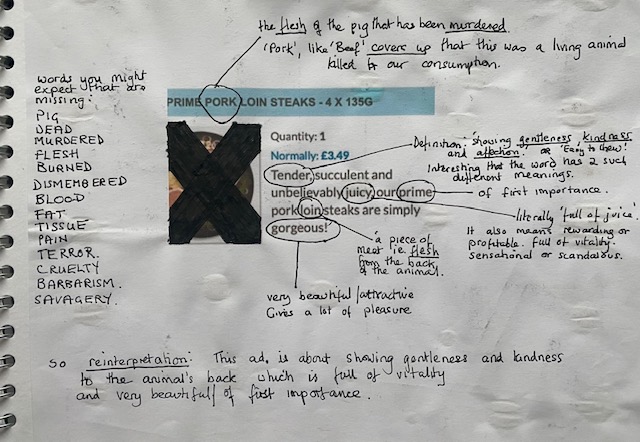
nb. I can do more than this. In fact ‘loin’ should be ‘body part’. And ‘juicy’ should be ‘bloody’.
I also think, in this section relating to personal experience, should come my many experiences of looking after other animals, both on the farm, and as someone who lives with a companion animal. Two ideas came to mind:
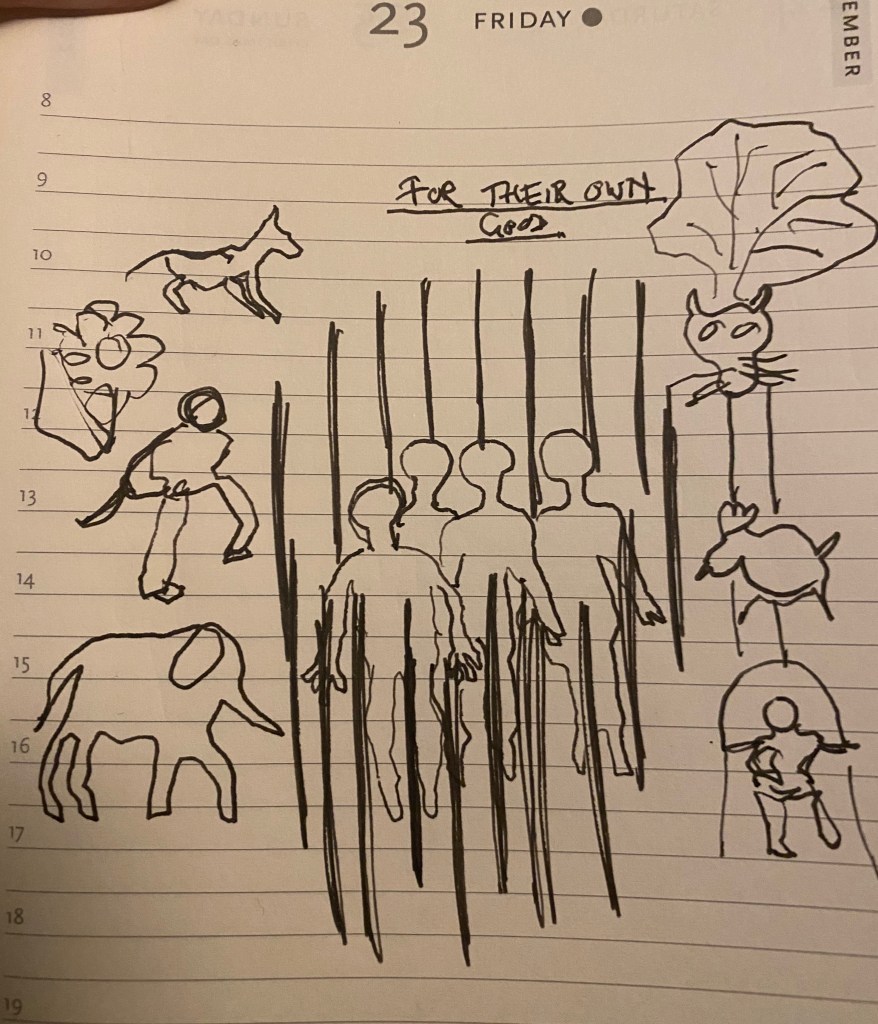
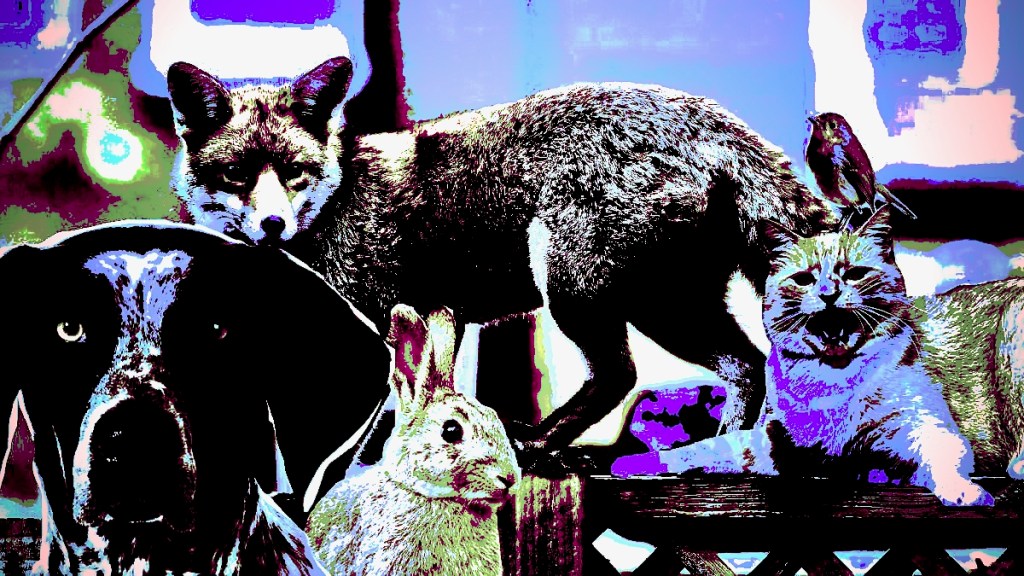
Another idea related to the saying that ‘Dogs are a man’s best friend’, which made me think it unlikely from most other animal’s perspective, that a Human is their best friend. I was thinking it might be fun to work on the image I have made as a computer collage below – using biro on Plike, or biro on copper. I’d like to make it as a miniature – about 2.5 x 5 in.
Following the Ideas Presentation group today, January 12th, my tutor also suggested that a focus on the visual might be getting in my way, and that maybe I should think of, for example, a soundscape. This is a really interesting idea, if kind of shocking that maybe I should not focus on the visual when I was fixated on this being a visual arts programme. I am certainly going to think about it. I was actually thinking of an audio recording, but I’d thought of it as accompanying visual images rather than standing on its own. One of the other students also suggested thinking about space – I think this came up because I’d mentioned being interested in another student’s work on surveillance and the panopticon. It immediately brought to mind spaces in which other animals are bought and sold – I’ve been thinking of visiting the market. Also both this suggestion and Anna’s suggestion make me think of absences and invisibility as compared to visibility.
 Drawing As Critique