This blog discusses other miniature art works and exhibitions as well as giving more details about the miniature works that I have made.
I tend to work small. Part of my reason for making small works is that, for me, their smallness gives them a ‘precious’ quality (I feel I have to protect them and remember their presence), as well as that I am concerned about the amount of physical materials I use and produce in relation to sustainability.
I am interested, therefore, in what miniaturisation can contribute to thinking about my current focus: interrupting the iconography of violence, exploitation and objectification of other nature, and particularly of other animals.
Research into the miniature lead me to the writing of Carl Knappett (discussed in more detail on the ‘Resolved works’ page of this site. Knappett touches on the work of Le Drey in the section on miniaturisation in art. This inspired me to take a look at the work of Le Drey.
Much of Le Drey’s work focuses on male identity and particularly the idea of ‘machismo’. Machismo, in my understanding relates to cliches of masculinity that are presented as ‘superior’, for example, personal power, virility and pride.
What is so interesting about the work of Charles LeDray is the way he speaks of a male stereotype in deliberate contrast to its ideal. In a rather poetic and gentle way , his miniature portraits (for his pieces are very much portraits of male identity) challenge these configurations by employing skills often associated with women – the delicacy of threading and sewing – and not least the miniature – so often associated with Victorian femininity.
https://www.fashionprojects.org/blog/2192
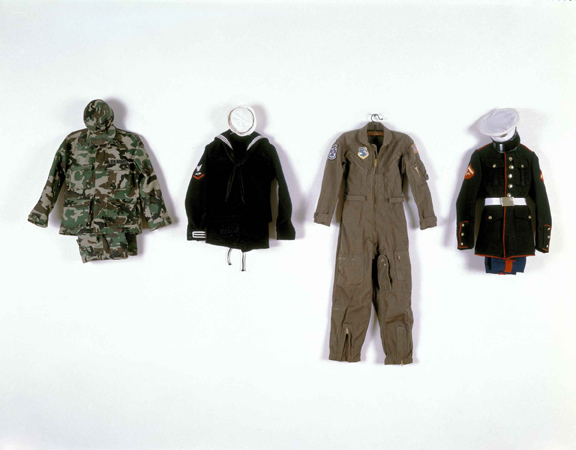
I particularly like, what I see, as the material juxtaposition that Le Drey employs here between his subject matter – challenging the stereotype of masculinity – big, brash, strong men are called to mind through the small, the delicate and the use of stereotypical ‘female’ skills, and in doing so perhaps the stereotype loses its power.
It appears that there have been several exhibitions of miniature art recently. For example, only last year in April 2022 there was a large exhibition of Miniature art in London: https://smallisbeautifulart.com/london/ Another exhibition in Turkey in 2020 explored how the contemporary miniature builds on the tradition of miniature art that had its origins in the court art of Mughal India, Persia and Ottoman Empire. This exhibition seems to have emphasised the political (as I am interested in doing), including colonialisation, gender issues, Orientalism, economic inequality and identity politics https://asianartnewspaper.com/miniature-painting/. In Turkey, too, there is a permanent museum of the micro miniature and visitors look at the works using magnifying glasses. Interesting to see that this example too has a strong political message:
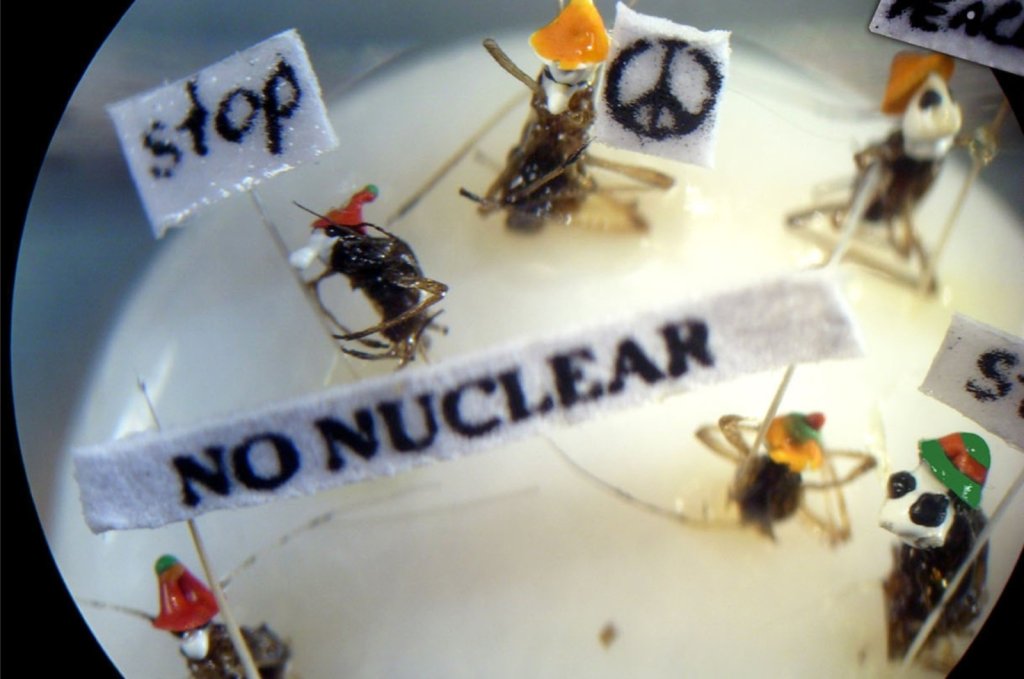
In 2018 the Tikotin Museum of Japanese Art curated an exhibition called ‘Small Is Beautiful’. I read on the website:
Over the centuries, the tendency evolved in Japan to value small objects over big ones and this for both practical and religious reasons. Since Japan is an island nation with limited resources and dense population, the use of large objects is not practical. In addition, the Buddhist perception of minimalism had extensive impact over a wide range of Japanese art forms.
The linguist Ôno Susumu (1919-2008) writes in his book “The Development of Aesthetic Consciousness and Japanese” (Biishiki no hattatsu to Nihongo, Tokyo: Risô-sha 483, 1973) that concepts exist in the Japanese language attesting to different values of beauty. One such concept expresses the sense that beauty resides in small, fine objects. Ôno argues that this tendency is at the centre of the Japanese word for beautiful, utsukushii.
https://www.tmja.org.il/eng/Exhibitions/5530/%22Small__IS_BEAUTIFUL%22#:~:text=%E2%80%9CNo%20matter%20what%20it%20is,artistic%20work%20of%20aesthetic%20perfection
And see below the description and artists involved in an exhibition called, ‘Small Worlds’ at the University of Vermont, Flemish Gallery, February 13 – May 10, 2019. Small Worlds explores the ways contemporary artists use miniatures to inspire awe, whimsy, and even dread. These artists either create or employ found miniature figures, rooms, and landscapes, displaying them through photographs or sculptures. The resulting scenes, reminiscent of our childhood playthings, can recall in us that sense of wonder for the world around us, but also call our attention to the dark forces hidden beneath the seduction of the small. As our inherent attraction to the miniature sucks us into the imagined world of the artist, real-world traumas such as violence, displacement, and environmental disaster are brought to our attention in intricate and intimate ways.’ Artists in the exhibition include Joe Fig and Minimiam (Akiko Ida + Pierre Javelle), Sally Curcio and Allison May Kiphuth, Thomas Doyle and Lori Nix + Kathleen Gerber, Corin Hewitt and Mohamad Hafez, Brian D. Collier, Matt Neckers
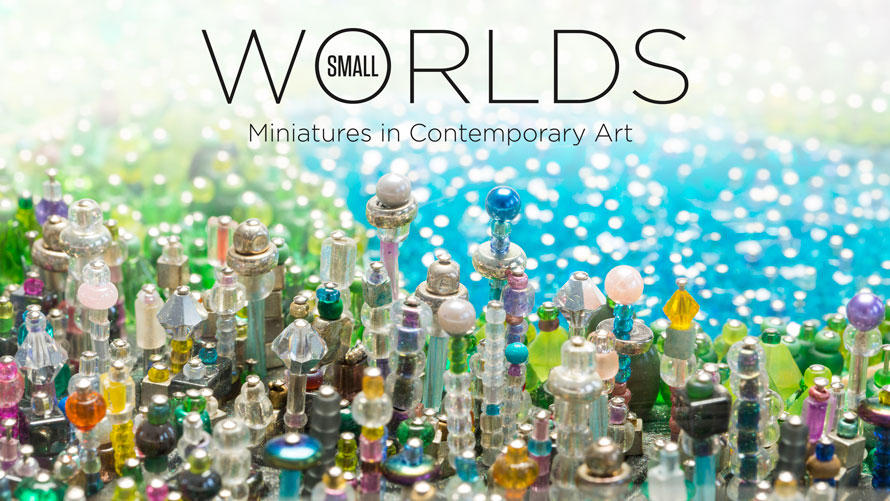 Small Worlds: Miniatures in Contemporary Art. February 13, 2019. Detail from Sally Curcio’s Jackie Onassis Reservoir, NYC, 2014
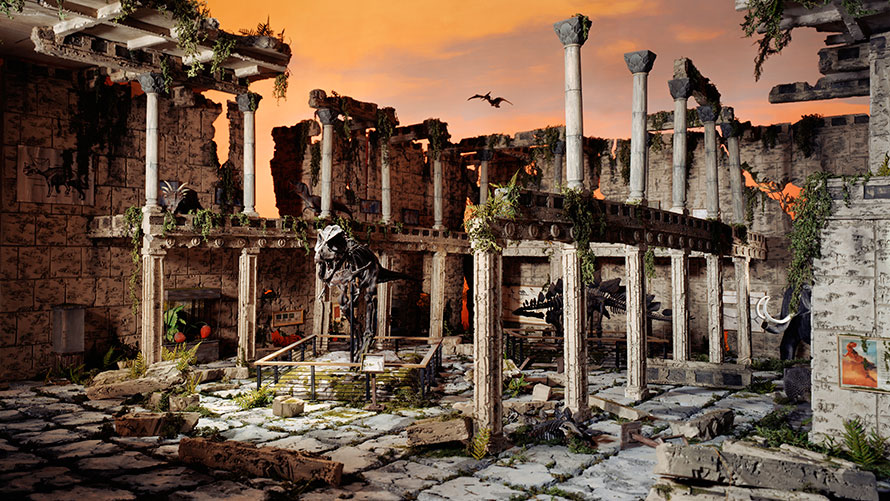 Detail from Lori Nix & Kathleen Gerber’s Great Hall from The City series. Archival pigment print. Courtesy of ClampArt, New York City. © Lori Nix/Kathleen Gerber
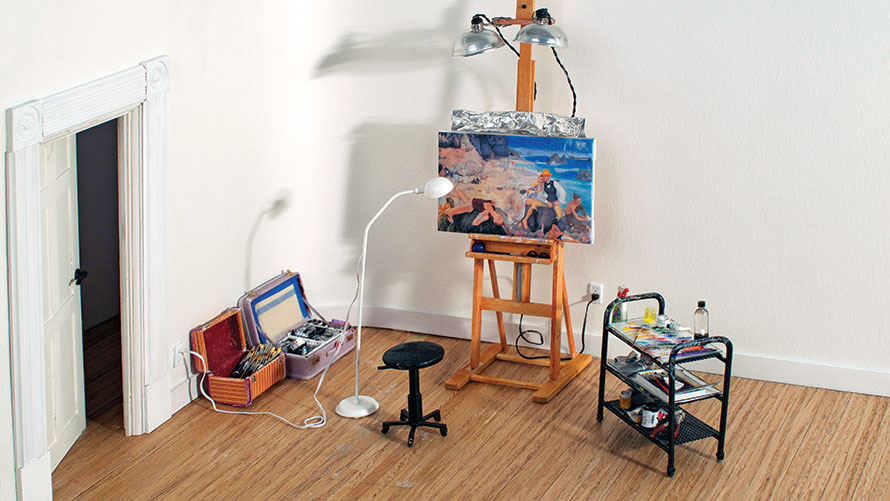 Detail from Joe Fig’s Hillary Harkness: July 17, 2013, 2014-15. Mixed media.
Thomas Doyle and Lori Nix + Kathleen Gerber depict the human world eerily overtaken by nature. Doyle constructs models of suburban homes subject to sudden, inexplicable environmental disasters that displace and bewilder their inhabitants. Nix + Gerber create and then photograph intricate scenes of cities and sites of arts and culture reclaimed by natural forces after humans have disappeared.
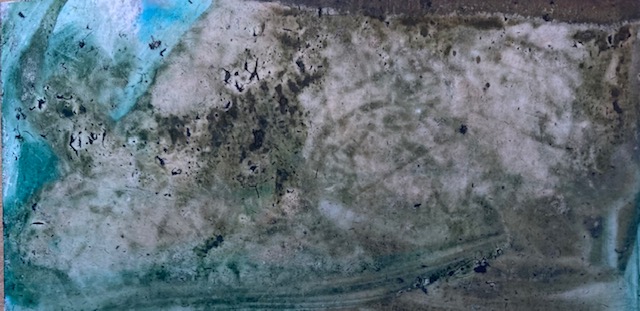
Work in development (nb the works below are actual size. I know from experience that the ink will fade fairly fast and so I have started with brighter than I would ideally want, and also the silverpoint will eventually turn from grey to brown. I like these changes that happen to a drawing that, in the case of the animal spirits, is about endurance and time)
- Inside Plato’s Cave the Animal Spirits Were Not Deceived
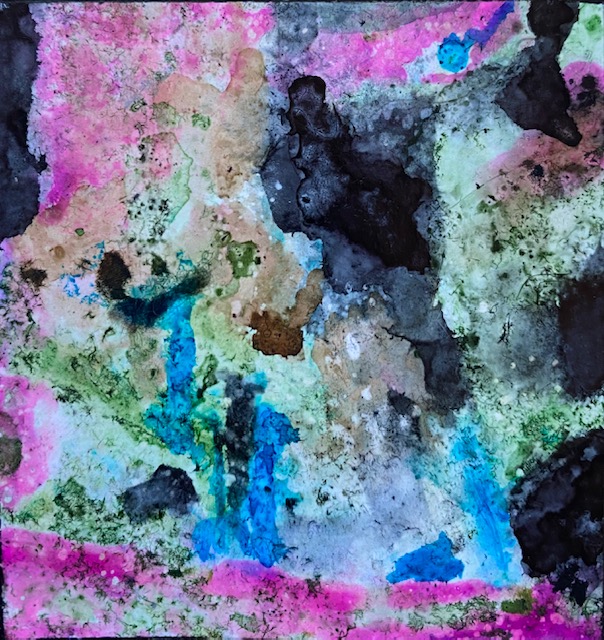
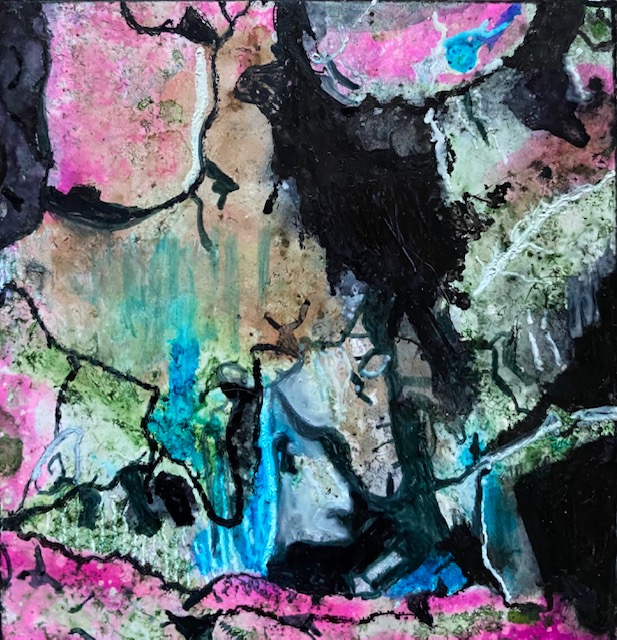
The next step I plan for the drawing above is to work on it with silverpoint.
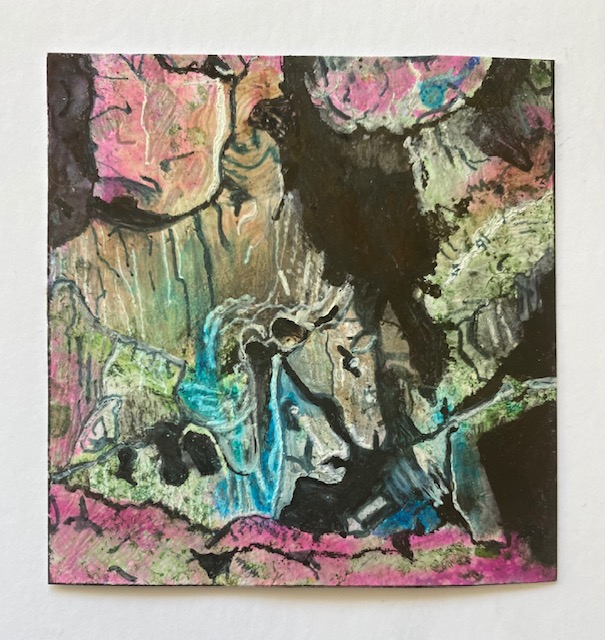
2. The Human Gaze
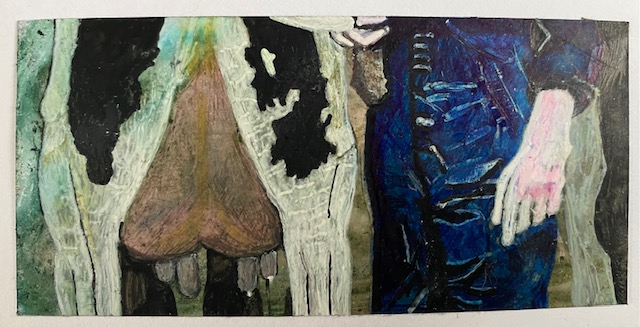
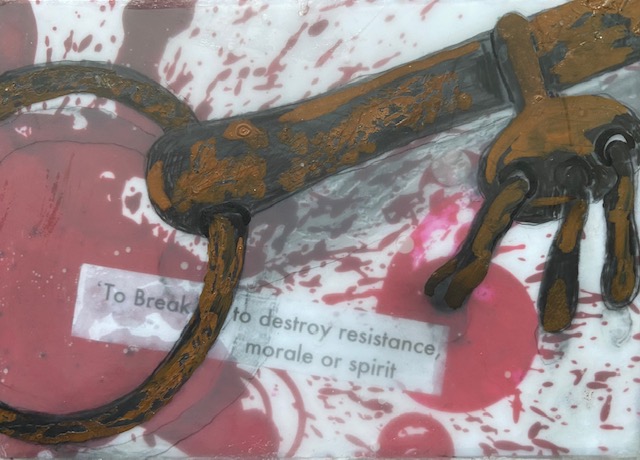
3. ‘To Break‘: to destroy resistance, morale or spirit
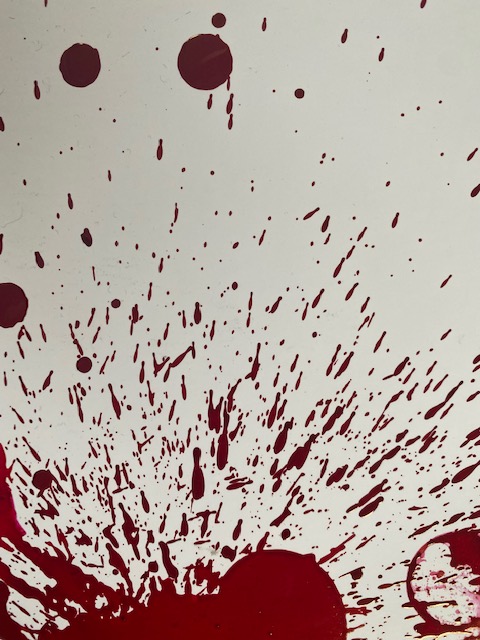
For this series of miniatures I want to go back to my original idea at the start of the MA: developing drawing as a method of critical discourse analysis. This series of drawing started with my understanding, gained from a lecture at Konsfact by Professor Marten Snickare, on colonial objects; the argument that colonisation cannot happen without objects. Objects are key to brutalisation and exploitation (see the post on contexts for a full account of this lecture). The lecture lead me to think about colonial objects relating to farm animals, and then to obtain some of these brutalising objects on eBay (see post on Installation/The Farmer’s Market). One of the objects is a ‘breaking bit’. The verb ‘to break’ is itself a violent description of the violent act of breaking the spirit of the horse.
I began by working on PLIKE, using a miniature spinning top I bought for the purpose of mark making a couple of years ago. I set the top spinning on top of the PLIKE and poured Karmin red ink onto it. Because PLIKE is non absorbent and very white, the red ink dries to a beautiful shine that is not apparent in the photographs, although its reflective quality is apparent in the third photo down where it has caught the light.
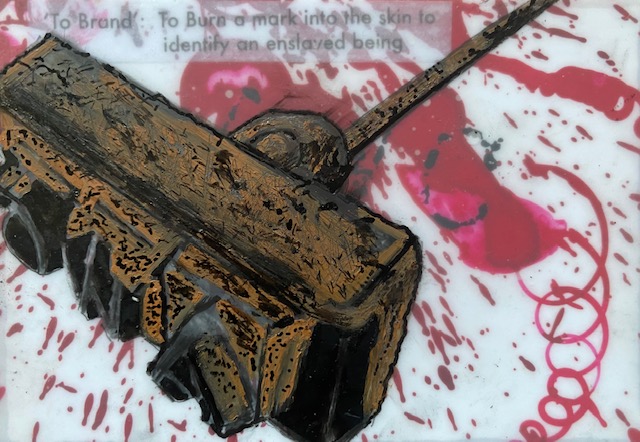
4. ‘To Brand’: to identify an enslaved, oppressed, or otherwise controlled being by a burn into the skin
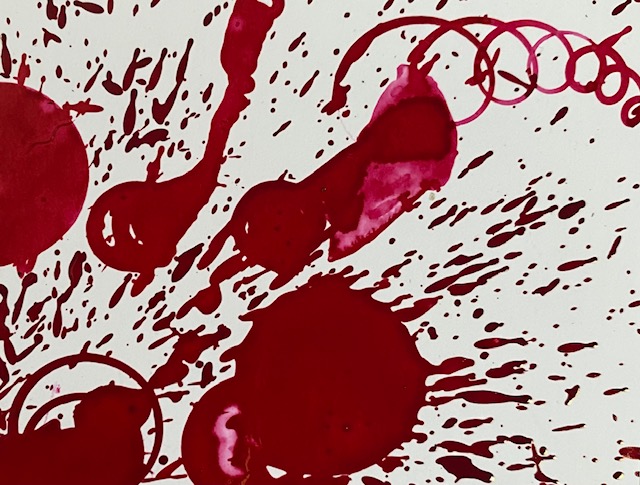
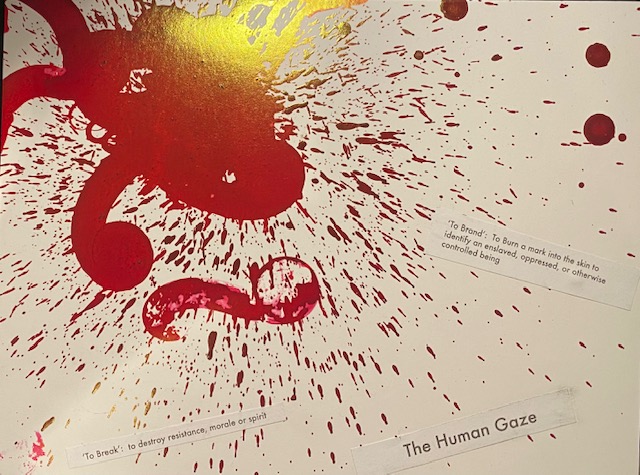
I plan only to put one piece of text on the final drawing. I wonder if it needs to be a little bit larger: the size of the ‘Human Gaze’ font.
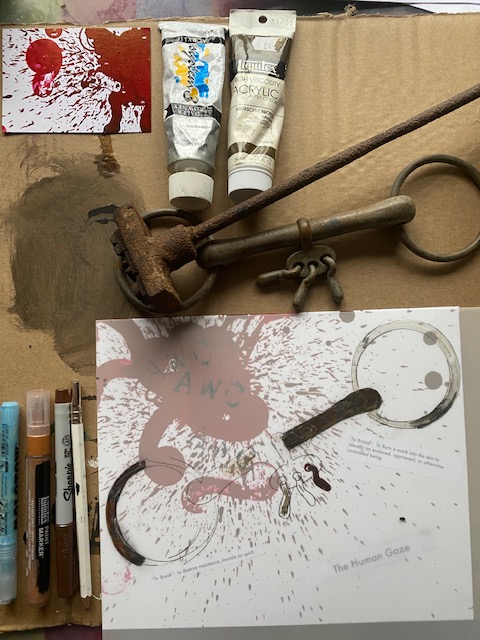

Above I glued together using ‘tacky’ glue and it’s annoying how it dries leaving an opaque greyish area over quite a lot of the red. I might try again this time using epoxy resin to attach the two pieces – it is after all what I bought the epoxy resin for in the first place. I like the finish achieved with pencil, then terracotta ontop which is scratched through. I have also drawn on both sides of the dura lar here – the shadow is drawn on the back which I think works quite well and I also drew behind the bit in case the scratching also removed the pencil.
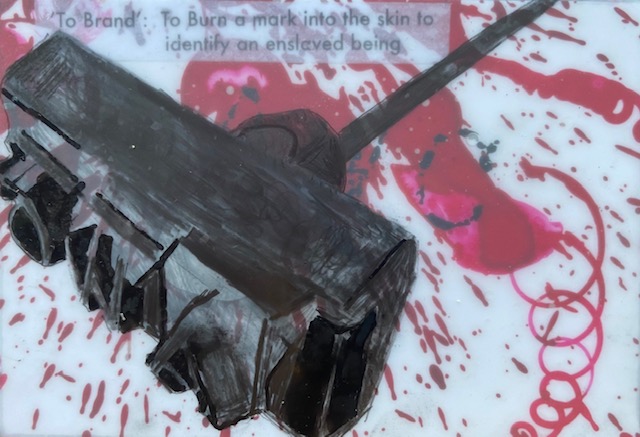
Epoxy resin used as a glue in a very thin layer has worked so much better, above, to fasten the two surfaces together (however I have since realised just how environmentally epoxy resin is and I really should not use it again). The red ink in the first layer has retained it’s colour and clarity far better. In my first and only other experiment with Epoxy resin (used to fasten layers of ‘cell drawing’ together in unit one) the bottom layer was ordinary paper and the resin turned the paper transparent in parts – however this does not happen with PLIKE, which is a non-absorbent paper. It has happened, however with the paper on which the definition is written – in this case it is good because the less the paper shows the better and I like the fact that the marks beneath that strip of paper still show through. . This is such a good find for any layering work I do going forward (ie PLIKE/EPOXY/dura lar) I also like the fact that the final surface is Matte apart from where the lead pencil gives it shine.
In fact, below, I have prized the two glued layers apart (they were already separating anyway) and reattached using epoxy. This is now much better. Two finished drawings below:
Portraits
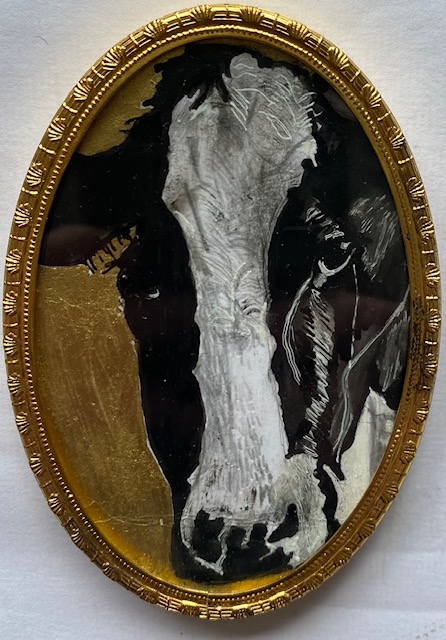
I like the idea of subverting the traditional miniature portrait/religious icon (I have combined ideas from both here by drawing both a portrait and using the gold leaf background traditionally used on religious icons). Here is the start of this work, using biro, silverpoint and goldleaf.
References
Ferguson, R. (2002) ‘Attention Level.’ In C. Gould (ed.), Charles Le Dray, Sculpture 1989-2002. Philadelphia: Institute of Contemporary Art, 13-24.
Hagan, S. (2002). ‘The Bone Collector.’ Review of Charles LeDray, Sculpture 189-2002, Institute of Contemporary Art, Philadepphia, May 10-July14, 2002. Philadelphia City Paper. May 30, 2002.
Knappett, Meaning in Miniatures: semiotic networks in material cultures. Conference Paper.
Susan Stewart, On Longing: Narratives of the Miniature, the Gigantic, the Souvenir, the Collection, Duke University Press, 1993
Consider looking at portraits of animals and children in art and repainting small sections in miniature? Also remember the idea of the animal portrait with a gold leaf surround to mimic the idea of the religious icon/ the traditional miniature portrait – am I confusing these two ideas? does it matter?
 Drawing As Critique