| Choose three teaching and learning events you have attended within the course to date and write an analysis of each event. Either interrogate the event as a whole, or focus on a specific idea or subject discussed. Briefly describe the event, the subject of the event, and analyse the content in order to understand and interpret it and situate in relation to your own research and /or other relevant contexts. 200 words each. |
I summarise four ‘events’ below and in each case reflect on the learning outcomes for me:
- Presentation by Catrin Webster
- Presentation by Giulia Ricci
- Presentation by Mathew Krishanu
- Visit to the end of Camberwell MA Fine Art students’ show at Copeland and Dilston galleries (please note the separate posts on the menu for this site, where I reflect on four further drawing exhibitions in London, visited during the last three months (including images of works from each) – the Drawing Rooms at the British Museum; William Kentridge exhibition at the RA; The Buoys wharf drawing Prize exhibition; The Royal Drawing School Drawing Year exhibition).
- Catrin Webster MA Programme Director, Fine Art. Wednesday 3rd October. 2022. Lecture at Camberwell Art College.
Catrin introduced her varied practice as a painter and stressed ‘thinking through making’. She talked about how landscape is a constructed idea – a projection of a cultural meaning – and her interest in what landscape might mean to a woman and how she might ‘deconstruct the terminology of the landscape’. The first works she showed us were made on journeys around England, firstly on a motorbike and secondly in a camper van, with a structure attached on the outside for making large paintings. Catrin described her methodology in this first series of works she showed us, as ‘performative’. By this I understood her to see motorcycling itself as a form of drawing, and the roads she drove down, as the drawing unfurling. She talked about ‘living’ in the space as her embodied experience. I searched on google to see if I could find images or writing by Catrin and came upon an article, with many visual references, called, ‘The Journey and Movement, repetition and time: drawing within my visual practice.’ (Webster, 2012).
When I try to understand something visually, I draw. I draw what I see and try, through drawing, to learn what I actually see, which is often not what I know or expect. Freedom in drawing is neither about self-expression nor flamboyant gesturing; rather it is the true freedom of thought that an intense drawing facilitates (p. 30).
She goes on to explain that the problem of place, as ‘experienced from multiple or transitory positions is a major concern for me as an artist’ (p. 31).
She writes of riding a motorbike:
riding a bike is primarily an aesthetic encounter with landscape, as you are overtly aware of the shape and character of the road and surrounding space. Everything is heightened, intense and engendered with urgency.
(Webster, 2012: p. 38)
In the lecture Catrin went on to describe her postcard drawings in Rome, her television drawings and her more recent collaborative practice.
My main learning and enjoyment of this talk by Catrin entered on four (related) understandings that I can apply to my own practice:
- In her article as well as in the talk Catrin refers to influences from literature and philosophy, including Foucault and Kafka, both of whom have also influenced my work – Foucault was the influence for my previous research, and Kafka has been a main influence with regard to a series of drawings relating to his short story, ‘the Hunger Artist’. I am reminded how important philosophy and literature are to me and to continue thinking about how to incorporate my reading into current making.
- I am struck by Catrin’s focus on using drawing to understand something, by her clarity about what this ‘something’ is, and by her determination to follow through her line of enquiry with courage. I have wondered in the last week or two exactly what it is I am trying to understand, and Catrin’s lecture and writing underline for me that I need to be much clearer about this: it is obviously central to research-led practice. What exactly AM I trying to find out about human supremacy over other animals? I already know that it exists and it is brutal.
- I am inspired by Catrin’s perception of landscape as a constructed idea and her goal to deconstruct and make meaning of the landscape through her embodied female experience – so that rather than viewing the landscape as an objective landscape to be ‘captured’ she deconstructs and reinterprets it. I view our human relationship to other animals as ‘constructed’ – a projection of our cultural meaning – and seek to deconstruct and reinterpret. I’m wondering what I can take from Catrin’s work. Perhaps for me too it is ‘the true freedom of thought that an intense drawing facilitates’ . Interestingly perhaps the true freedom of thought extends to freedom of feelings or freeing from dissociation: I have noticed a heightened empathetic response to pigs, as I draw their epitheal kidney cells.
- I really appreciated starting the MA with such an exemplary model of research-led practice and this talk and Catrin’s writing have helped me understand that research-led practice is not only research into materials and medium, or research into how I can communicate ideas to others through drawing, but research into understanding something differently. I am left with the question of whether and how this new understanding is communicated: is it through the drawing, or does the drawing have to be accompanied with writing/speaking? If the latter – is the drawing needed (in the final communication) to facilitate audience understanding of knowledge created? (i.e. the drawing is a producer of new knowledge but not a communicator of knowledge?) This is something to struggle with.
Webster, C. (2012) The journey and movement, repetition and time: Drawing within my visual practice, Journal of Visual Art Practice, 11:1, 27-47, DOI: 10.1386/ jvap.11.1.27_1 To link to this article: https://doi.org/10.1386/jvap.11.1.27_1
2. Giulia Ricci. Wednesday 10th October. Camberwell College of Art Lecture.
Giulia talked about her focus on pattern, and where pattern comes from. Her work has been commissioned for Architectural decoration. Here are some examples of her work:
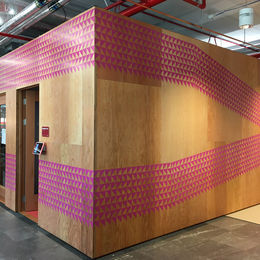
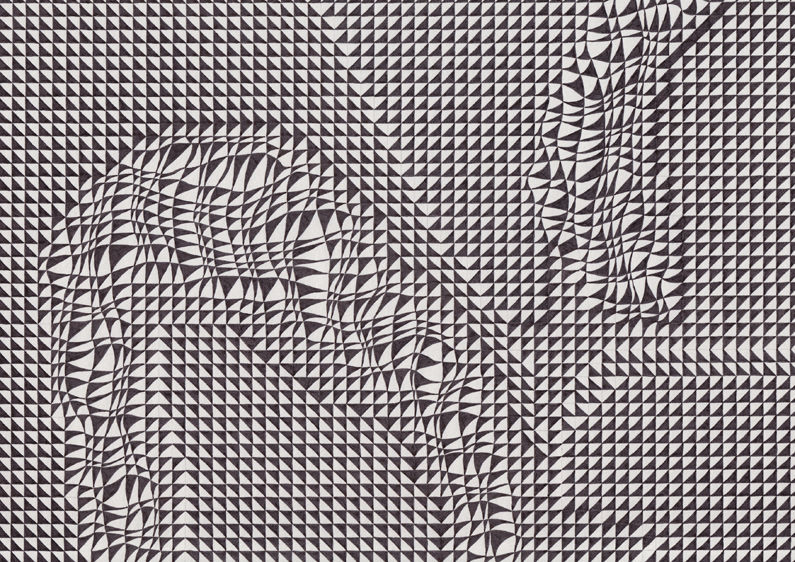
Guila talked about the influence from her home town in Italy, where there are many geometric tiles in Churches and other buildings e.g. Roman tiles on the floor, and many mosaics. She works in small scale in her studio and started by making her works using graph paper, inspired by crosswords. She uses acrylic pens on paper in her studio work, and then scales up large for the architectural commissions. She spoke of tactility and materiality as key to her work. She also mentioned the metaphor of ‘ploughing’ in her work – like me, she grew up on a farm. Much of what Guila talked about resonated with me. For example, she talked about how, when she doesn’t have a public deadline, she creates for herself. She decided during lockdown, for example, to focus on herself – thinking about her motivation, relationships between her works, and becoming more conceptual. Her more recent projects have focused on labelling and mental health and being inspired by neuroscientist Marco Brancaccio. Her blue and white geometric quilt explores ‘What is Normal’ – the figure and background are interchangeable. She is currently about to publish a book ‘Lines of Empathy’, which is a collection of interviews with artists working on paper, and focused on one drawing from each artist, that Guila has chosen to incorporate into her book. She interviewed each artists with a series of questions: summarise your practice, explain choice of paper, which tools/materials did you use and why? How does your use of paper relate to other materials and process that you use? What is your physical experience of working on paper? Reflect on how your work relates to your physical senses. Can you describe the work using an analogy?
Giulia explained the title: Lines of Empathy, as relating to lines for mark making, and reaching out to understand someone else’s experience. She shared work from all the artists included in her book. I made a note of, and will research: Rachel Duckhouse – who explores our relationship to landscape. Kathy Prendergast – also interested in the environment, and works with maps. Omya McCauseland – natural pigments on paper. Wendy Smith – focuses on the idea of ‘control’. Based on grids and very structured. Louise Hopkins – Also uses grids – one grid on top of gridded paper – works with pre-existing surfaces.
I was struck at one point by Giulia saying that because our bodies are different, might mean we perceive the word differently (the body speaking to us). I have previously pondered myself that the fact that we use different languages (and might have words for experiences that only exist in our language), might mean we perceive the world differently. Finally I noted that Giulia talked about coming to understand the self through making (a similar point to the one made by Catlin above), and asked the following useful questions: Who are we making for? Who are we trying to make connections with?
My learning and enjoyment of this talk by Giulia centered on the following:
- Giulia’s questions for other artists in her book, as well as the questions I end with above about who we are making for, are central and important for me to ask about my work. I’d also add the question: Is my work inclusive or exclusive? Does it need to be explained in order for someone to get something out of it and for me to communicate with them (this is the same question I asked above after Catlin’s talk). Again – if the answer is I make it for myself – why would I show it to others?
- Empathy – reaching out to understand the experience of others, is a key focus for my work. I am reaching out to try to understand the experience of other beings ( is this a research question for me?)
- The idea of perceiving the world differently, if in a different body, is really interesting and important to bear in mind when thinking about the experience of other animals. Their bodies are so different to our own. Many animal’s physicality and senses far outstrip our own. I’m thinking for example of a cat – cat’s can jump from a standing position to at least 4 or 5 feet – this is perhaps equivalent to a human being able to jump from standing still to 30 feet. I have also seen a cat fall unharmed from a 30 foot window – the equivalent for a human of falling unharmed from about 200 feet. Cats also have an amazing hearing ability – they hear a human coming to their house a couple of minutes before they arrive – witness they go down to the door. They also KNOW that person walking up the street is THEIR human. I could go on. The point is that it is only possible to guess at how another animal experiences the world, but I guess they experience the world with sensitivity that is inconceivable to we humans.
- A final point. I’m reminded that while science, e.g. neuroscience, has much to say that is interesting, all science is at best our incomplete understanding of what we are studying. My understanding from teaching research is that the ‘best’ science is never presented as ‘FACT’ and we need to be careful not to quote scientific findings as such. The point, for my work, is that I want to use drawing to explore dominant discourse, and scientific discourse is part of this critique, especially when presented to the public by mainstream media, as ‘Fact’. I’m also reminded that the major colonising discourse relating to other living systems: that humans could be lord and masters of other nature, was presented, by Descartes as being enabled by Science.
- Guila’s use of metaphors is another thing to learn from. For example, ‘ploughing’. I should think about metaphors in my work. Perhaps particularly for key ideas, like violence/brutality; empathy; dissociation and ‘covering up’.
3. Mathew Krishanu. Thursday 17th October. Camberwell College of Art Lecture
Mathew showed us many images of his work. He works in series and we saw work from ‘The two boys’, ‘The House of God’, ‘Missionaries’, ‘Crows’, ‘Everyday Heroes’, and his wife and child. Mathew was born in Bradford but spent 11 years during his childhood in Bangladesh. He talked about his mixed race heritage, growing up in Bangladesh, and being born of a white father and Bangladeshi mother. He mentioned his Father’s faith and role as a Christian hospital chaplain, as well as his grandfather’s conversion from Hinduism to Christianity.
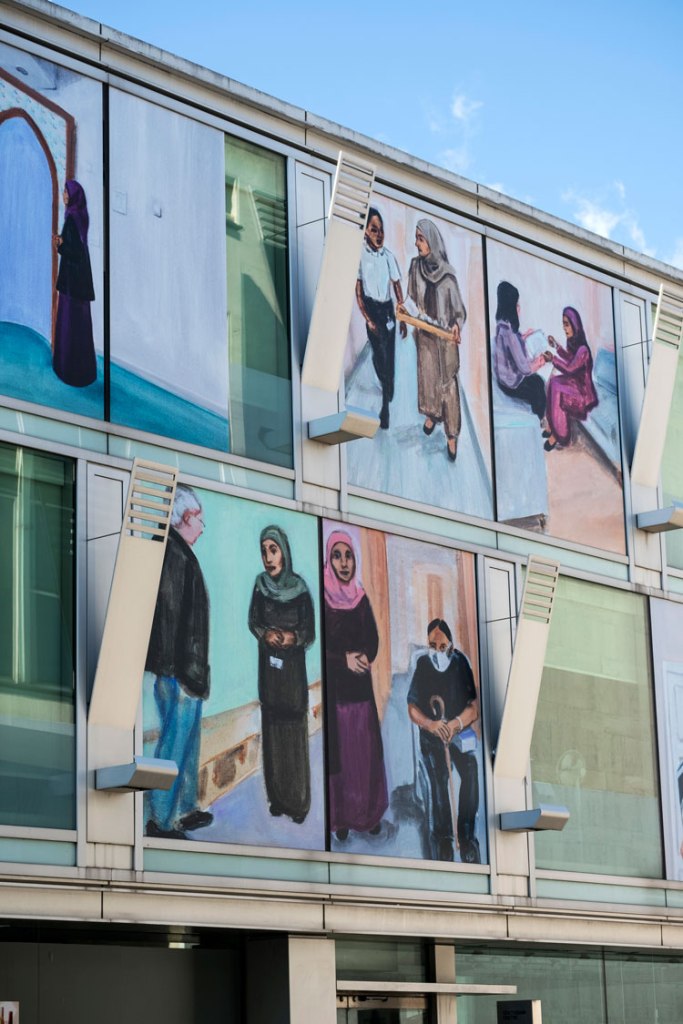
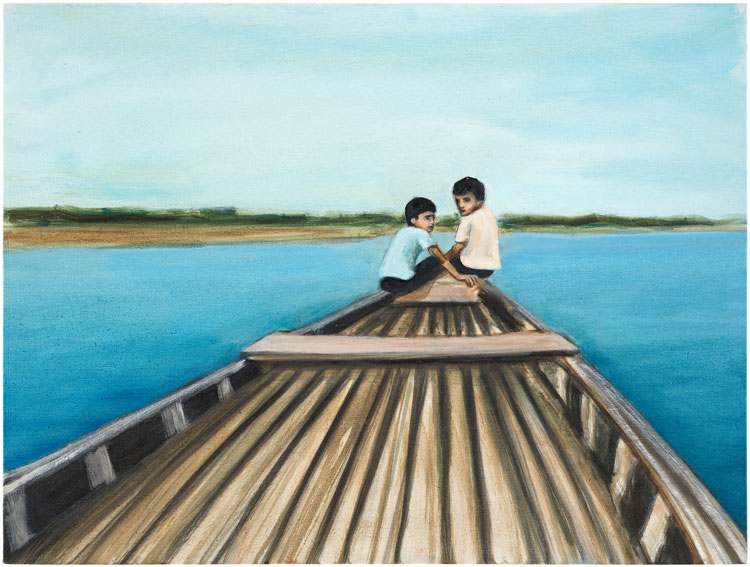
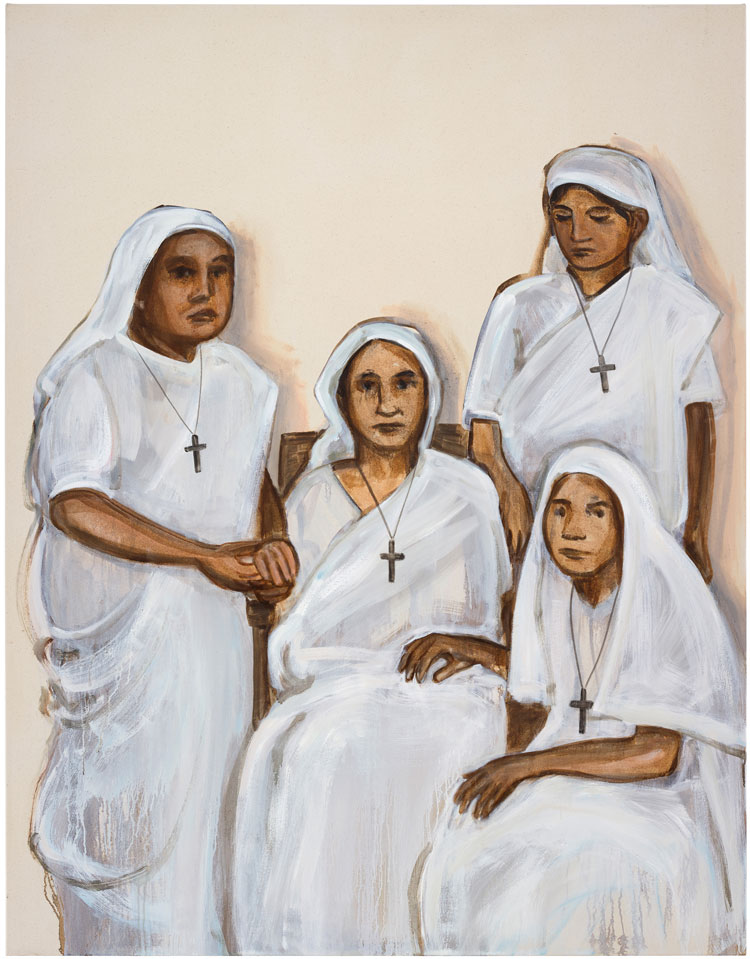
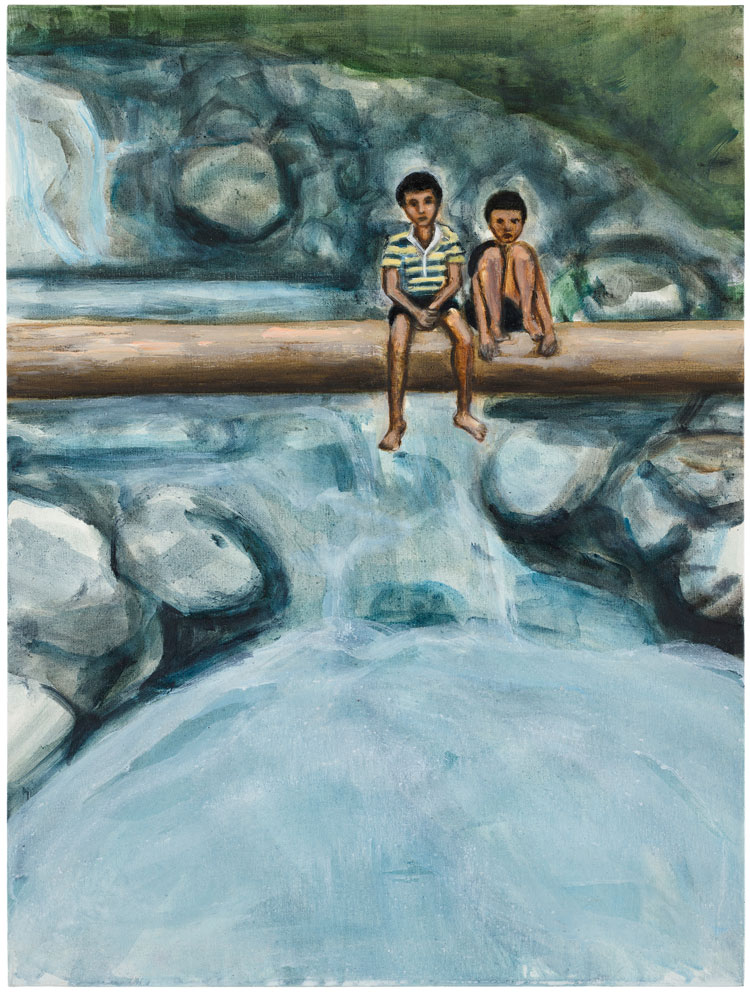
Much of Mathew’s work focuses on memory, religious themes (not ‘religious paintings’ but exploring religion in global contexts) and family. I very much appreciated hearing about how he draws on memory, as well as family photographs, and imagination. I also was interested in his explanation of his process – often painting very small studies, e.g. postcard size using oil paint on prepared paper, or A4 using ink and brush, and scaling up. Another aspect that interested me was his use of thin washes of transparent oil paint that he builds up, sometimes, depending on the subject, allowing to drip and run – “It’s so much about the surface. How much the canvas breathes.” He described taking the canvas off the frame and sanding down the surface of one work, and ‘”setting up tensions” between different areas of the painting – thin/thick, drip/non drip, the configuration between figures.
Mathew talked about where his works are shown – in the UK, USA, India and soon in Bangladesh too. He is interested in how his works are viewed differently in different contexts. “The question of otherness depends on the context in which shown. Who is ‘the other’? There will be different readings in different contexts Also different feelings.” For example, a painting with a brown boy and white man will be viewed differently in Bangladesh than in the UK, and in an ethnically diverse city like Bradford, than in a homogenous rural area of England. He mentioned too, how some of his large works have been blown up as even larger posters either to advertise his exhibitions, or in the case of ‘Everyday Heroes’ to celebrate the work of those who supported ill and dying people during the recent coronavirus episode . This latter work was commissioned for the Southbank Centre 2020 exhibition.
With regard to his ‘House of God’ series, Mathew showed us several images where the architecture of the Church, and the image of the cross, are very small in a very big landscape. He spoke of “a marginalised cross in the weight of the landscape, and the weight of the paint itself.”
Finally I was drawn to his answer to a question about representation/figurative art. I have noticed myself that there has been a turn toward the figurative in art. Perhaps particularly in painting. I had been wondering whether this turn toward the figurative is a particular feature of painting by minority ethnic painters, and in fact Mathew mentioned several painters of African/Caribbean heritage including Kudzanai-Violet Hwami, Hurvin Anderson, Lubaina Himmid , Lisa Brice, Chris Ofili, Mamma Andersson, Lynette Yiadom-Boakye, Chantal Joffe (I saw the work of several of these artists about a year ago at the Hayward gallery, but he also mentioned Peter Doig and Jenny Saville.
Someone in the audience also asked about why memory and everyday life are popular now. Mathew responded by talking about a ‘loosening up’ in painting and moving away from photo-realism: “Richter gets dissolved by Luc Tuymans. It becomes a play with paint. The art world has become more open to different conversations, multiple narratives and multiple voices – for example to women artists.”
My learning and enjoyment of this talk centred on the following:
- Working in series: I see that Krishanu makes many studies of the same subject, working at different scales and often starting very small. I am particularly interested in doing the same thing myself. I like to explore a subject until I feel I have learned enough about it. I wondered about the scaling up, and wish I had asked a question about this. My question would have been whether he ever views a small painting as ‘resolved’. It seemed that the exhibitions mainly featured very large works (although I note that the crow paintings are small and feature in exhibitions (I think he mentioned A4 size, and some of the House of God series are approx A3 size) . My feeling is that small can be just as resolved and powerful as big. (Also that ‘big’ takes up a lot of material and space, and for me this raises sustainability issues).
- Showing work in different context and thinking about how work may be viewed differently by different people in different contexts. I am particularly interested in thinking about how my work might be viewed outside the gallery to people who do not normally visit galleries – I think this group of gallery-goers is select – largely professional, white, middle class. I also think some contemporary art is particularly exclusive/undemocratic in terms of inaccessibility (I’d argue that Krishanu’s work IS accessible).
- I found Mathew’s work highly emotional and personal. At times almost unbearably so as he talked about death and painting those who had died. This made me think again about the importance of not remaining coldly intellectual if we want to reach out to communicate with people – I am also painting people after death, but not people with whom I have a personal relationship. (I also made some personal connections because I lived in Bradford for a while – I’m from North Yorkshire – and my first husband’s father was Indian-Pakistani, my first husband spent childhood years in Pakistan, and my daughter has both Pakistani/Indian heritage and English heritage. I wonder whether I connected more with the works than possibly I might have if not for this personal history).
- Making connections between different series of works: Mathew made some connections between the religious and crow series and showed some images where the two series were intermingled in an exhibition. I like the idea of bringing together works from different series – clearly there IS always a connection because they both come from the same artists whose passions and interests are bound together in some way.
- I was interested in hearing Mathew talking about the art world opening up to different conversations, multiple narratives and multiple voices. I have two concerns relating to this. One is that I am an older white woman pushing a vegan narrative and being very critical of the animal agriculture Industry: I worry about how the ‘art world’ might respond to this critique – it might be threatening to some individuals or seen as critical of some human communities (who may be seen as ‘more important’ than the other animals my work hopes to speak for). My second concern is whether the focus on materiality in contemporary drawing (rather than figurative or representational drawing), is more appropriate for some themes/topics than others – perhaps more appropriate for exploration of identify and feelings, for example, than for political topics. But I need to talk and think about this more. (I can see on the other hand that performativity might very well be useful for social justice themes).
- ‘Otherness’ relates to the point Krishanu made about context (ie ‘The other’ in his works will be seen differently in different contexts). I am interested in the concept of ‘the other’ relating to other animals. I wonder if there is ANY context in which the concept of ‘other animals’ will differ? I think this also relates to the question of who we make the work for. I guess the only difference here will be whether the works are made for/seen by vegans (who choose veganism for ethics reasons) or non-vegans.
4. Reflections on the Camberwell MA final year show at Copeland and Dilston galleries.
Both galleries are beautiful spaces for showing art. The Church at Dilston Grove is particularly beautiful. Starting with this first – it’s a dark space and this is why it was chosen for showing so much video and so many works that required lights. (I’d wondered before arriving why there was no video at Copeland -I went there first – the answer is because it was all at Dilston, and I found it overwhelming).
I find, looking back, that I don’t remember very much – apart from the Band, (worked by fans moving strings over drums, guitar, piano keyboard). I think I remembered this because it’s a large installation, plus I am currently thinking about how to make drawings with no hands. (I am not suggesting this is a drawing – an installation rather). I also remember some Cakes, made from plywood with the laser cutter, with a video transposed on top (I remember this because I’ve recently done some drawings of cakes – also I noted that the video was not working). My main feeling at the Dilston gallery was chaos, and wanting to get out as soon as possible. I know that this work is the cumulation of hours of work, and that it will have reflected much interesting and insightful thinking. But (and, I apologise for this) – the curation did not work for me.
The Copeland gallery worked better for me. It was light, calm and large. I thought a lot of thought had been given to how to show the work off to advantage. I still thought there was slightly too much packed in. I saw that some works had been grouped because they had a similar theme – for example, the work I liked best was grouped on the right nearest the invigilator’s desk and had a political theme. For example photographs of Russia that I found interesting. An installation with large photos, splashed with white paint, and a flag and a kind of white punch bag dripping in ‘blood’ with two voices on each side that seemed to be having a conversation. Is it the German flag? I must admit I didn’t spend enough time really listening and working out what this installation was about. (I think again because the environment was too distracting. Perhaps this says more about my attention span than how the works were curated).
There was also a short story, printed on A4 and clipped together hanging next to about 6 small paintings of plates. And another large painting about 12 feet across of a black family with a poem ‘who am I’ printed off for people to take – I like the idea of the armchair here so we could sit and read the poem. I also like the previously mentioned story, but I’m not convinced either worked in the art gallery setting – both poem and story took considerable time to read. The poem had a QR code which is a good idea, but unfortunately I didn’t think to photo it.
My favourite work of the MA show was a piece by an Iranian artist called ‘Getting Out’. This was about getting out of Iran. It was a wooden rectangular, waist- high chest with doors and drawers inside. On the top of it was a ceramic ‘pot’ with a lid wired down, and holes in the sides of the pot, full of small ceramic balls, which were also in the drawers (but we couldn’t see them – I wondered why the drawers were not cracked open a glimmer). I really liked the simplicity of this idea – the balls, I supposed, represent the people trapped inside Iran. I liked that the voice of the artists, singing to herself, was also coming out of the pot. The wooden chest was beautifully made from recycled wood, with dove-tailed joints. I thought conceptually it was very coherent, as well as aesthetically beautiful. The idea was clear and the sense of being trapped inside was strongly communicated.
I felt quite disconnected from much of the work – the idea behind it was difficult for me to understand – therefore hard to feel interested or connected. My concern is that work that is ideas based, but where the idea is not clear, is exclusive/undemocratic. (Comments from my husband following our recent end of term show – “Are they trying to not make their work understandable?” “The world is about relating. I could not see anything I could relate to.” “I am too ignorant to understand this.” I find it painful that someone like my husband, who is a photographer, video maker and musician, but not white, not middle class, not part of the Fine Art world, and did not spend his early years in (over)developed Europe or North America , can feel so alienated and excluded in this context.)
Work that was aesthetically beautiful and technically detailed was easier for me because I could simply admire it – for example the large drawing of a figure with red paint covering the head, (again, though, I’m not entirely sure what this communicated), and there was some beautiful printing, for example, the large piece that went with the tiny poem by William Blake ‘To see a world in a grain of sand.’ I thought this piece was coherent and the poem helped to ‘interpret’ the print.
Overall I thought the following in relation to showing my own work:
- Issues are raised for me about showing work in a group exhibition. Does showing so many disparate works together take away from, rather than add to each?
- Video shown amongst dozens of others makes too much noise, flashing lights and distraction.
- Look for a simple and coherent idea and a simple and coherent way to show it e.g. Getting OUT.
- Only one work is shown in a student exhibition, or a small group of related works. Quality is definitely more important than quantity! Go for one final work that is both technically proficient, and good in terms of the idea expressed clearly.
- If my work was not in a final group show – where would I put it, or where would I put it in addition to a final group show, and would the final group show be the most important showing?
- Think practically – this show lasted 3 days! I guess it is unlikely to lead to representation or solo show. Therefore think about the practicalities of work being shown in a gallery with little individual space e.g. if heavy make it small – or if big, think light! Think about impact/Standing out.
- I noted common approaches – a LOT of video, much of which I could not find a meaning for (but this is most likely my lack of concentration in this environment). MANY very large works (there were one or two very small works, but nothing in-between in terms of size). I am on the drawing pathway so particularly noticed that there was little experimentation with drawing mediums or drawing surfaces: e.g on different surfaces (e.g. copper, slate); few mixed media works (e.g. I didn’t see any soft or oil pastels; were there any ink works? Coloured pencil?) There was one biro work. I don’t think there was any work using text? Was there any collage? Very little Textile work -I saw only one work that used a small amount of stitching. Was there any stop-motion drawing animation (possibly I missed this amongst the video works?)
- Difficult to distinguish which pathway most artists came from. I see that in terms of practice after leaving the MA this does not matter. In ten years time if by a stroke of luck an artist is getting some attention, it is not going to matter one fig which pathway they took on their MA. However, I have chosen an MA drawing pathway for a reason. I intend learning more about drawing. I don’t think video or sculpture are obviously related to drawing (nor was it clear how making sculpture might inform drawing practice or vice versa). In fact there were two sculptural installations next to one another in the Copeland exhibition – one by a sculpture student and one by a drawing student, and it was impossible to make any distinctions between them in terms of basic discipline. I do, of course, want to extend my drawing practice, which for me is fundamentally an activity about making line and mark on a 2D or 3D surface, rather than forming a material into a 3D form. I read that the term ‘expanded field of drawing‘ comes from the American artist, Robert Morris, and refers to investigating one art discipline (drawing in this case), through the lens of another (www.modernartprojects.org/project/drawing-in-the-expanded-field). I also understand that working in other disciplines, including animation, ceramics, printing, might help us challenge, extend, expand, depart from and reframe our usual drawing practice. I am open to this idea, but I am thinking about if it depends on why we draw in the first place. Is our most important motivation to explore how we understand drawing and to understand drawing differently? ie. are we enclosed in the closed, and self-referential world of the drawing (and if so, is there any relationship between this and our living in a post-industrial capitalist, individualist society)? Or are we drawing to understand ourselves and/or the world differently, and to communicate this understanding to others? (and is the latter a more inclusive, collaborative and social undertaking?) Can we draw for both reasons (or do they conflict) and if so are both equally important? ie does it have to be either, or?
 Drawing As Critique