This section critically reflects on three events that I attended during the term and identifies my learning from each. I chose these three events because they are closely related to my research focus on the MA Fine Art. They are:
- The Artistic research week at Konstfack university, Stockholm that I attended in January 2023.
- Science Frictions exhibition and interview with the curator, Maria Ptqk. An exhibition in Bilbao that explored post humanist ideas – attended and interview in February 2023.
- MILK. A exhibition at the Welcome Collection in London – attended in April 2023.
1. Attendance at the Research week, ‘Refractions’. Konstfack university, Stockholm, Sweden. 22-25 January 2023.
I decided to attend this research week to become more familiar with Artistic research/Art as Research. I have previously taught research in the humanities/education fields, but am new to Art as Research and want to understand it more clearly. On the Konstfack information about the research week, artistic research is described as follows:
Sometimes defined through its capacity to incorporate the intuitive, the pre-conceptual, and the non-linguistic, artistic research contributes to the production and dissemination of new knowledge in and through the practice of art, crafts and design.
Further, on Konstfack Fine Art research page, research is defined as ‘A critical exploration of everyday life’, and:
Art is a fundamentally critical, exploratory practice, able to make visible the hidden threads driving everyday practices and events. Research projects in Art adopt a critical vision on our societies, their history, on prevailing norms and possible future forms of coexistence. Through these projects, new knowledge is made available on the artistic practice itself, as well as on its intimate relation to our daily experiences.
In Art, the methodological starting point is our own artistic practice. Research explores the untried; new working methods are tested, and new forms of dialogue and cooperation between fields of knowledge are established. In an open and interdisciplinary dialogue, Art interacts with the Crafts’ material tradition, but also with the humanities, social sciences and technological disciplines.
https://www.konstfack.se/en/Research/Fine-Art/
This is very much how I am seeing my current work.
During the three days I was at Konstfack I attended 16 lectures. The first 12 on Monday and Tuesday were focused to some extent on what artistic research is. On Wednesday I attended a ‘node’ which focused on Counter Histories (other nodes e.g. on sound production were closed to me as a member of the public – I would like to have made a sound space for my animation!). I chose to attend counter histories/narratives because I believe this is what I am trying to tell in my work.
The remainder of this account of my learning will focus on a summary (as brief as possible) of two of the lectures on the counter narrative ‘node’ that I found particularly interesting for my work, followed by my thoughts and learning and possibilities for my future research. The final section will summarise my key learning about artistic research generally, and the distinction I identify between artistic research and art as research.
Professor Marten Snickare. Colonial Objects in Early Modern Sweden and Beyond. From the Kunstkammer to the Current Museum Crisis.
Snickare is professor of art history and coordinator of research at Stockholm university since 2006 and before that curator of old master drawings at the national museum of Stockholm.
He spoke of his interest in materiality and objects of colonisation. He started with a photograph of a tomahawk from Canada and how it found its way into the Stockholm museum. He quoted W. Mitchel ‘Empire of Objecthood’ who wrote of ‘the brute necessity of objects’ and the ‘multitude of things that need to be in place for an Empire to be even conceivable: tools, instruments machines and commodities.’ I was particularly struck by his argument that colonial practice is generated and shaped by objects, as much as by writing. I understood him to argue that the object ‘always takes the side of the coloniser.’ The object ‘stresses the conflict.‘ How we incorporate objects into our narratives can upset the hierarchies, meanings, values and uses of objects. Objects and colonisation are closely connected. Colonial violence is implicit in the objects. Objects have agency – they do things. He asked : Where do the objects do most good today? How does our perception change if the object is place in an unexpected places? Can you talk about objecthood without talking of the subjectivity of the colonised? Snickare ended by pointing out that Museums and colonisation are totally intertwined – the museum is a colonial institution. How can we reframe the Museum and are Museums likely to disappear? (I think that would be a disaster – the Museum could be reframed as a place to remember the violence of colonisation. We must not forget this. I suggested a name change – ‘Memorial to colonial violence’, for example. Perhaps if the objects are all returned – and many will not necessarily be wanted back – we could make replicas/films or virtual copies should be possible now).
Lisa Rosendahl. The Ghost Ship and the Sea Change – On Curatorial Research and the Production of counter narratives.
Lisa Rosendahl is a curator, writer and educator, as well as Associate Professor of Exhibition Studies at Oslo National Academy of the Arts. She described the curatorial research leading up to the 2021 Göteborg International Biennial for Contemporary Art (GIBCA), titled The Ghost Ship and the Sea Change. Gothenburg was founded around 1621 as a maritime/trading centre – the biennial celebrated the 400 year jubilee. Her initial research into the history of the city, unearthed a plot of land in Gothenburg harbour that was initially traded with the French for Canadian land ‘owned’ by the French, so allowing the French to trade in Gothenburg and the Swedish to trade in Canada. She used this as a narrative device to alter the hegemonic perspective on the history of the city. The presentation discussed research processes rooted in feminist methodologies of embodiment and situatedness, deployed in Gothenburg as a way to make visible how the city’s colonial past continues into the present. It also addressed the challenges of practicing self-reflexively as a curator – for example, accusations of taking authorship of the resultant works or attempting to hihjack attention from the artist who creates the work. .
Rosendahl started by asking, ‘How does one tell a counter history?’ ‘Who can tell them? who is given the power to do so?’How does one address colonial crimes? ‘An art exhibition is an inversion of official history. We can imagine what should have been, what is, and what still could be.’ She emphasised that Art has been part of the colonial project since its’ inception. Also that there is a continuum from colonisation to modern global capitalism.
I was particularly interested in her assertion that Sweden does not generally recognise itself as a coloniser. She started by showing us information from the city commissioner’s for the exhibition, who clearly envisaged a celebration of the city’s glorious maritime past. But Rosendahl, was intent on bringing to public awareness both colonialism of the past, and also its impact on current day Sweden. She explained how iron was a major export from Sweden and shipped from Gothenburg to be used in the Caribbean economy. The buildings and artworks of Gothenburg (she showed many examples of these) are entangled with other parts of the world and with colonial practices. In fact the colonial legacy of Gothenburg has permeated the whole city. The works that were made for the Biennial are site specific and ‘trace dislocated sets of relationships, enable understanding of foundational ideas and theoretical associations.’
The past is not sealed off but part of the present and exploitative actions have ongoing effects in the here and now.’
Lisa Rosendahl. Lecture note.
In answer to her own questions about the role of the curator Rosendahl ended by suggesting that perhaps focus on site can replace authorship? The world is made of relationships – can the curator be one aspect of the dynamism of forces that effect one another? Can she open up and own her perspectives without claiming ownership and objectivity? Can there be a potential counter model of curation also in which meaning making is decentered?
Thoughts and learning relating to counter narratives.
- I’m struck by the focus on objects as agents of, and necessary for colonialism; that they operate in the coloniser’s interests and are always violent and reminders of the struggle. This makes me think about the myriad of objects used to exploit other animals; they could be used to reference the violence without involving images of the animals themselves. Perhaps importantly, we can imagine what the implements were/are (they still are!) used for on the farm when I grew up – both outside and in the kitchen – the meat grinder, the bit, the branding iron, the de-budding knife, the castrating tool, the ear clip, the nose ring and so on.
- Objects remind us of our dark side. They were invented to use AGAINST other animals and symbolise our POWER
- I was interested in quotes about Glissant and the poetics of diversity and borderlands. ‘Those who do not belong may notice what those who belong take for granted.’ I may not live on the borderlands (though my ancestors hail from the borderlands literally) but by becoming vegan I place myself in the borderlands in some respects. Certainly ‘the taken for granted’ is always the subject of my work.
- Snickare’s question about where objects do most good, and how we perceive them if placed in unexpected places makes me think about the value of placing objects of violence to other animals in an art gallery. This would be a VERY unexpected place I think – a farm museum – yes, and there they would be unremarkable and not speak particularly of colonisation, but in an art gallery they have a different meaning. We would understand them, not as historical objects, but as symbolising cruelty, and we would understand, I think, that they flag the message that we need to look differently.
- I was also interested in the assertion that colonialism in Sweden is ‘pushed out of site’. Cruelty to farmed animals is also pushed out of site.
- ‘How do we tell counter narratives?’ is something I’m also struggling with. Who gets to tell them is easier to answer in relation to other animals – only the powerful can tell them. In doing so we take authorship, agency and speak from our own privileged perspective. Someone in one of the other lectures spoke of ‘Nature as the silent witness’. I had previously thought myself acting as a witness, but the idea of the other animals being the real witnesses is powerful. I don’t know what to do with this idea yet – is there any way at all that other animals can be agents in this work to tell their own trauma?
Thoughts and learning related to Artistic Research/Art as Research
- I hadn’t understood that there might be a difference between artistic research and art as research before I went to Konstfack. This was not specifically discussed at the event – the focus was totally on the former. First let me summarise what I understand by artistic research – sometimes by listing words. Here is my understanding:
Artistic research like all research exists to develop knowledge. The kind of knowledge produced might be rather different from knowledge produced in either the sciences or humanities. It might be practical, embodied, emotional, sensory or speculative knowledge. Its methods will almost certainly be distinguished by being creative, and imaginative. Artistic research will lead to some kind of change/shift/transformation. This change might be in the way that we see something – it might produce new glimpses or views (hence the name of the week – refractions) It is not the case that only an artist will do artistic research. It could be conducted in any discipline.
Art as research will fit my definition above, but in addition, it will be conducted by a maker, and the knowledge will be explicitly produced through the making. Art as research will also create new knowledge about the world and our place in it, but in addition, knowledge about materials and making. I feel it is fine to use either term interchangeably.
Other points I noted speakers say about artistic research:
- Artistic Research involves unlearning learning, re-learning. Re-searching. Re-looking. Re-invention.
- What is the role, function, meaning of Artistic Research.
- What is the relationship between theory and practice? (not using theory to describe, or as hypothesis to be ‘proved’, but to position self).
- Gaps might be identified and filled.
- ‘When art crosses the border, something changes.’
- Start with details (for example, for me that could be details about food production on farms during the Second World War in which EVERY farm was required to turn at least 10% of land over to grow crops – crops are not normally grown on land in the Yorkshire dales – it is sheep and dairy country, but this fact shows that crops CAN be grown).
- Keep wonder in the process – wonder has to be over before new knowledge happens (Francis Bacon – philosopher).
- Artistic research develops our artistic capacity.
- We descend into the hole (Alice in Wonderland) and come back to share our knowledge.
- Rethink the obvious.
- Artistic Research involves exploration of social norms and practices (I was glad to hear this. My focus is absolutely concerned with not only exploring social norms and practices, but critiquing them).
- As well as ‘What Kind of Knowledge’? Think about ‘Who are we doing our research for? (currently I’d say I am doing my research for humans, but the priority is for the other animals).
- Artistic research relates to our ability to respond ‘Re-sponsibility’.
- Reflect on artistic position.
- Rather than ask ‘what is research’ ask ‘what can research do? ‘what is its’ capacity’?
- Ask, ‘how to do research’ ‘what to read’ ‘what to see’ ‘where to go’ ‘who to talk to’ ‘how to make art’ ‘how to disseminate’?
- Challenge sedentary forms of knowledge production.
- Alternative ways of thinking for social transformation, emancipation and solidarity entail alternative methods of investigation.
- Contextualise past, otherwise cannot begin to claim decolonisation (For my work I cannot begin to claim any sort of decolonisation).
- AR is a creative, imaginative way of discovering alternatives. (Think about this. What alternatives might I offer?)
- AR is a critique of traditional scientific and qualitative approach to ontology and epistemology. (ie knowledge viewed differently, as well as the researchers relationship to the researched).
- AR begins as a hunger for transformation.
- It is not what you know that matters, but how that knowledge transforms your life.
- We become researchers by learning how to show our findings.
- The research objects constantly changes.
- If knowledge requires empathy, but also difference – revisit places of not knowing, listen to other animals, glaciers, Forrests that find it hard to empathise with us.
- Difference must be welcome Confront viewer with other forms of life to show difference. But the other must be recognised as an alternative self to engage empathy.
- What is at stake? What kind of world view might we create? Are we trying to reinforce or introduce ?
- How do images create different experiences and moments in time?
- Research is an inherent attempt to patch or mend the world.
- What is an image? What do images do? What can we do with images? How can an image be critical?
- The work lies between documentary, experiential and fictional narratives.
- Work is abut trauma. Nature as a silent witness.
- Give space and form to other stories.
- Drawing as political practice. Drawing as a tool to communicate. Drawing as an expression of identity. Drawing as a performance.
- How do we produce images without perpetuating the gaze of the perpetrator?
- How do we interrupt the human gaze and produce a counter gaze?
- The impossibly of seeing.
- Research as a possibility for action/participation. Research to make visible and challenge norms.
- Animal imaginaries – what are the possibilities for alternative relationships between human and non human? How can they be imagined (art is poor in visions of the future).
- Violence of discourse inherent in food advertising.
- Critical discourse analysis – identify dominant narratives what do they contain? what kind of ideas are they rooted in, make an intervention that comments on these narratives. (see Bell Hooks. Talking Back).
The next three points specifically relate to Eric Bunger’s Performance Lecture, ‘The Elephant who was a Rhinoceros’ . This performance-lecture focused on the naming of things.
- To call something by name is to call it forth.
- Animals teach a clueless humanity.
- Man pushes his darkness outside himself and calls it ‘Animal’ (I am not sure about this. Perhaps the darkness in man is there because he eats the animal. It is his guilt that he pushes outside and that he uses to punish the animal he is about to eat).
2. Science Frictions. February 2023.
In February I travelled to Bilbao specifically to see the Science Frictions exhibition curated by Maria Ptqk. I interviewed her directly after seeing it. Below I weave together both my responses to the show, with photographs, and the fascinating story about the several steps on the journey toward fruition of a complex show.
My interest in this exhibition, and reason I travelled to Bilbao specifically to see it, arises from the fact that my own focus for making visual work relates to the post-humanist critique of human exceptionalism, or supremacy over the rest of the living world. This is an exhibition that is about connections and collaborations and interdependency; it brings together art and science; it brings together information and aesthetics and ethics. And, for me, it works: it is important, inspirational, accessible and relatable.
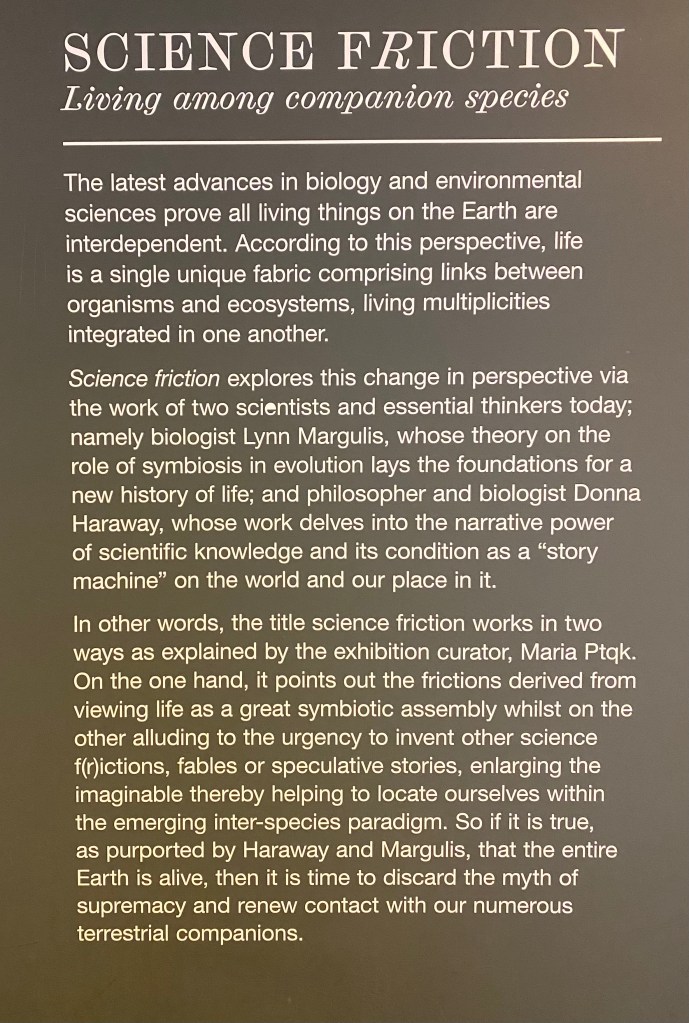
In the introductory information at the exhibition I read:
At the start I would like to highlight that the collaborative/connective aspects of the exhibition that I write about below, are mirrored in the genorosity of Maria’s sharing in the interview.
I began our interview by asking Maria how she came up with the idea for the exhibition:
…very soon in early 2000 I got interested in the internet. I encountered people like Donna Haraway and this movement called cyber-feminism, and people that were working at the crossroads of a critical perspective of science and technology and the arts. First the technological dimension was more important (for me), slightly opening my mind in a different way. First in a more Foucauldian way as social technologies (like architecture and language are social technologies, etc) and also thinking of technology in the realm of scientific culture; of culture in the sense of scientific imaginaries being part of our culture. This connects to the preliminary steps that took me to this exhibition.
This exhibition started from an invitation I got from Jeu de Paume in Paris which is a centre devoted, to the visual arts. They suggested I curate an online show for them, with a selection of artists. That was in 2016-17 – the last book from Haraway had just come out. I had been working on her previous work for my Ph.D which was about cyber-femininism. I took this invitation from Jeu de Paume as an opportunity to reflect on the last book of Haraway (Staying With The Trouble) – to understand it – not to illustrate it or explain it, but to understand it for myself.
Interview with Maria Ptqk. February 2023.
As Maria highlights, the exhibition builds on the work of two biologists – Lynn Margulis and Donna Haraway (perhaps we forget that Haraway is a biologist as well as philosopher). The title – Science Frictions plays with the fact that Margulis has her detractors, particularly the Neo-Darwinists, who have questioned her theory of endosymbiosis, the role of bacteria and the Gaia theory more generally. As well, Science Friction must call to mind Science Fiction – and the speculative fictional world that Art can contribute to, in which the human privileging of themselves over all other life forms is replaced, by our recognition that we are part of a cycle of life that is interdependent, and that if we have any role in respect of interfering with other life forms, our interference must not start with the question of how we will benefit from it, but rather, how we can support the subjectivity and autonomous rights of all life.
The second thing to say, after emphasising the post-humanist theme, is that the exhibition is beautiful. I was struck at the start by how it brought together works that would be striking alone, but in combination each work is enhanced by the other, and by the theme – the fact that we live among companion species is mirrored in the companionship of the works on show – I found this moving. It has a beautiful aesthetic, it is colourful, it is varied, it is curated beautifully. It has an exuberance, which reminds us of the beauty of the world. Finding a way to combine the aesthetic and the ethical regimes in art (Ranciere, 2016) is an aim to which I aspire, but I find it a difficult balance to achieve.
I selected a small group of artists and artworks that in a way would help me to address some of the topics in the book. These were not artists that were explicitly dealing with her (Haraway’s) work, or with that book, but resonated with it, for me. I thought if it resonates for me, maybe it can resonate for others.
The images I present from the exhibition are by no means a representation of this large collection – I understand from Maria that the Barcelona show, where the collection was first brought together, was even bigger. I have left out important works – for example, a video interview with Lynne Margulis talking about her work on bacteria.
I aim, instead, to choose work because it had resonance for me and my work, making a brief commentary about what caught my attention and why – continuing to intersperse my responses, with commentary from Maria herself.

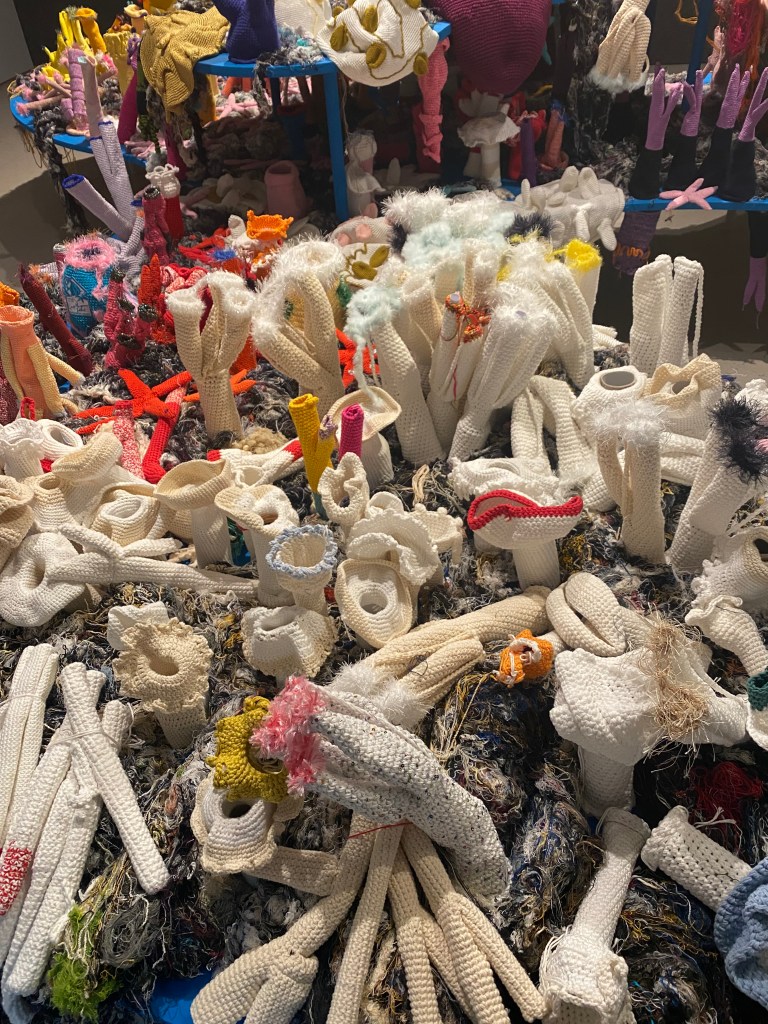
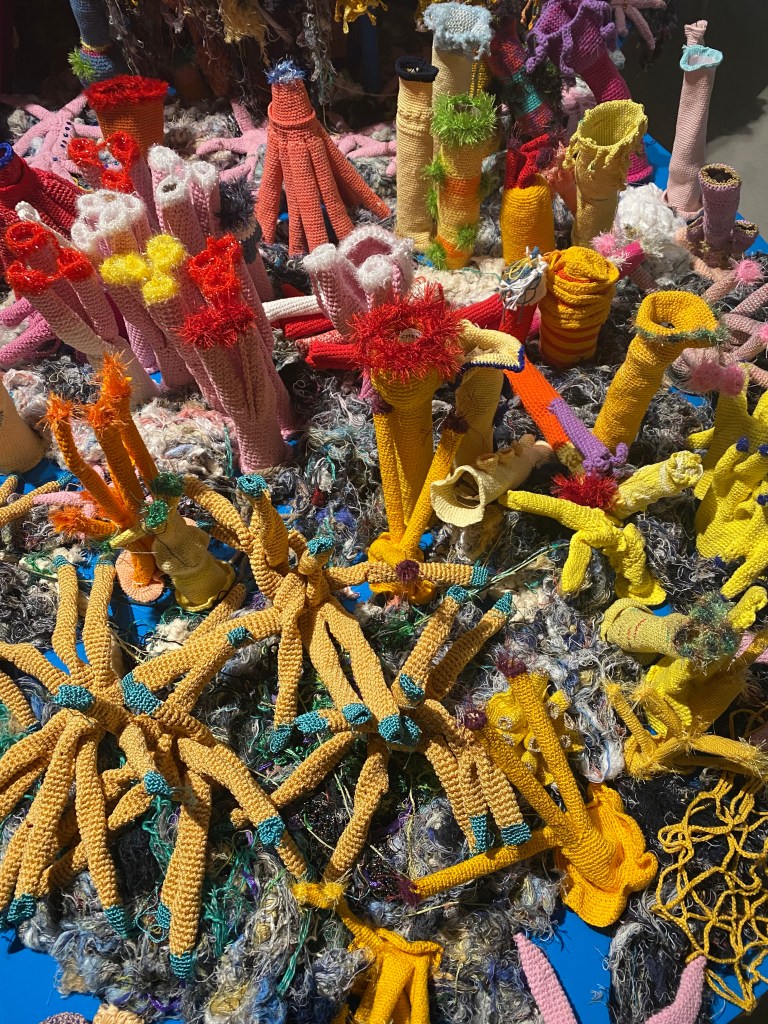
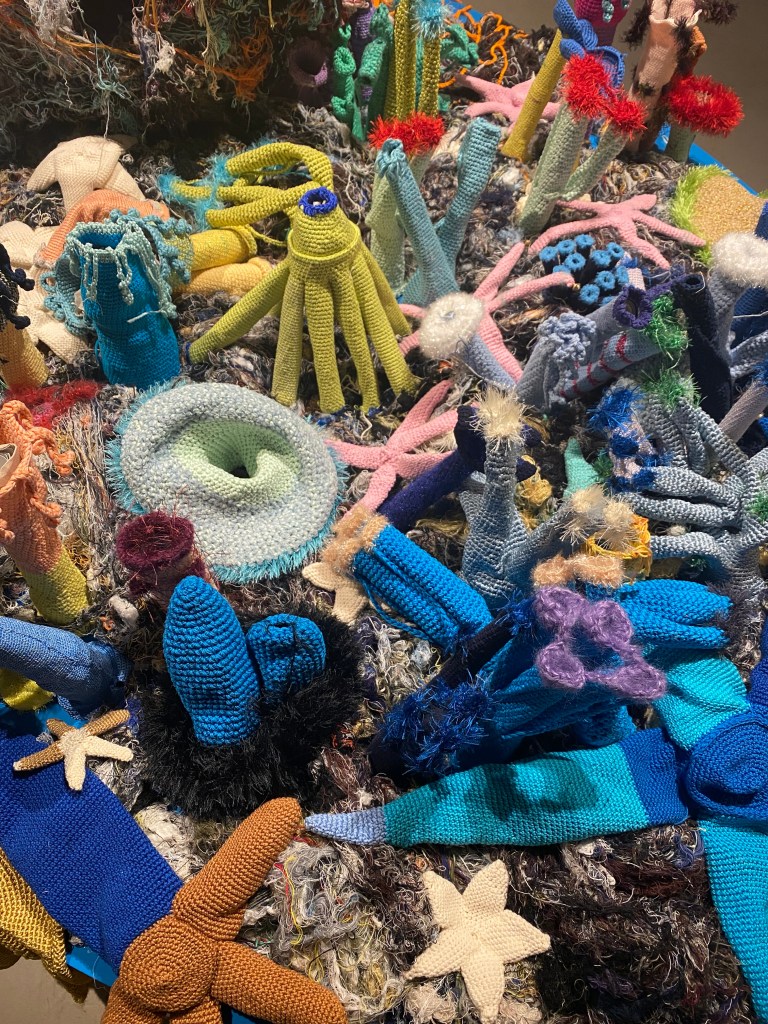
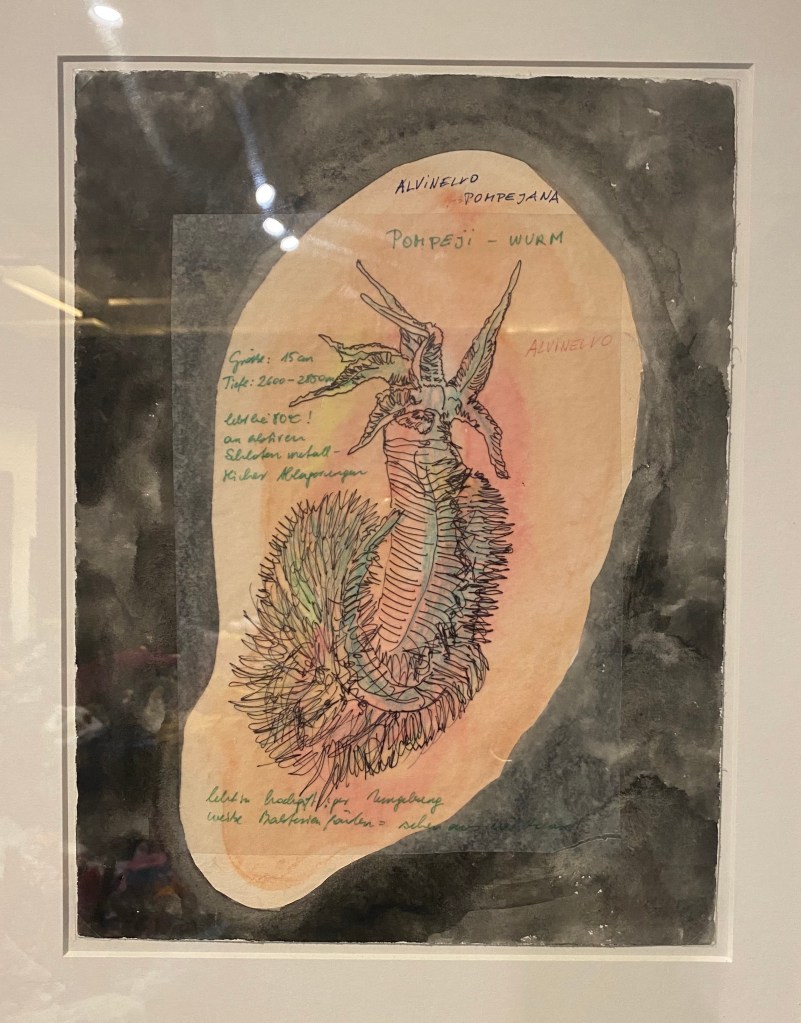
I focus on the installation made by Petra Maitz because of the ingenuity and patience/dedication it took to make a work that is so complex. I understand this has been a work in process for 20 years and I imagine it started life as a small installation that has been constantly added to. It is so effective in bringing our attention to the damage to coral reefs, home to many species. I like the drawings alongside the knitted works, and the text on the drawings. I read too, in the curatorial notes, that corals are a classic example of symbiotic association since they result from the union between the genome of coral and algae, which are responsible for its photosynthesis. It is the disappearance of the algae caused by acidification and warming, that results in the coral bleaching and death. The drawings describe the biology of corals.
I basically consider myself as a curatorial researcher, not an academic researcher but as someone who tries to look for materials, for inputs for inspiration.
Q: And how did you find the artists?
A mix of pulling threads. You are looking for this work and you find that. Artists that have been in your mind for a lot of time. Or sometimes you feel you need some kind of practice and you look for it in a more active way. Also the time – it’s a mix of serendipity and searching.
After the online show I had the need to put together all the research I had done that was not in the final online show. I looked for funding to write a book. That was a small book somewhere between a catalogue of an exhibition (there were many more artists), and a space to write a longer text that I needed for myself to make sense of all of it. I also invited three other people to write texts, also reflecting on the issues from different perspectives. The name of the online exhibition was ‘About and around the Chthulucene’ (approximate translation), and the book title was ‘Especies del Chthuluceno. Panorama de practicas para un planeta herido.’ (Gabinete Sycorax, 2019).
I chose the next work for its critique both of the battery egg industry and the biotechnology industry that ‘domesticates the reproductive capabilities of women’ in particular using hormone therapies to stimulate the ovaries for artificial insemination. Thus the work points to fellowship between the hen and the female human. I was interested in the background wallpaper – a clever repeated design showing hens and eggs alongside Fallopian tubes. The voice over on the television is basically an advertisement for the egg.
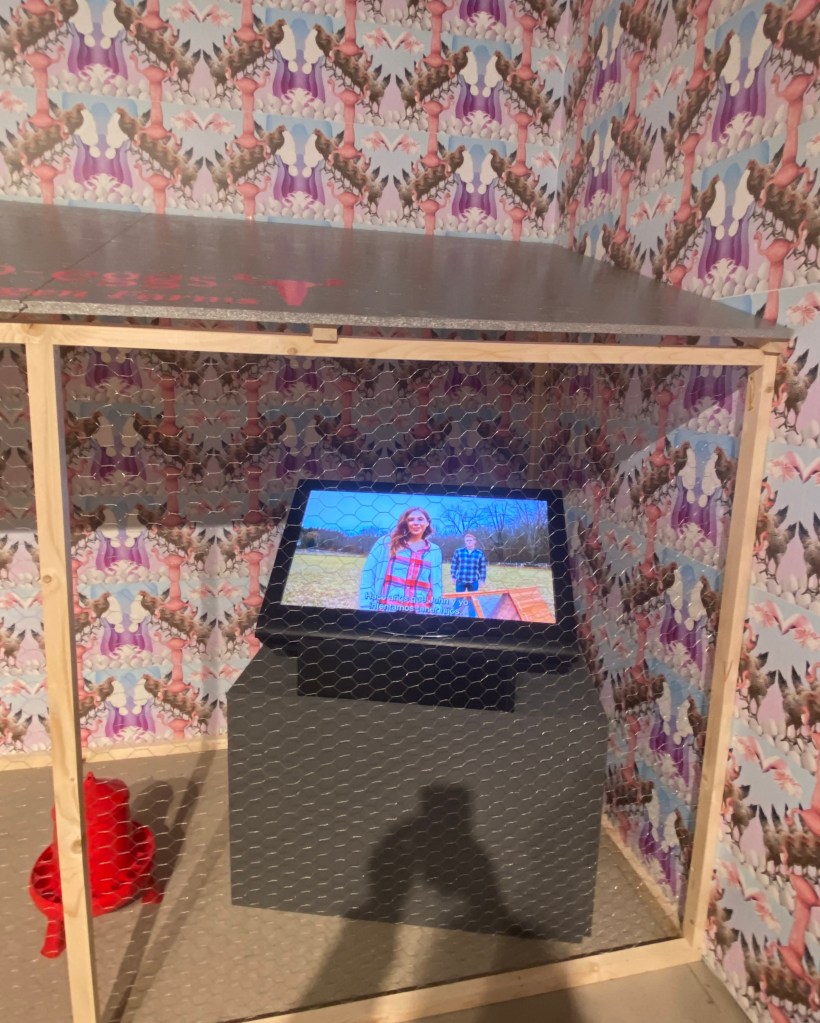
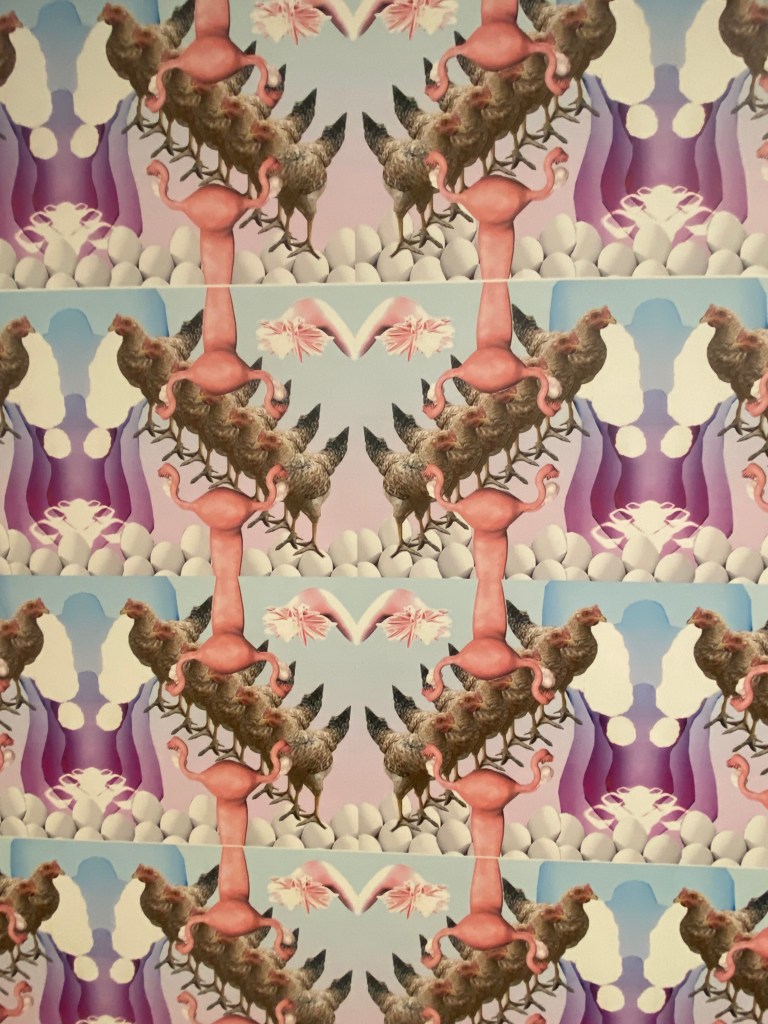
I was thinking of artistic practices but also philosophical approaches to species. These are the species of this ecosystem that evolves around this concept of the chthulucene. This is the book that got into the hands of Jordi Costa: the then, new, director of the department of exhibitions at the CCCB (Centre of Contemporary Culture, Barcelona). He said he had been following my work for a while and he invited me to turn this into a show in Barcelona. CCCB is a very important place. For me it was a shock and a challenge and a great opportunity to turn what I considered small research into a big project.
Q: You were doing it on your own?
Yes, because it was my research. It was my responsibility. You have to take responsibility for your work.
I am particularly caught, here, by Maria’s conviction that we must take responsibility for our work: I interpret this, for myself, to mean I must have confidence in my work, stand behind it, champion it. Trust that it is important.
In contrast to the two installations above, I chose these three black and white drawings by Ernesto Casero. I could not find information on the medium, but I think it is graphite. Ernesto imagines a political movement for nature’s rights which defends the non-human’s legal subjectivity. The messages are simple and clear, the drawing beautiful.
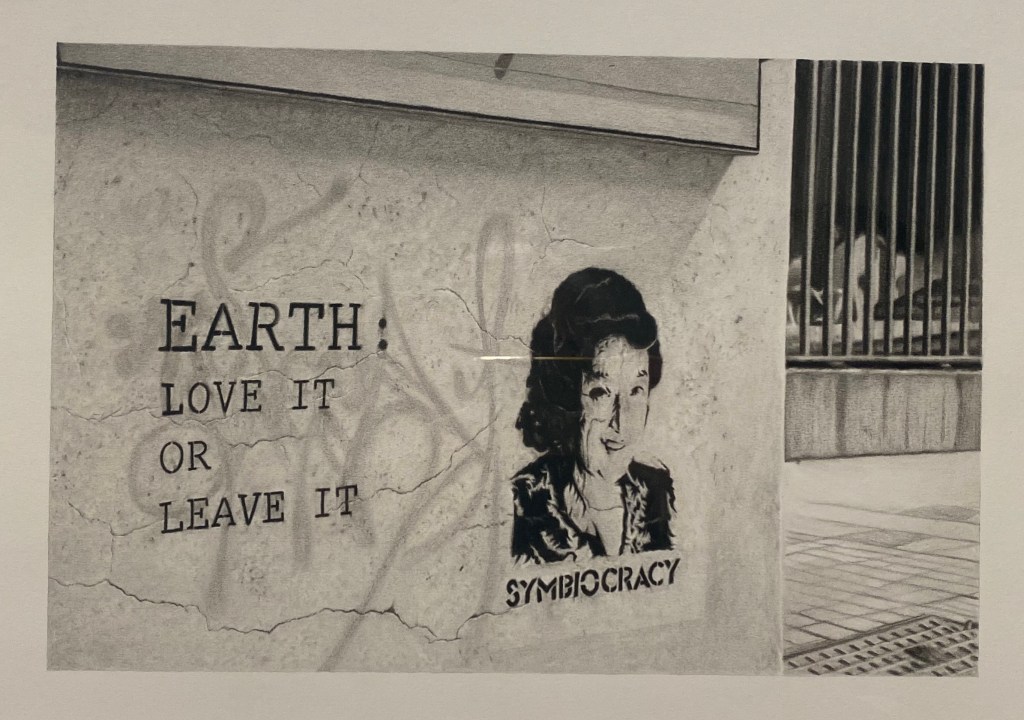


The notes accompanying ‘Posthuman Protests, 2018-19’ tells us that in it Ernesto Casero ‘makes a nod to the movement for nature’s rights, defending the legal subjectivity of the non-human’. Casero comments on ‘our incapacity to think about politics outside anthropocentric boundaries.’….’a social contract relegating the world to inert object status, must be replaced by a ‘natural contract’ open to post-anthropocentric whereby animals and vegetables, likewise rivers, mountains, valleys and ecosystems are protected by their intrinsic value regardless of their utility for humans’.
This was a much bigger exhibition and it worked very well for the audience and for the artistic and cultural media and critique etc. Of course it was personally satisfying. It was a surprise for me because I tended to think it was a niche exhibition and then it turned out that as a society this is what we want to hear about. It was the right time.
Q: I’d like to hear a little about your own interest and your own concerns/thinking in this area? For example when you put something like this together, do you have a question in your mind that you are trying to address through putting the exhibition together?
That’s one of the most difficult parts. I didn’t have a precise question in my head. I was very much moved by the work of Haraway and the questions that she had…it’s like you are looking in one direction and all of a sudden you need to look in a different direction, and I needed to pay attention to this new position that I was looking at. It was more that than a precise question or concern. Although of course these are collective concerns. From looking in that direction I started meeting other perspectives that helped me to understand better what I was seeing. I should also mention the work of Lynn Margulis which is also in this exhibition. It was more of an awakening of a form of sensitivity that probably was there in me before but I wasn’t aware of it. This radical shift of perspective in thinking, ‘So maybe us humans we are not the centre of everything’, and saying it like that now seems very silly for me, because now it is absolutely obvious, but it was not obvious before’.
Next I chose a series of beautiful ‘sculptures’ and drawings by Pinar Yoldas. She imagines organisms that might evolve from the micro plastic accumulation in the Ocean. The information accompanying the drawings tells us that the algae and bacteria in the ‘Great Pacific Garbage Patch’ (covering an area the size of Central Europe) are already starting to adapt and thrive. The organisms can metabolise plastics. Yoldas is professor in visual arts at the University of California and known for her work on speculative biology (she holds degrees in Architecture, Science and Fine Art). Her process merges hand drawing and sculpting with bio-engineering and digital technologies.

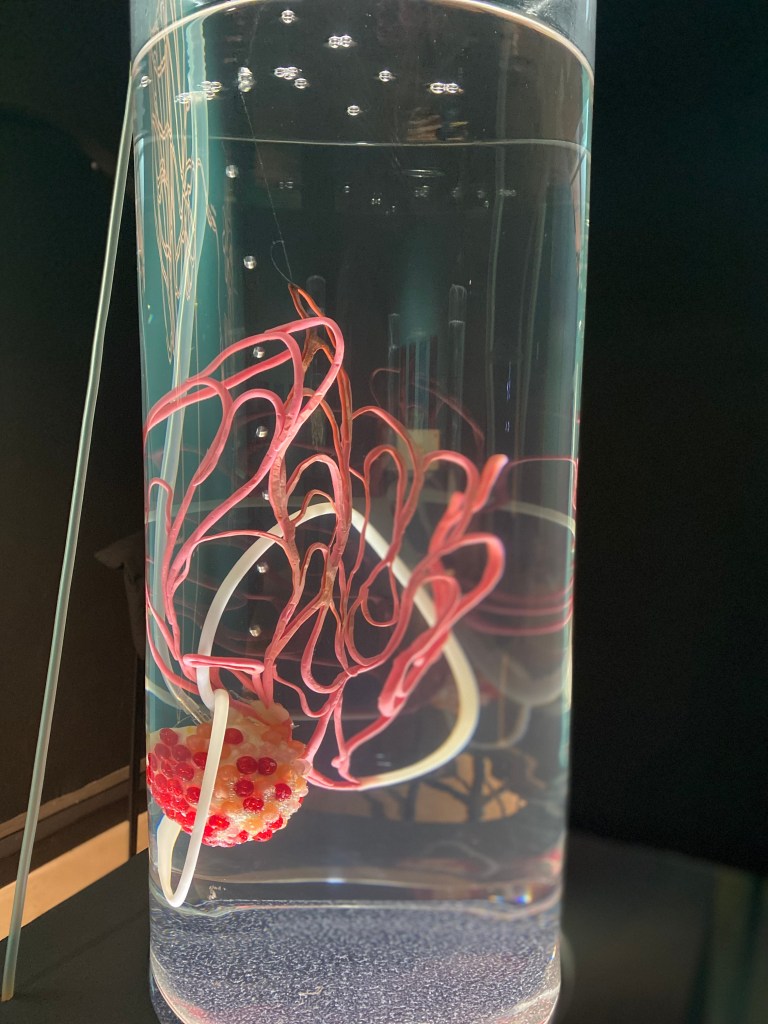
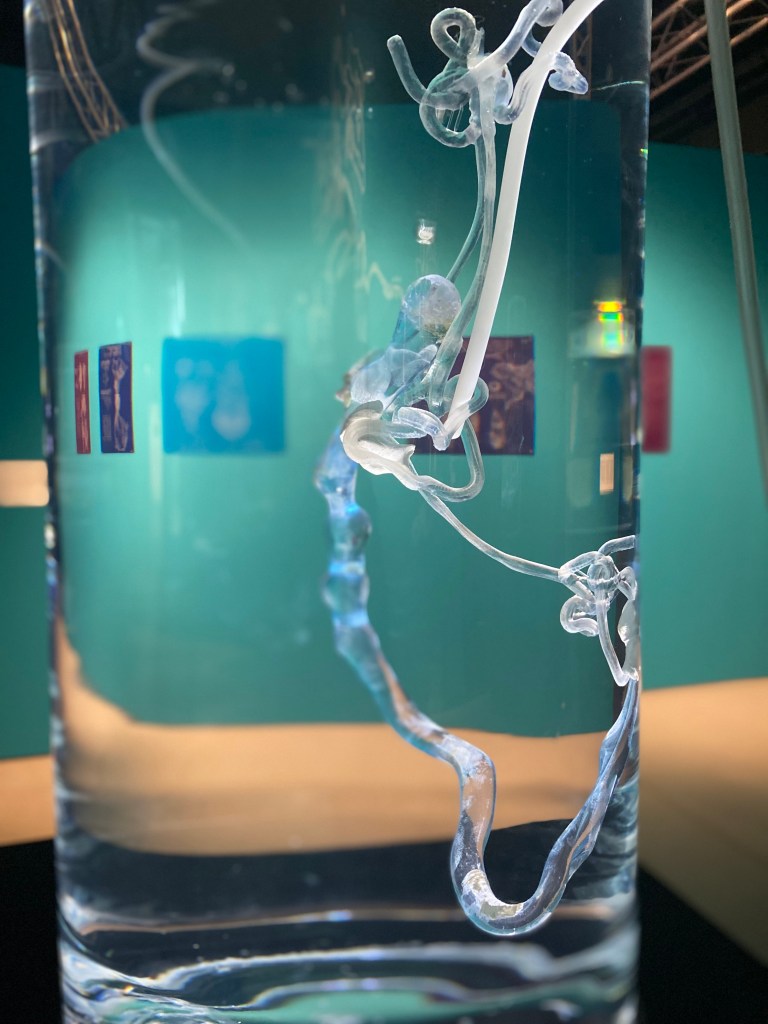


The movement that got me into this work was to pay attention to this new awareness and what it means. It means a lot. Let’s not be naive. We cannot change the whole way the world works. But there is a change in our perspective, as a society.
Q: I guess the fact you are able to put the exhibition on is one piece of evidence for that.
For me, absolutely. And the answer I got from the audience as well because I was very pleased that this exhibition has been appreciated by people from very different backgrounds, and very different experience of going to exhibitions, and for art practice – its not an exhibition for artists, or for professionals from the art world only. It’s an art exhibition but for me it’s like an essay for the present.
I love the idea of the exhibition being ‘an essay for the present’. I also think about who my work is for. I’d like it, too, to be for the public beyond the art world.
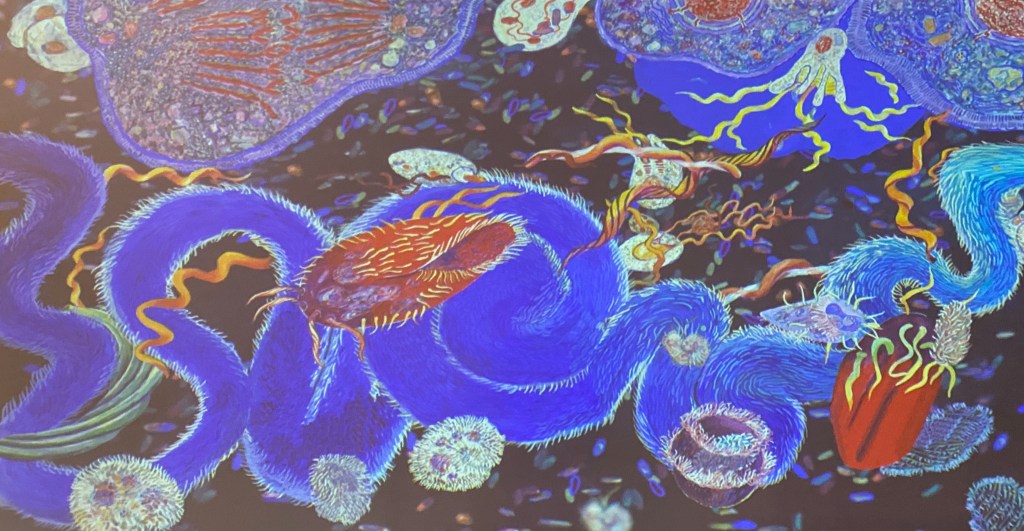
Below is a painting by Shoshanah Dubliner in a still from the animation made by David Domingo Barrios made expressly for the exhibition that pays tribute to the endosymbiotic theory of Lynn Margulis; that all life is connected through our bacterial origins which also created the atmosphere on Earth. This account proposes that the Earth is a living system kept in balance by the organisms that live on it. This is contrary to the neodarwinian theory that evolutionary changes arise instead from competition between independent organisms. ie a Margulis proposes a collaborative view of life rather than a competitive one. More and more people now recognise that the competitive ethos adopted by humans is bringing us closer to chaos and disaster. Barrios’ vision of the collaborative micro bacterial world is stunning, in my view.
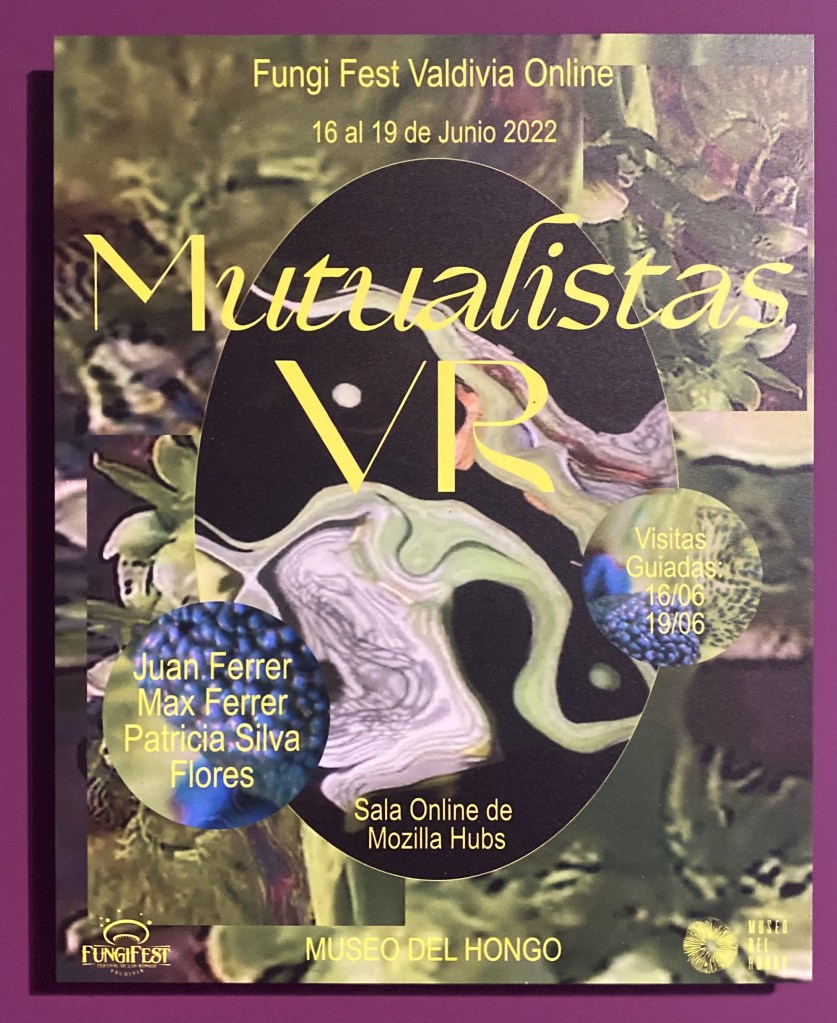
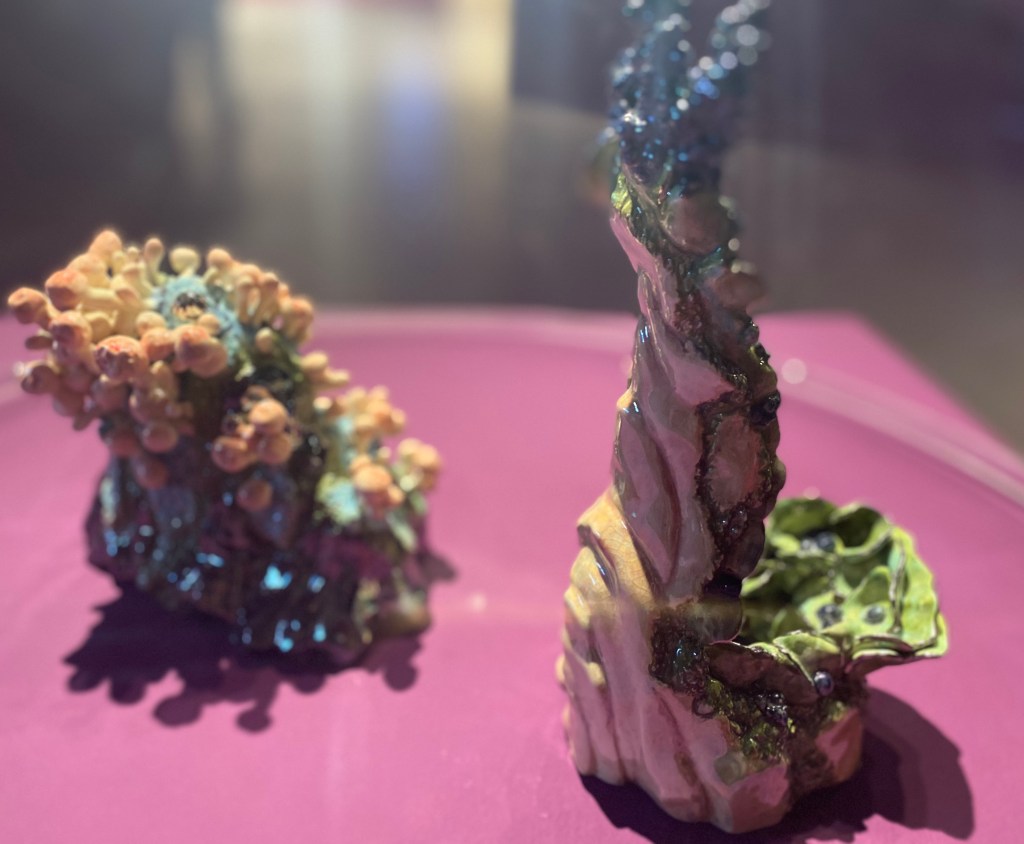
The ‘Museo del Hongo’ or Museum of Fungus is a collaborative online festival curated by Juan Ferrer. Several of the covers from different years were shown in the exhibition. The notes explain that there are two types of fungal symbiosis: mycorrhizae and lichens – the first, meaning fungus root, is a symbiotic fungus and fundamental to the history of evolution. Lichens are the result of symbiosis between a fungus and an alga and are themselves a miniature ecosystem hosting as many as five other species. Fungi can regenerate matter and acquire nutrients and are therefore ‘champions of survival’ (exhibition notes).
Jordan Castillo’s interest in different lichen is also evident in the ceramic sculptures below:
It (the exhibition) is a toolbox for the present. To help us make sense. So it’s not that I am providing answers. I am trying to make sense of my own concerns which are not only my own. So yes, it has changed my view on the world, but then how does it translate into action? In the exhibition in Barcelona there was a final chapter devoted to the Rights of Nature, which is not so visible here. That is recognising political but also legal subjectivity to ecosystems, It’s not really present here because I could not make it all fit. The exhibition in Barcelona was organised into chapters more clearly, like a museum of Natural Sciences, kind of. So after displaying all these perspectives, for me there was the question of ‘now what’? What happens when we look into the world like that. Recognising political and legal subjectivity to ecosystems. So not to a landscape, but to a political ecosystem, for example a forrest. It’s an ecological perspective. So it’s not the right of this tree not to be cut. It’s the right of the forrest to exist as a whole, and it also includes the human people who live in the forrest. For me it was very important to have this last chapter because it opens the path a fraction. And it is a tool that is already existing and working in reality. Not that all the experiences with the Rights of Nature are successful at all, but it’s a start. Human rights took centuries and we are still far from being done with that. Tiny, humble, but still small victories for me are important.
The exhibition included a display of texts, as well as music, that are concerned with the life of plants. At the bottom of the photograph below is the album cover for Stevie Wonder’s album, used as the soundtrack by film maker Walon Green , in turn inspired by the book ‘The secret life of plants’ written by Peter Tompkins and Christopher Bird in 1973. The latter includes studies of plant life that challenge the perception that plants are insensitive.

There is of course a concern for ecosystems here, and a call for action. But I am very aware that social and political changes take a very long time and are a collective work and an exhibition is not going to basically change anything.
Q. It might do. I was going to ask about what you have learned from the exhibition?
I got very interested in the microbial world and understanding that of course we are part of nature. At the end of the day we need oxygen. Oxygen which is produced by trees and bacteria. So one thing I learned is to look at ecosystems and not at particular forms of living beings only, to broaden our idea of what are living beings and how we are made of microbial communities. What is a living being – the soil is a living entity – what we are doing to the soil – we are killing the soil. Another important thing I learned is that when it relates to ecosystems it is practical knowledge that is useful.
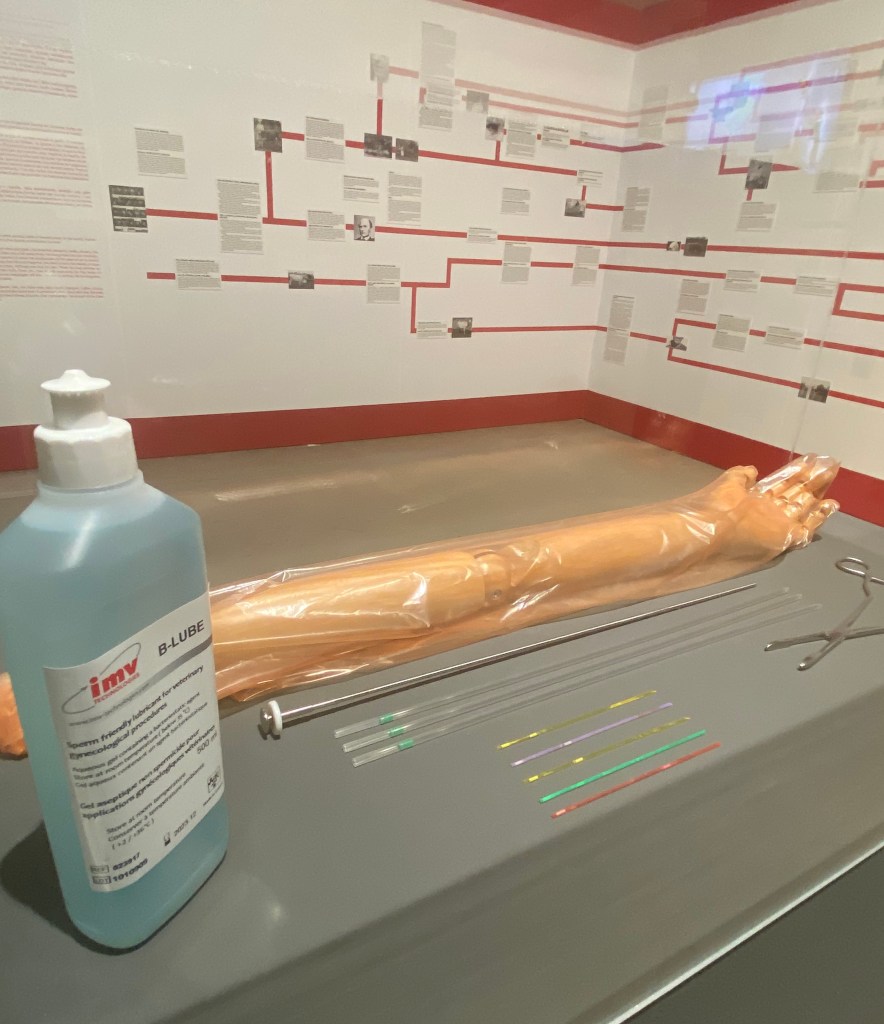
A critique of post humanism, by writers in the Critical Animal Studies field, is that while it theorises the connections between all life, it is silent on the rights, treatment and exploitation of other animals, and does not speak out about actions to end this: it is a theoretical and descriptive approach rather than an active and campaigning one. I have noticed that much art taking a post humanist stance focuses on the land and plants, rather than also on other mammals, and so was concerned that Science Frictions might take the same line. However, I was very glad to be wrong: Science Frictions includes works that recognise human cruelty. See the installation below: ‘The Museum of the History of Cattle’ by Gustafsson and Haapoja. Here, along side the ‘history’, they bring to public view, in an art gallery, instruments of artificial insemination in cattle. The long object, that looks rather like a bread stick, is actually a human arm, that is pushed into the cow’s vagina to insert a semen straw – at the front are the straws of semen from different breeds of cattle. I feel that to make this violence visible, in an exhibition with this focus, is an important and courageous move. Visual artist Terike Haapoja, and writer Terike Gustafsson, explore problems that arise from the anthropocentric world view of Western traditions.
Q. Could I ask you about the connection that you see between Margulis and Haraway?
Haraway’s work could not be possible without previous Margulis work, because she was the one that put together the contemporary vision of symbiosis, which very much informs the work of Haraway. And she makes that very clear in this last book. And then you understand it more when you go deeper into each other’s work. Haraway takes it more from a philosophical perspective, even though she is also a biologist. On the contrary Margulis was a microbiologist but the kind of scientist who is very much aware of the implications of science in how it frames and shapes our understanding of the world.
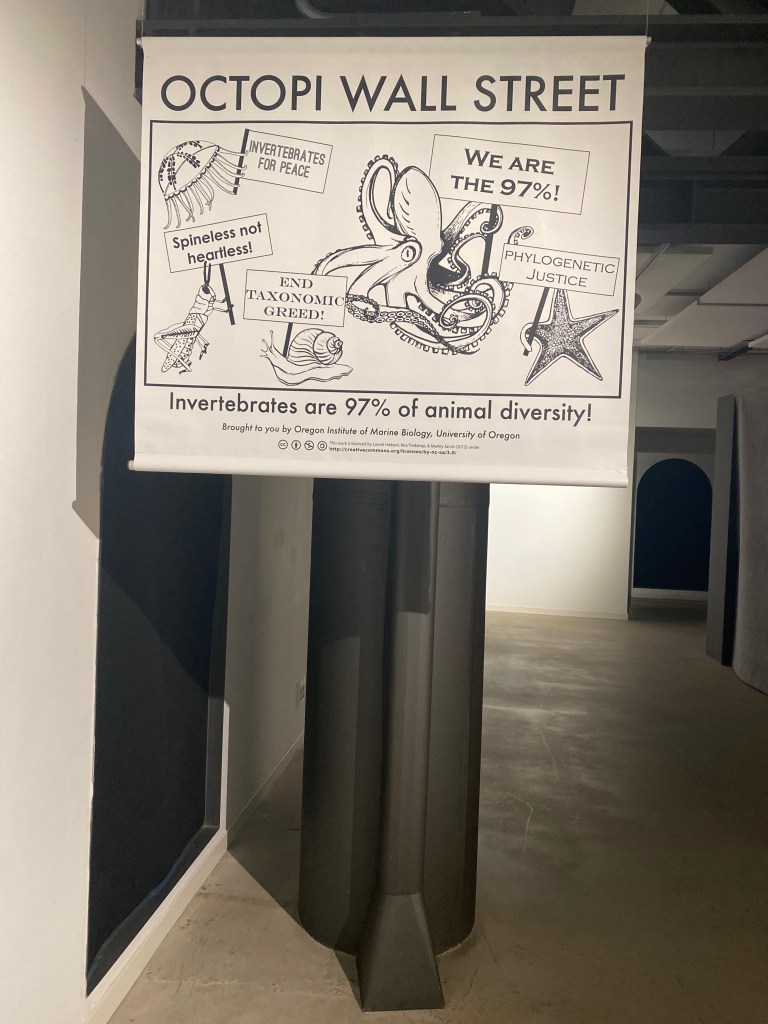
I enjoyed the humour of Octopi Wall Street. These flags criticise the anthropocentrism of classifications of the natural world. Originally conceived as a campaign to raise money for the Oregon institute of marine biology, these flags were designed by former students of the institute, Laurel Hiebert and Kira Treibergs with artwork by Marley Jarvis.
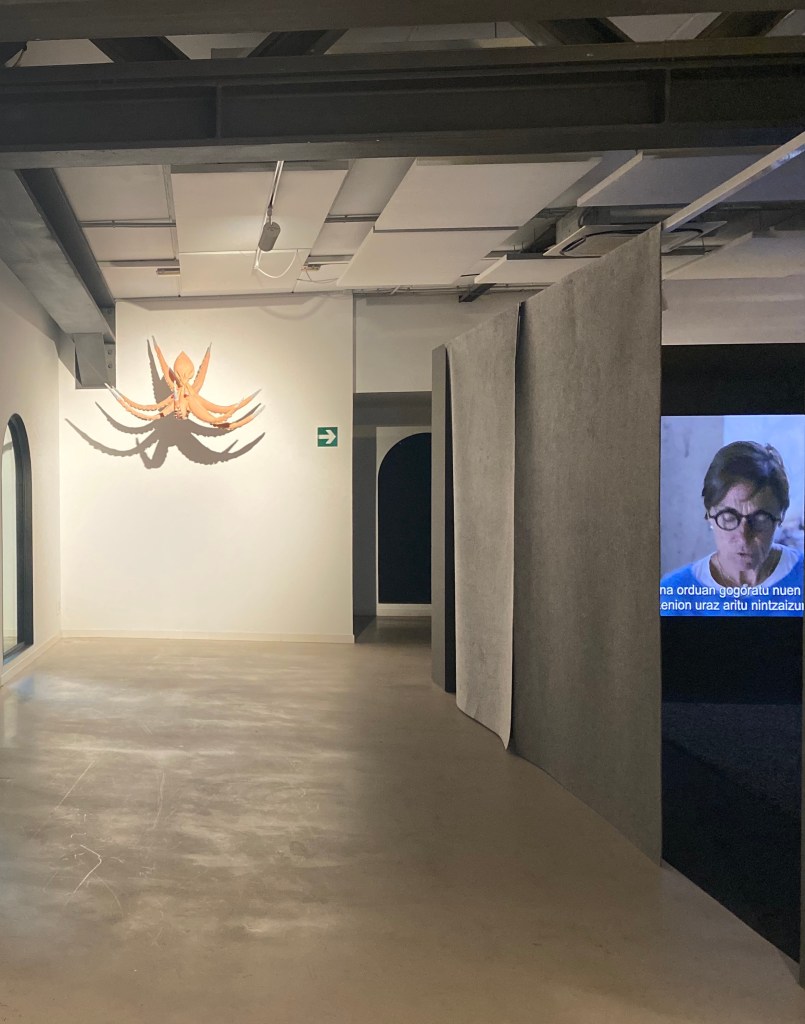
Q. Let’s talk about the exhibition specifically. Is there any aspect that you are particularly pleased with, or on the other hand, that you would like to have made stronger.
I see it as an overall work. What I am more pleased about with the exhibition is that I have managed to make a synthesis, to connect the works one with the other. At least I tried to do it and the answer I get from visitors is that it works. For me it is more about the connections. It’s not so much about particular art works but about the whole idea. It’s true that as a curator you have to find the right balance between your own statement and these connections that you provide, and give space to each artwork to have its way and its space and enough space around – not only physically but also conceptually to display all its meanings. So this is a difficult balance that then implies decisions that have to do with the design of the space, lighting and things like that which are scenographic, which is not only conceptual work that you can do on paper, but that you have to translate on the space. You have to think of size, and space, and light and materials. I started this work in 2017 and it has had different phases. It’s not like I put a concept and a list of artists on a piece of paper and that’s it. All this universe has been with me for five years: online exhibition, shows, podcasts, writing a book, talking about it – at the end it’s a totally different body of work. There is a process of metabolism that is like when you are cooking a sauce . This is the result of time. And that connects to the whole economy of the art production. The economy of art production is fast. We have to produce things fast. We have to make exhibitions very fast. And jump from one subject to another because of funding. Part of the success of the exhibition is because I managed , or I had the chance, to navigate though the circumstances that gave me the time to have this metabolisation of the process.
Susana Talayero (below) presents an installation that evokes the work of the naturalist Maria Sibylla Merian (1647-1717), the first entomologist to document the life cycles of insects and the dense networks of connections between insects and flowers. Her mediums include ‘ink, watercolour, plastic, wax, rubber, resin, paper, and supports intended for other use, combined with waste and processes of deterioration.’ Maria Sibylla Merian was the first person to document in details the lifecycle of insects and the first to document the flora and fauna of Suriname, along with the names and usage of plants by the indigenous people.


Q. Now would be a good time to ask you about your future plans for the exhibition?
The exhibition is not showing after Bilbao at the moment, which is a pity in a way. But for me personally it has been a very intense personal and professional cycle. It’s good to end for the moment. I don’t want to rush into another project. In the sense of this particular research, I need to let things simmer.
Q. Is there anything else that you would like to say in relation to the exhibition that you haven’t been able to in this interview.
Maybe I’d like to know about your take or what you liked most. I would be pleased to hear about your feelings.
Me. I felt very affected by it. It’s interesting to ask why. I think it’s because in London and on my MA course I’m not in touch with, or aware of….it doesn’t mean it’s not happening…I’m not aware of a focus on the things that to me are so important at the moment. You would think your exhibition would be everywhere at the moment. The exhibitions I go to are often apolitical. Most of the work I see is still to do with exploring issues like personal identity and I am quite critical of that. The political work that I do see is often about issues to do with racism. Again it’s not that I think that is unimportant, it’s that I’m interested in intersectionality, and all these things are connected. The work you are doing is connected to racism, it’s connected to gender – and the underlying issues seem to be ignored in the UK – in my experience, and I might be wrong. So one of the things that moves me so much is that it seems comes right down to some of the basic problems, and that’s literally you’ve got Margulis on the beach talking about bacteria, and how that connects to all life. I’m always interested in what’s beneath …this exhibition seems to be getting at some of the very basic issues of how we are all connected. Rather than the emphasis on the ‘other’. That’s my biggest concern really – that we don’t really ever seem to get at the very basic thing which is that we think we are separate. And we are not separate, and once we come to understand that we come to think about how we treat the other as we would like to be treated. And the ‘other’ is everybody, including the soil, the sheep on the farm. I think your exhibition gets to some really basic questions about how we perceive ourselves as human beings. And how we perceive everyone else in the world. And how we perceive ourselves as being better than, superior to, and therefore we can abuse the world. I think the exhibition is really challenging those ideas.
Maria: I think of myself as a vector. I just put together ideas that other people are elaborating in a more sophisticated way. I am like a transmitter.
Below is a still from the film ‘Camille & Ulysse: Extracts from the Journal of Symlinguistics (2021) ‘ 2021 directed by Diana Toucedo. The film is based on the fictional works of philosophers Vinciane Despret (Autobiography of a butterfly, 2121) and Donna Haraway (The Camille Stories, Staying with the Trouble, 2016) who also lend their voices to the film. It follows the protagonists of the philosophers’ tales, Camille and Ulysee, as they navigate living on a planet undergoing massive extinction as members of the first generations of humans living in symbiosis with a species (respectively, the monarch butterfly and the octopus). It is filmed as an oral-tale and correspondence between two narrators.

Q. We haven’t really talked about the art works. As someone who tries to make art I was interested in how people have responded to the issues. There’s some fantastic works. There’s a lot to learn for me as an artist. I like the different ways of looking at the problem, using drawing, ceramics, fabric, digital works. The material used are often materials that themselves are not damaging to the environment.
M: I wanted to show different artistic practices. I didn’t want to use a lot of big screens, which are unsustainable because of the materials you need to build them, and part of an economy based on planned obsolescence, so we are producing and throwing out. I didn’t put a very strong limit on that. Everything is unsustainable. Artistic exhibitions are not sustainable – this exhibition was only on for three months and that is unsustainable.We have to rethink the whole production of everything, including in the art world. Which I didn’t do for my exhibition, even though I tried to have some good practices. I’m not very optimistic – our grandparents went through the world wars. That’s the war of our time – it’s the environment.
To summarise, beyond its essential concern with the survival of life on earth as we know it; what I particularly like about this exhibition is that I came away from it having learned a lot about science, as well as being immersed in many visually engaging works. The information alongside each work was short, but clear. Perhaps this is what is lacking for me in many contemporary art works that I see – when I talk to the artists and understand what their concerns are, I am invariably inspired, but usually the artist is not close by to explain to me, and usually there is no accompanying text, and sometimes not even a title. I think it is important that there is – text and visuals are another two companions that need not be separated. I also learned so much about how an exhibition of this breadth is put together and the importance of research, and time to develop ideas and connections
3. MILK. Exhibition at the Welcome Collection, Euston, London. 29th April, 2023.
I was curious to visit this exhibition, especially following my visit to the exhibition at Welcome, ‘AIR’ in 2022 – I thought AIR excellent. Milk is an interesting fluid to focus an exhibition on – the food produced by every mammal to feed her child, and tied up with concepts/actions such as love, nurture, empathy, femaleness, mothering, exploitation, abuse, embarrassment, shame, guilt, and killing. Some of the issues I raise below could seem a world away from Fine Art. However, any visual work I make relating to social justice issues must be informed by an understanding of the context: particularly the economic context which all social justice issues are essentially tied to.
I wondered, beforehand, how the ‘story’ of milk would be approached, and what message I would come away with. Would it tell the story only from the human angle, or would it also explore the cruelty involved? Would it be neutral – telling both sides of the story? And what kinds of artefacts would it use to tell the story of milk? To what extent would the exhibition itself continue the violent iconography toward ‘dairy’ cows? These questions all relate to my interest in a post-humanist and critical animal studies approach to thinking about how art can disrupt the violent iconography of other animals, and specifically farmed animals. I wondered whether I would come away wanting to make an ‘alternative’ MILK installation, and if so, how would I approach this?
It feels important to first ask about the history and interests of any organisation that is involved in a public presentation of iconography.
A quick search to find information about The Welcome Trust uncovers that it was established in 1936 with legacies from the pharmaceutical magnate Henry Wellcome, with the aim of funding research to improve human and animal health. Also I discovered it is an ‘independent charitable foundation’ funded from an investment portfolio that currently stands at £37.8 billion. The web site continues by stating their investments have:
… enabled us to spend more on science to solve the urgent health challenges facing everyone. We’re now planning to spend £16bn over the next ten years to support new discoveries in science and health, and to help find solutions for three of the world’s greatest health challenges: climate change and health, infectious diseases and mental health.
It is interesting to find that the impact of climate change of health is mentioned as a priority: the agriculture industry generally, including the dairy industry, has an enormous impact on climate change, and the broader problem of environmental degradation – I would therefore expect the exhibition to explore the impact of milk production on this.
A little further digging brings to light that the Welcome Trust is tied in with the pharmaceutical industry, although their portfolio of investments have diversified into stocks and shares, venture capital and private equity, and so on.
The original source of our funding was a bequest left by Sir Henry Wellcome on his death in 1936. For the next 50 years, we were the sole owner of Wellcome Plc, the pharmaceutical company founded by Sir Henry. Dividends from the company funded the charitable grants we made for research.
In 1986, we decided to diversify by listing and selling shares in the company, which was subsequently bought by the pharmaceutical company Glaxo in 1995.
Given this history, it is difficult to see exactly how independent the Welcome Trust is, particularly in relation to pharmaceuticals. It is difficult to discover how much the pharmaceutical industry makes from the dairy industry – I searched for some time but came up with nothing. I did find mention of various drugs used in the diary industry – the most common seems likely to be antibiotics for mastitis (cows frequently get this udder infection), as well as mention of Boivine Somatotropin (a bovine growth hormone to increase milk production), vaccinations e.g. to prevent abortion or viral Diarrhoea. I read that new drugs are being developed to prevent stress and anxiety in cows. Clearly the pharmaceutical companies make huge sums of money from farmed animals.
Given this background I feel that the curator/s must be constrained with regard to how critical they can be.
With regard to the first issue of the impact of the dairy industry on climate change and environmental destruction – there is no mention. The exhibition focused on both human milk and non-human milk. For me this felt rather odd since the issues are so very different. The focus regarding non-human milk was on how, historically, milk has been ‘sold’ as the most complete and healthy food. There was some material on changes in the dairy industry and the push for farmers to farm more intensively – getting more milk from each individual cow – as profits for farmers fall. I know this to be true from growing up on a dairy farm, and hearing from my brother: returns for dairy farmers are very low indeed. There was also some information about the milking process.
With regard to human milk, the issue of sale of human milk was raised – apparently this is on the rise. Apart from this, I am not really sure what the exhibits relating to human milk were about – there were several disparate messages, for example, the sense of loss a mother may feel when she stops breast feeding.
I also felt that the obvious, to me, comparison between human and non-human milk production was totally missing – this is that ALL female animals, including the human animal, produce milk to nurture their own young. Feeding their young is an act of love, nurture and care for the mother. It is the most loving thing a mother can do. Stealing the milk from a cow, and removing her baby from her is horrendous for the mother cow, as it would be for female human. Milk is produced for the young, until they are old enough to get nutritional from other sources.
The exhibition made no mention of who cows produce milk for; that milk production depends on the baby being taken away at birth; that cows are forced to continue milk production by daily milking; that cows are forcibly impregnated or raped annually so that they have a calf each year; that if cows do not have a calf they do not produce milk; that the calves, if male, are fattened and slaughtered at about 10 months; that if female the calf very quickly is forcefully inducted into this cycle of impregnation, loss of baby, continued milking. Nor did it make mention of the common problem of mastitis because of this over-milking, anti-biotic resistance, botulism, bovine tuberculosis, foot and mouth disease, Johne’s disease or many of the other common diseases that dairy cows are prone to in the crowded and increasingly factory-like milk production industry. Nor did it make mention of questions now asked about whether milk really is either necessary or good for humans after infant hood. As the school of public health, Michigan university informs us:
The bottom line is no, dairy products are not a nutritional requirement for humans. We can get all of the nutrients for optimal health from a high-quality diet that limits or contains no dairy.
https://sph.umich.edu/pursuit/2019posts/cows-milk-human-health.html#:~:text=The%20bottom%20line%20is%20no,limits%20or%20contains%20no%20dairy.
Given these incredibly important omissions I have to conclude that the exhibition was biased. I also have to conclude that alternative visual work on MILK is needed, and this could be the focus for my next work. I can imagine, for example, another site specific installation – in this case the site would not be the building in which the work is exhibited but the ‘site’ of the Welcome MILK exhibition itself – it would be a ‘response’ to this.
In the remainder of this report I present photographs of the exhibition with critical commentary.
There was much focus on the historical advertising of milk as a cheap, healthy, whole and pure food for the whole family, and on milk as being central to UK welfare schemes:
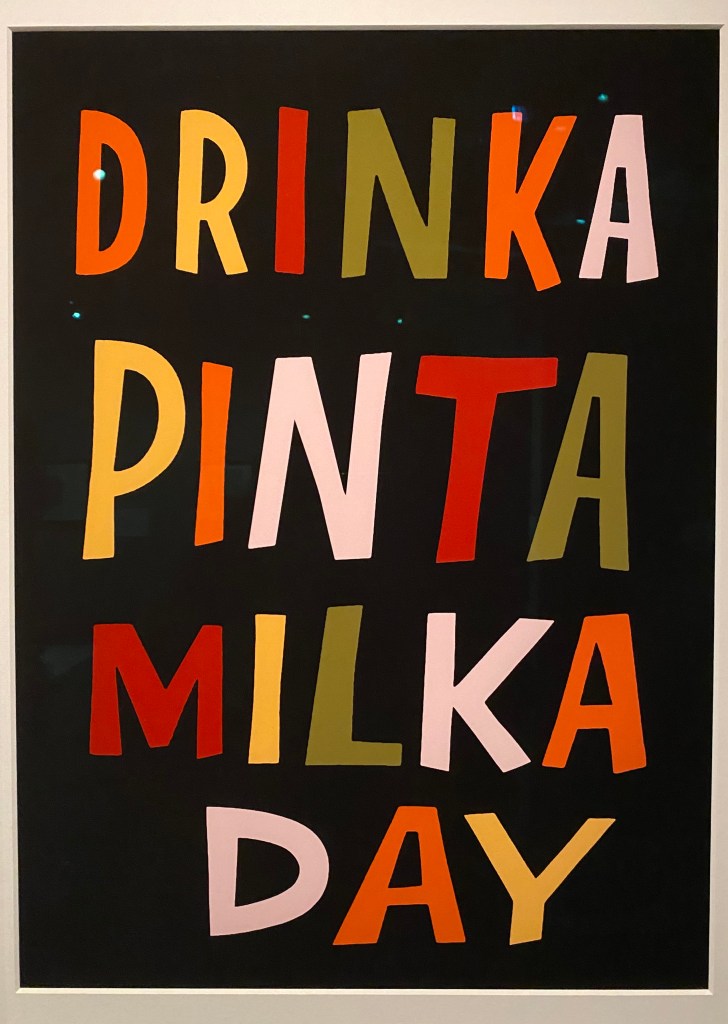
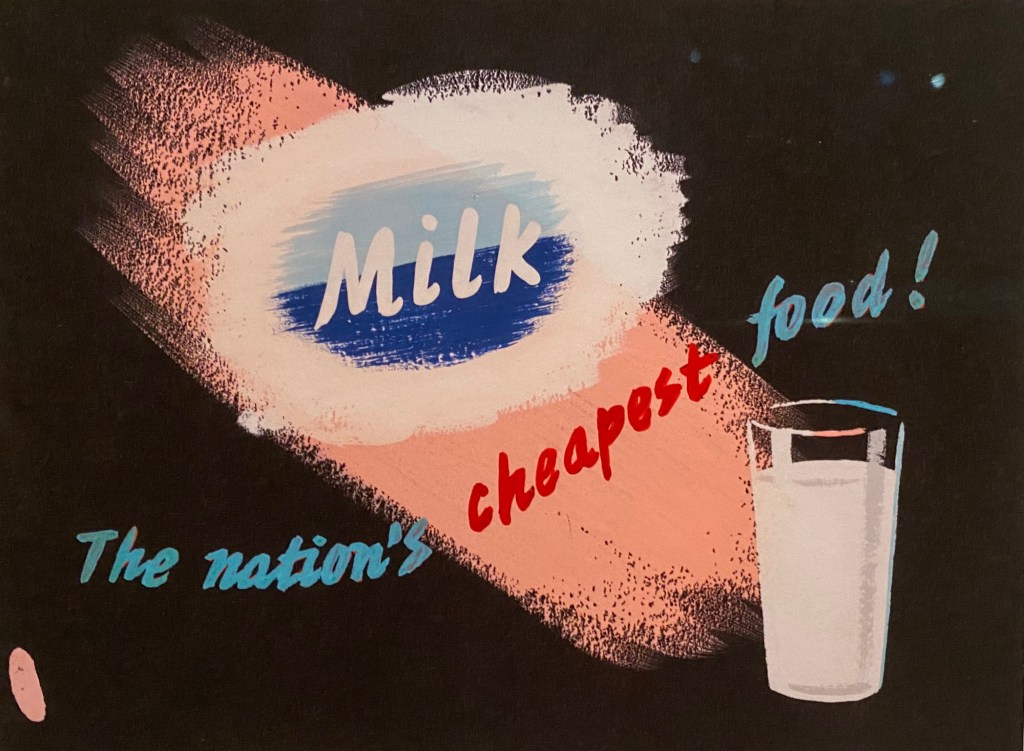
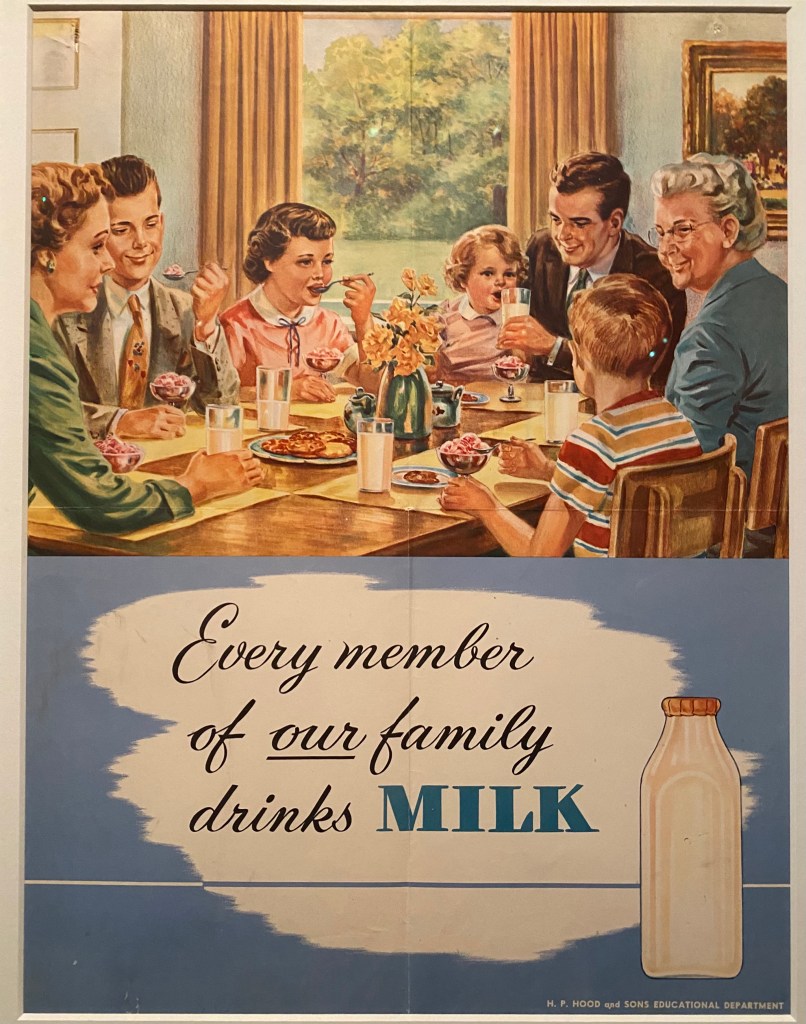
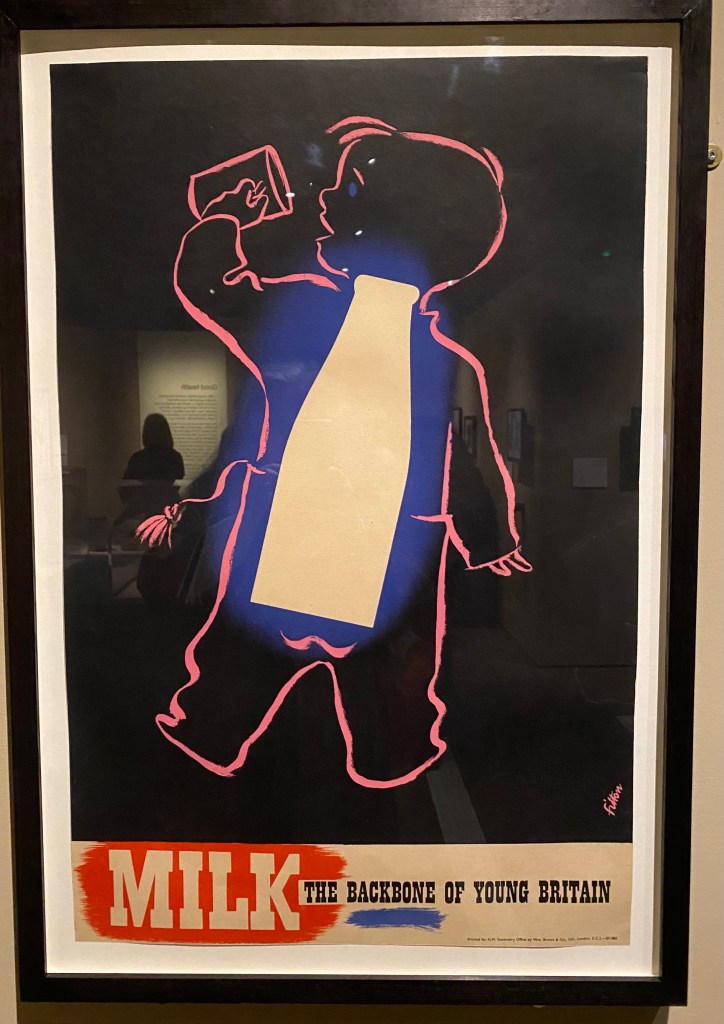

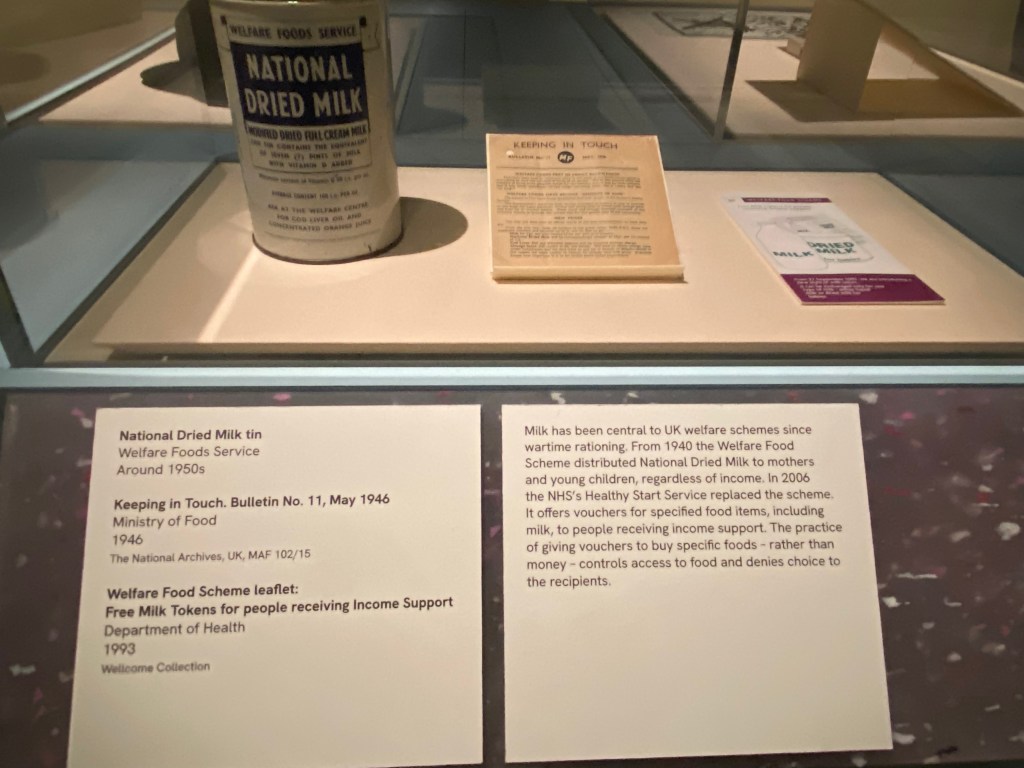
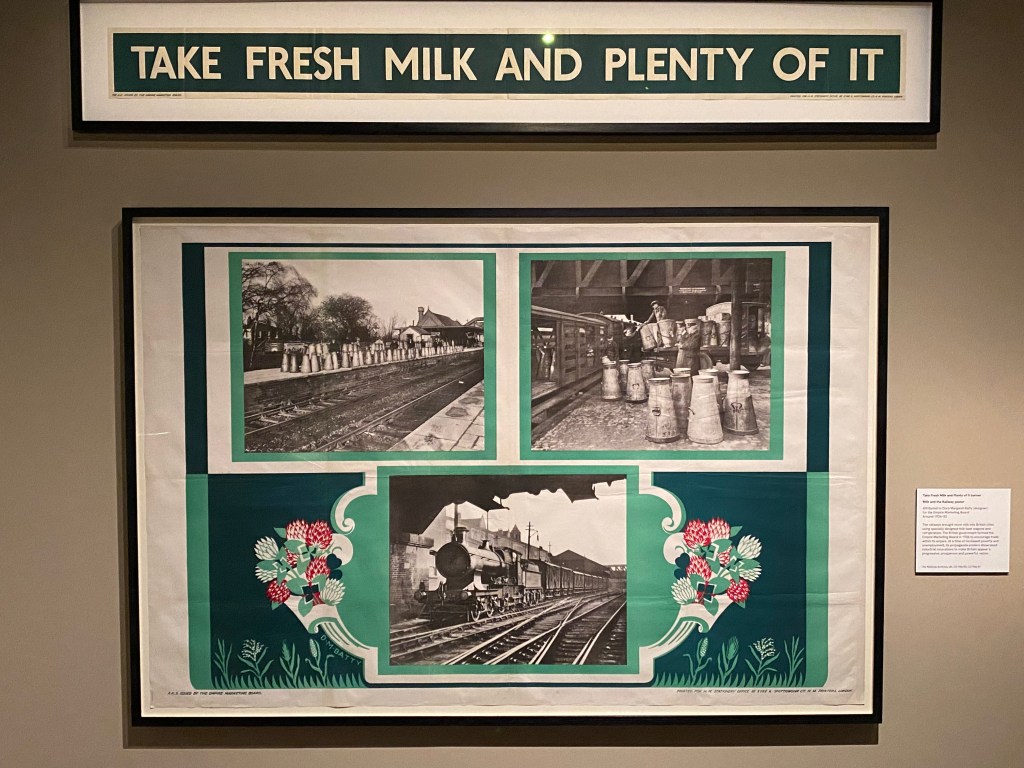
The idea that milk is necessary to a healthy diet was never directly stated in the exhibition, but I wonder whether all this iconography might perpetuate the idea that it is. All the emphasis was on the historical pushing of milk. Here for example is a photograph of the weekly rations for two people during the Second World War in 1943. It includes 7 pints of milk ie. half a pint of milk a day per person:

There was also some attention to the idea of milk being sold as ‘pure’ and ‘safe’:
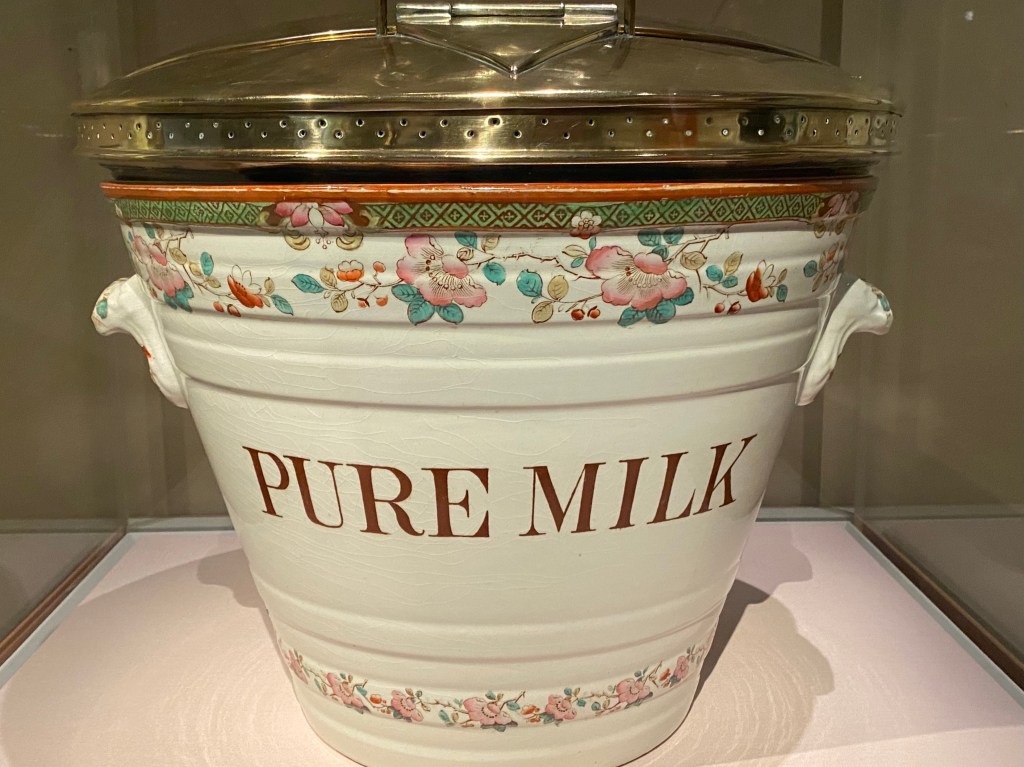
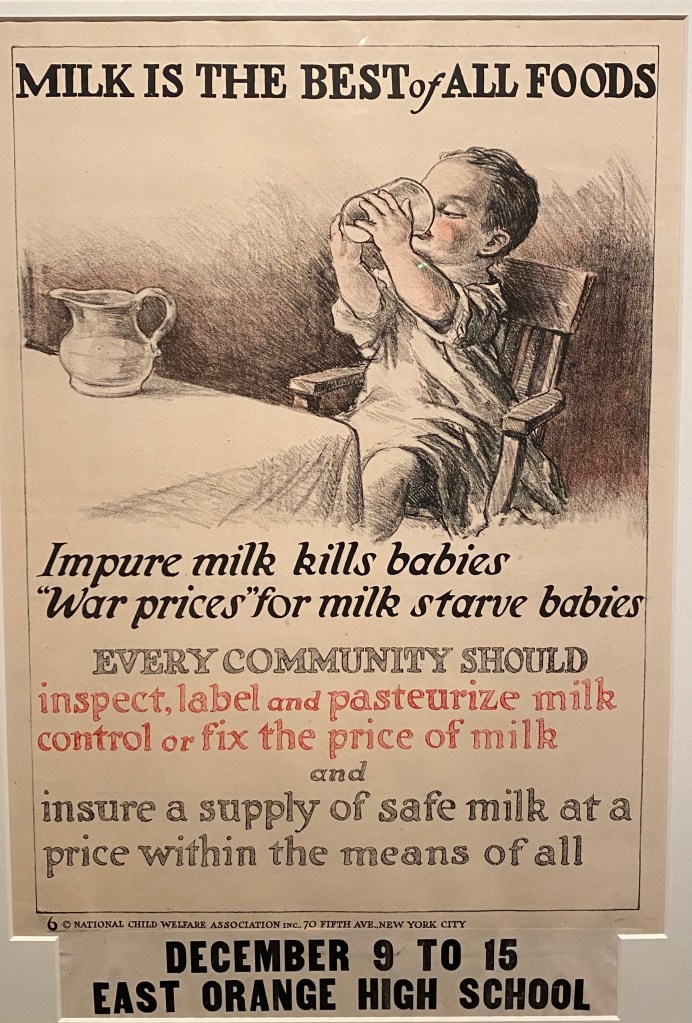
The idea of ‘purity’ was linked to milk’s whiteness, and a critique was made of this, particularly in the USA where racist literature was produced in the 1920s -1930s:

The advertising for the exhibition specifically mentioned the ‘politics’ of milk production, and I can see that this politics extends to links between the dairy industry and racism/colonisation. A mention of the colonising interference in the food production systems of East Africa is touched on:

We are told that this poster was issued to farmers in East Africa to promote British farming practices and that British colonists dismissed East African farming methods as ‘unclean’ and ‘unprofitable’. We are also told that the colonists used this as a reason to enclose land used by pastoralists to graze their cattle, and ignored local knowledge about the role cattle play in the local ecosystem through grazing and imposed their own beliefs and value systems.
There was also a response to the ‘whiting’ of milk and associated ‘bleaching’ of the land, in the form of an animation, from the artist, Danielle Dean, (2023). Images from this below. Dean’s animation explores how the introduction of dairy farming into New Zealand has interrupted traditional methods of food consumption and damaged the ecosystem:
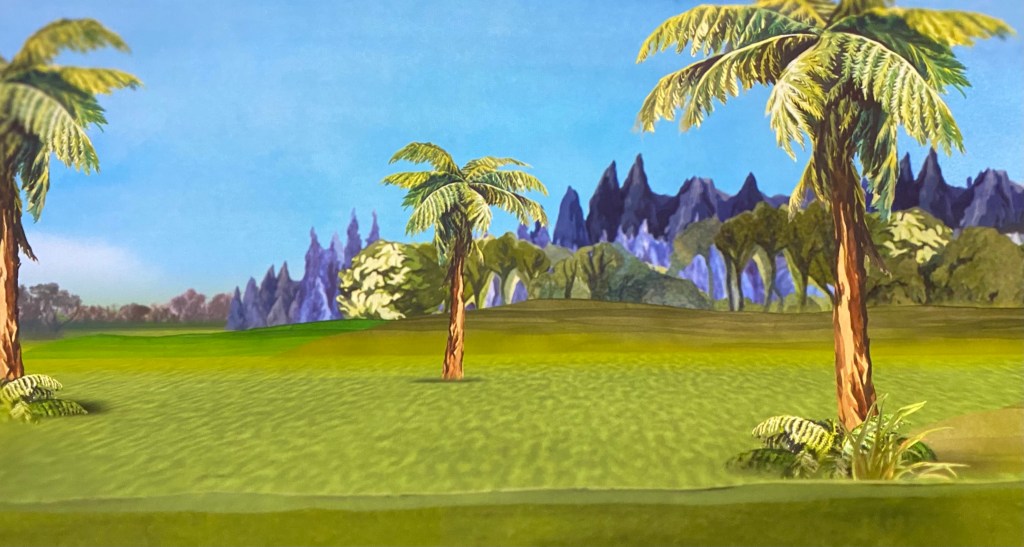


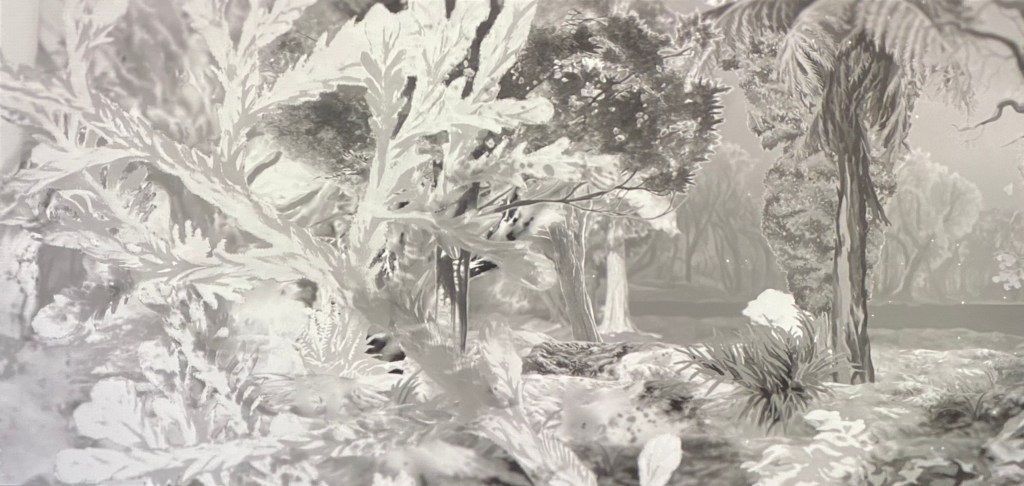
I think that this is a great example of how fine art can challenge social injustice in the form of racism and colonising practices that impact/damage both indigenous people and the land. I just wish that the exhibition could have extended to an intersectionalist approach which would recognise the connected systems of injustice underlying agriprofit. How is it possible to ignore those who pay the biggest price – the cows themselves?
With regard to the cow’s themselves, I came across only one mention of the cruelty involved in the dairy industry. And even this one mention puts the cruelty in the context of human concerns – it seems to suggest that without this cruelty milk would cost humans more (nb No dairy farmer keeps ‘calves at foot‘ – I have never known this practice in the heart of dairy land – the North of England – where I grew up on a dairy farm and come from generations of dairy farmers. I imagine it would only be practiced by a hobbyist who kept a cow or two):


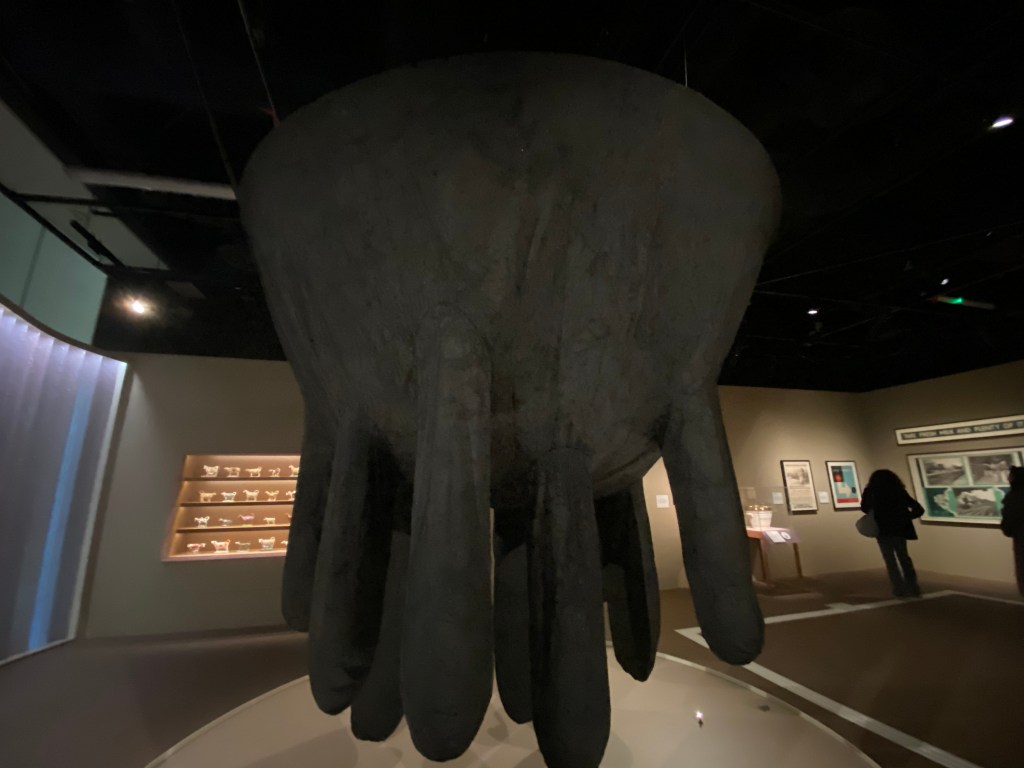
Julia Bornefeld. Untitled. 1995. Metal, coal dust, paint.
The sculpture above might be interpreted as a second reference to the cows pain and constant discomfort but this was not made explicit in the accompanying note.
There was recognition of the over-crowding and intensification of dairy farming practices. This was introduced through interviews with dairy farmers, photographs and a video:


The farmers talk about how the intensification of dairy farming is forced upon them by the cutting of government subsidies over the years, the cheap cost of exported milk and the amount consumers are prepared to pay for milk produced in the UK, together with rising production and feed costs. This is of course all true. My father struggled for 50 years as a dairy farmer and did not make any profit, by brother struggled for 30 years, and now my niece is struggling and looking to diversify.
The fact that dairy farmers struggle is not really the issue. The issue is Food Policy in the UK and in every other country. Food is the most basic and necessary consumer good. For governments to support a cruel and unsustainable industry is scandalous. Governments could, if they wanted to, instead support a transition of farming from dairy to crops grown for humans (of course many crops grown throughout the world are not for humans but for consumption by other animals). Nor did the exhibition touch on this. (During the WW2 10% of all land was given over to growing crops – even in the North of England – a policy that ended with the end of the war).
I’d like to briefly turn to the kinds of issues explored in the focus on human milk in the rest of this critique, to highlight the difference in issues when human and non-human milk production is visualised.
First, while the agony of the cow who loses a baby every year (to slaughter or the slavery of the dairy industry) is not mentioned, the trauma of weaning of mother and child is examined in a sculpture by Clementine Keith-Roach.
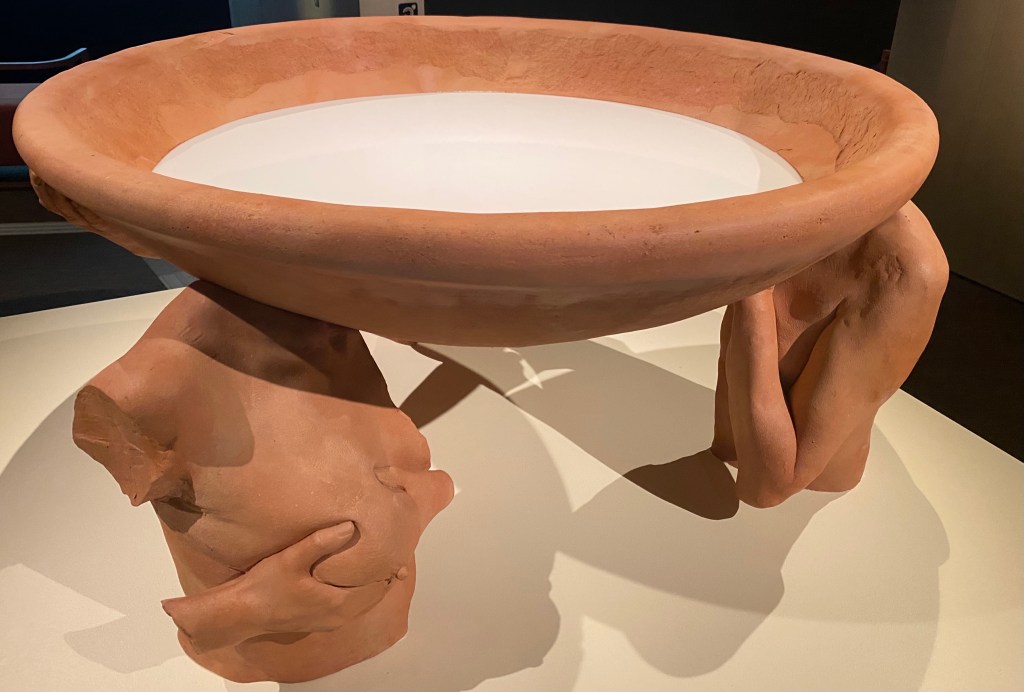
Again I do not mean to undermine the sadness a mother might feel when she stops breast feeding her child. However, this is insignificant in comparison to losing a child every year to murder or enslavement. The breastfeeding human mother continues, I hope, in being able to satisfactorily nurture and care for her child.
There were other photographs of breastfeeding mothers in the exhibition. The implication, I suppose, was that breast feeding mothers are strong, natural, icons of fertility. There was also some mention, as I raised at the start, of a growing demand for human milk, by body builders for example – such a trend can only be exploitative. I will end this with some photographs of a huge installation by Jess Dobkins, 2023, who explores the regulations, politics and ethics of human milk in the 21st century. Conversations with mothers’ are heard throughout the installation, where they talk about their experiences. I was particularly caught by a woman repeatedly saying the word ‘LOVE’. I didn’t fully understand the installation but I did find it interesting and feel engaged by it, and I did think it was a pity a similar installation was not made on Milk from the non-human perspective. In fact there are some references here to other forms of drink labelled ‘milk’. Below are only a few photographs from this very large work, started in 2006, ‘The Lactation Station’. I guess she has been adding to it over the years. (I like her use of labels here. This is something I could use too).
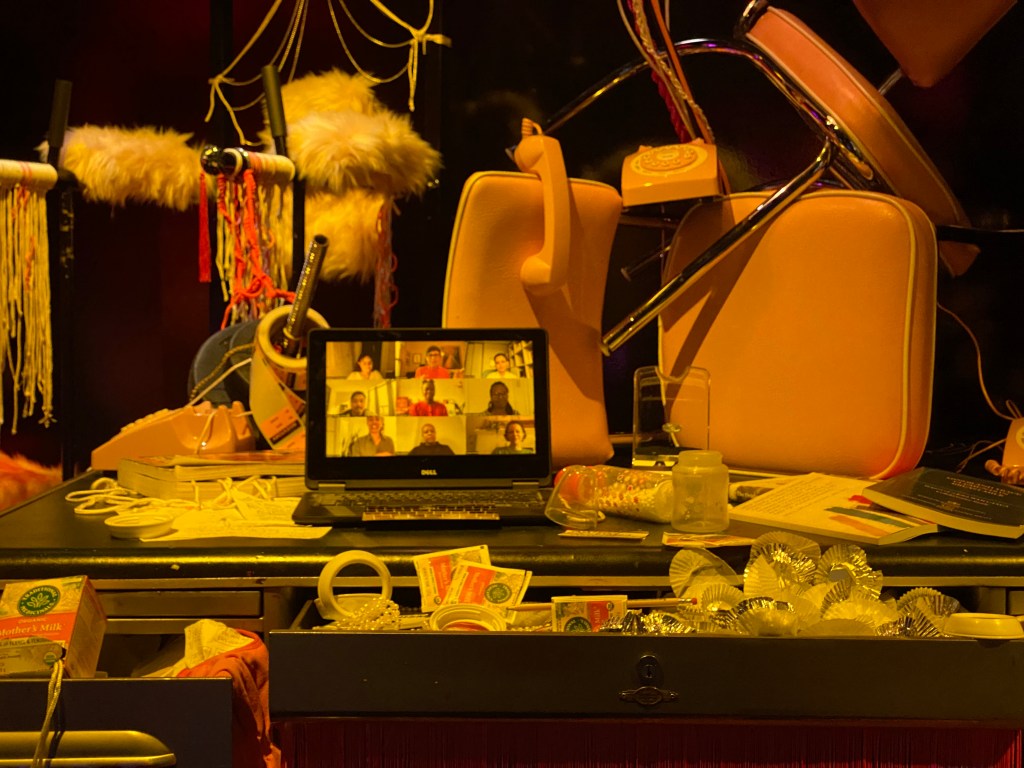
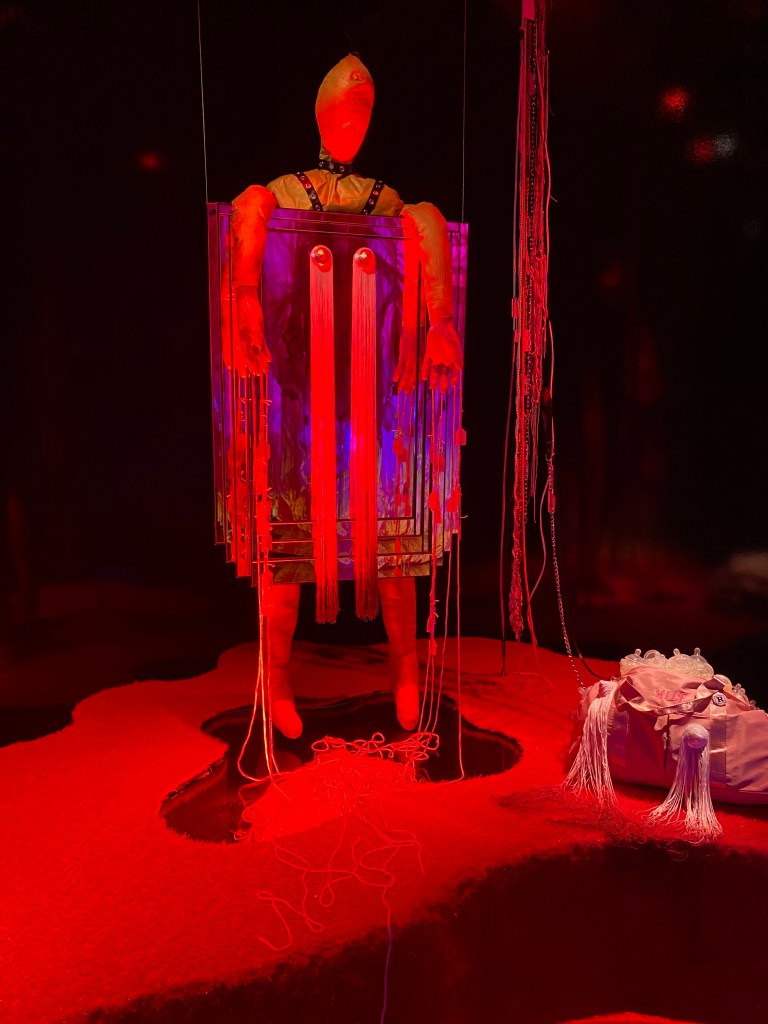
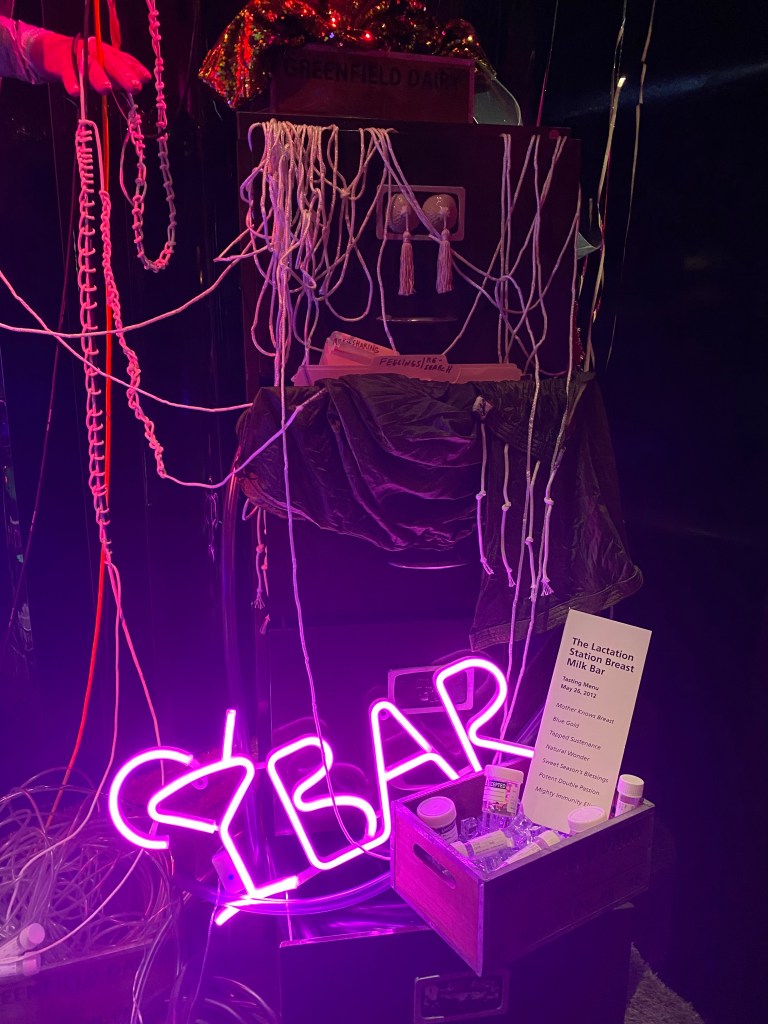


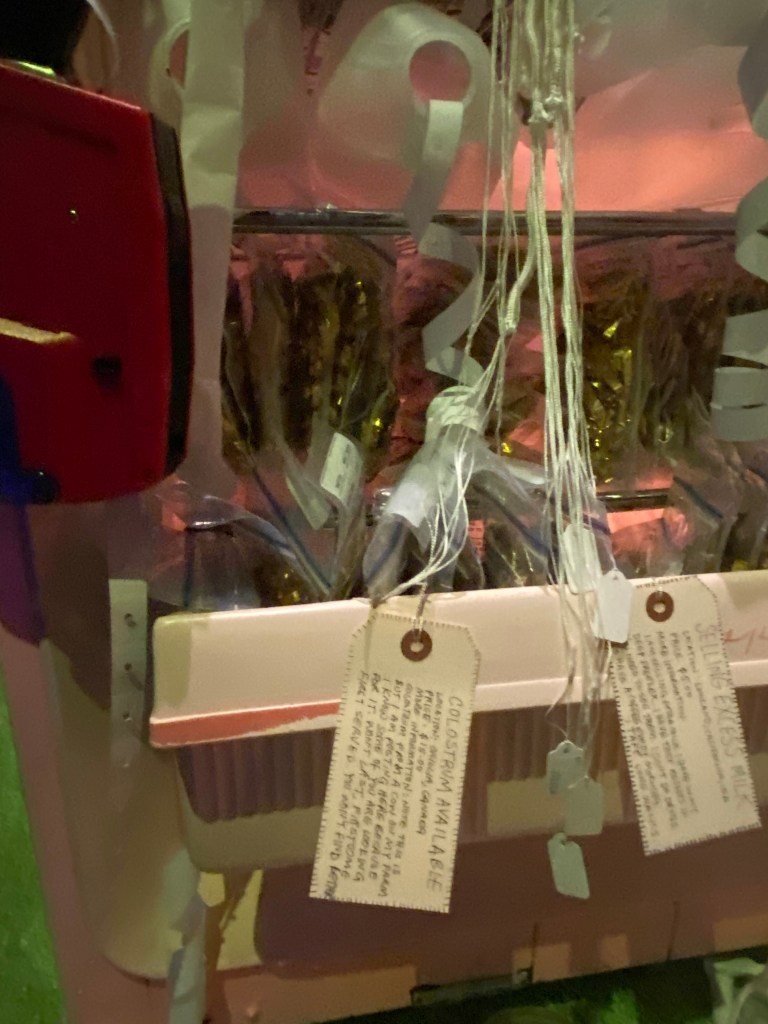

In conclusion – I think a missed opportunity to explore intersectional issues of power and control, exploitation, marginalisation and violence. Dobkins work comes closest to doing this but it is heavily weighted toward the human female experience.
 Drawing As Critique