During unit two, investigations relating to the research question were made using three different methods. On this page I present more resolved works using each of these methods, as well as a critical reflection on each. At the end of this blog I reflect on the implications for work going forward to unit three.
Other pages on this blog report the ‘process’ of each of the three separate investigations, including the research conducted (e.g. into the history of The Bargehouse), images of the works in progress, information about mediums; additional works – the majority from the ‘experiments in imagining otherwise’ (collages) section; ‘diary’ and reflections during making; experiments relating to each method.
Links to the three ‘process’ pages are found here:
1. Bargehouse: I Learned Not To Look: https://wordpress.com/page/susanaskew.uk/2928
2. The Miniature: https://susanaskew.uk/part-two-the-miniature/
3. Experiments in Imagining Otherwise: https://wordpress.com/page/susanaskew.uk/2902
The ‘resolved’ works are presented as follows:
- Site specific installation produced in response to the Bargehouse. Title: ‘I Learned Not To Look’
- ‘The Miniature’ – works produced for the Filet exhibition
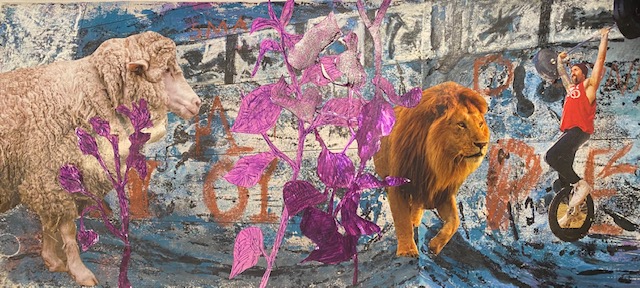
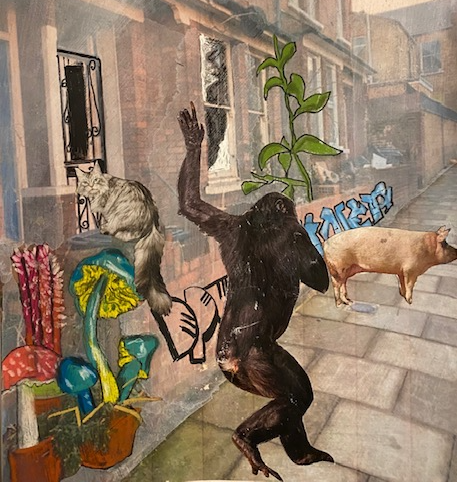
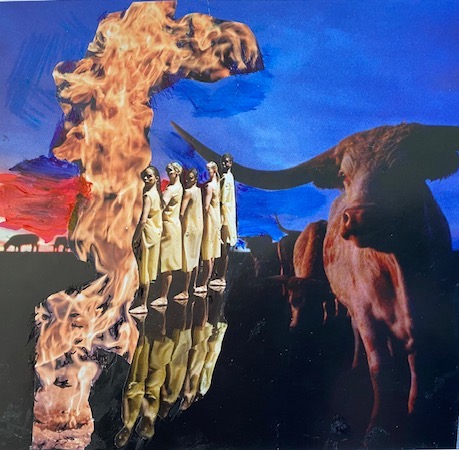
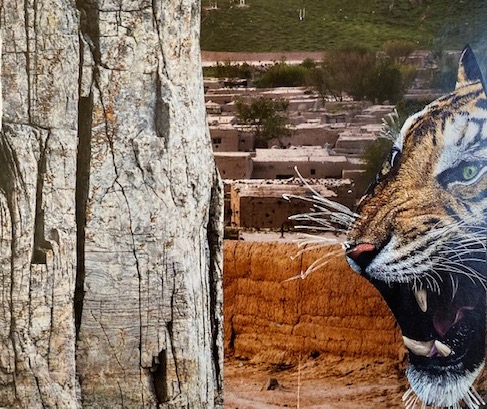
- ‘Experiments in thinking otherwise’ – collages produced as speculative imaginaries about how our relationship with other animals could be different.
The research question for all current work is:
What can I Learn about how artistic interventions can interrupt the iconography of oppression, objectification, invisibility (as subjects) and discourses of violence in our society; specifically toward ‘other’ animals?
(for information on the application of this research please see ‘Artists’ Statement’).
- The Bargehouse. Site Specific Installation – I Learned Not To Look
Definition of ‘site specific’:
As a site-specific work of art is designed for a specific location, if removed from that location it loses all or a substantial part of its meaning. The term site-specific is often used in relation to installation art
https://www.tate.org.uk/art/art-terms/s/site-specific
My focus has narrowed, at this point in my study, from a critique of iconography of ‘other’ nature, to ‘other animals’. In the work here it has narrowed further to specifically focus on farmed animals. I grew up on a dairy and sheep farm; the male offspring of the cows (who must produce a calf every year in order to continuously produce milk), were fattened for the ‘meat’ industry/consumption/profit and so bull calves were/are an essential part of this chain of exploitation/killing in the dairy industry.
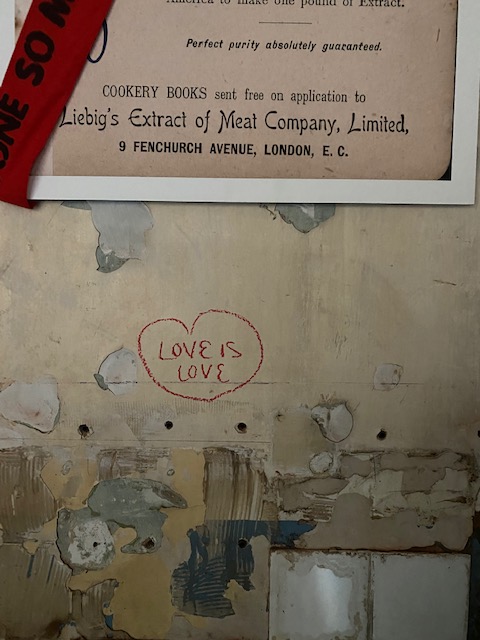
I began by researching the history of the building where the show was held – the ‘Bargehouse’. This was inspired by my understanding that the Bargehouse must have been used in the past as a centre of trade/commerce, and that our exploitation of other animals is centrally tied up with capitalism/consummerism. I discovered that the site was acquired in 1928 by the company, ‘Liebig’ who made the OXO cube, to build a cold storage facility (The Bargehouse), and the OXO Tower opposite. There is annecdotal evidence that animal carcasses were stored in Bargehouse – on 12 December 1945 there is a newspaper report of 10 crates of meat being stolen from there.
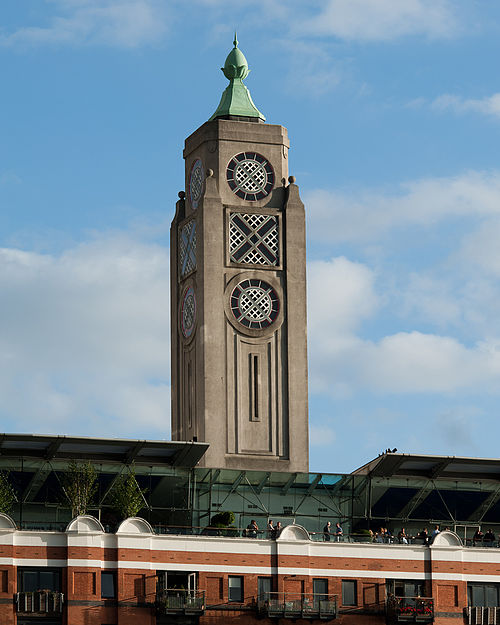
AIMS:
- To critique our generalised cultural acceptance of the abuse/exploitation/murder of other living beings.
- To critique the discourse that living beings are possessions that can be traded and profited from.
- To highlight our dissociation from, and lack of empathy for, other living beings in the context of the history of the Bargehouse, and its association with LEMCO (Liebig extract of meet company) AND OXO brands.
- To highlight what I see as disordered cultural perception between a view of farm animals as ‘cute’ toys, or animated figures in films, and our treatment of them in reality .
Ethical issues
I have identified four ethical issues:
- Identification and critique of a specific branded product, in a building that is iconic for the brand.
- Drawings or video from the auction mart that could hurt people involved.
- A critique of the consumption of animal products which implicitly challenges the personal behaviours of most of the world’s population (but the population of the ‘over-developed’ wealthier countries, particularly.
- Filming cattle that are very distressed and most likely to be killed shortly and showing this in a public exhibition.
In relation to the first ethical dilemma – I draw on a long history of critique of consumerist culture in art – particularly in pop art, including for example Andy Warhol’s drawings of Campbell soup tins, and the work of artists including Ron English, Gabriel Kuri, Josephine Meckseper, Irina Korina, and Martin Basher. Because the work of these artists has become mainstream and is exhibited in major galleries/collections, I take it that consummerism and specific consumer products are fair game for the artist and do not pose a problem.
With regard to the ethical dilemma of drawing and making a video from the auction mart, I feel the needs careful consideration since I do not want to cause further harm either the people who work there or the animals themselves. A workable, but ethical approach, is to take photographs/video images/sound footage openly, and to edit it in such a way that the main focus is non human animals .
This in turn raises a serious dilemma about the ethics of capturing footage of animals that I know are soon to be murdered, for an art project. I do not have an answer to this. I hope my work will have some impact and make a small contribution to saving lives in the future.
My work challenges the behaviours of most people, and what people eat is seen as a personal issue of ‘choice’. Many personal ‘choice’ issues have been challenged in the past. Violence is not ethical, and therefore any work that suggests non-violence to other animals IS ethical. Secondly, the scientific evidence for a plant based diet being more healthy than an animal based diet, is strong. Therefore, like smoking, it can be argued that animal eating is bad for health, and that encouragement for a plant based diet is good for health, and therefore ethical. Thirdly it is incontrovertible that animal agriculture is harming the planet – we have no qualms in encouraging plastic free shopping, and therefore it is also ethical to encourage plant based shopping (evidence for these claims can be found in the ‘Application’ section on my ‘Artist Statement’ page).
Work for the installation.
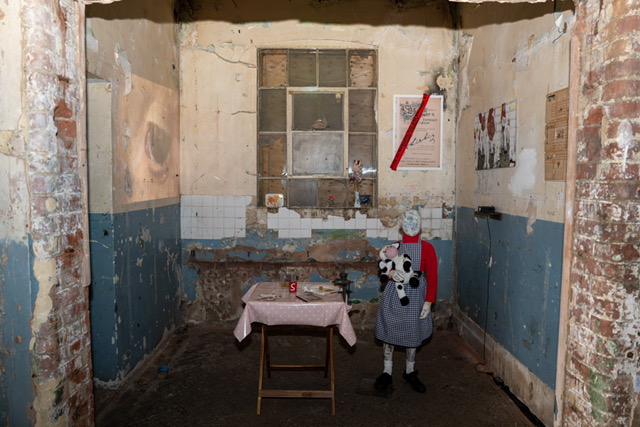
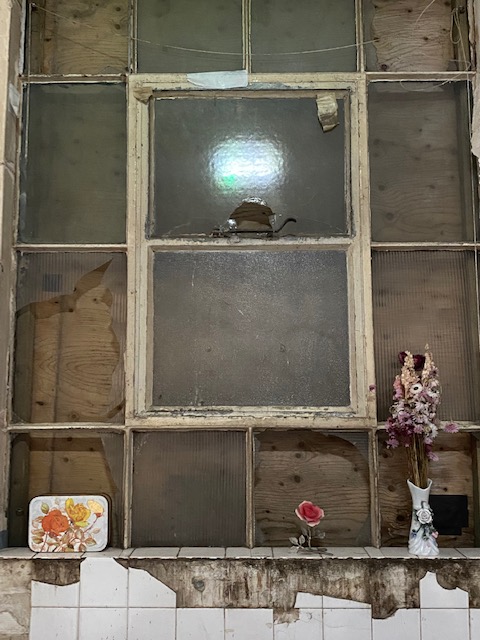
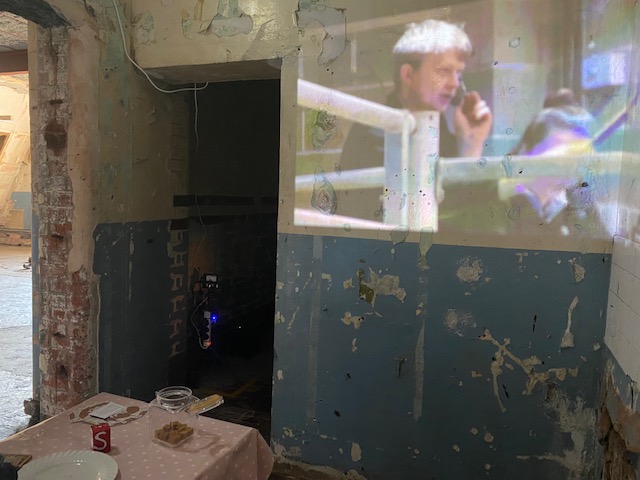
After deciding on the focus I explored the Bargehouse to think about where would be most suitable for the installation. I decided on a room in the attic – a ‘rough’ space that looked rather like an old kitchen because of its boarded up window with white tiles beneath, but also a space that reminded me of farm shippers and cow sheds. This is about 9 x 7 feet. I was lucky enough to be allocated this space after requesting it.
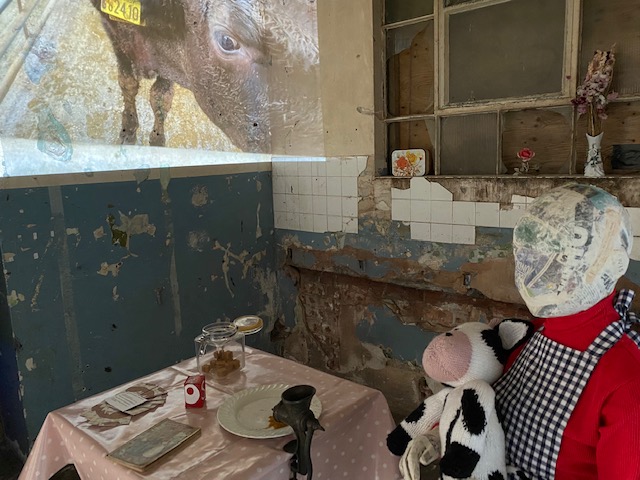
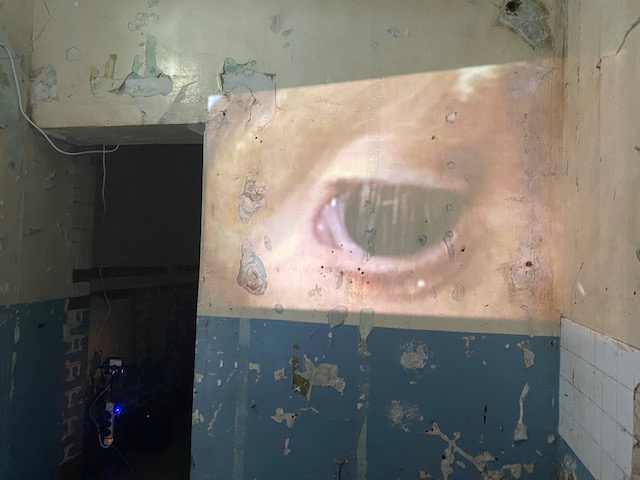
Here I include photographs of the installation, finished works and video. Photographs of the works at different stages, as well as more information about materials, can be found in the ‘process‘ blog (links above) for this installation.
I made the following for the installation:
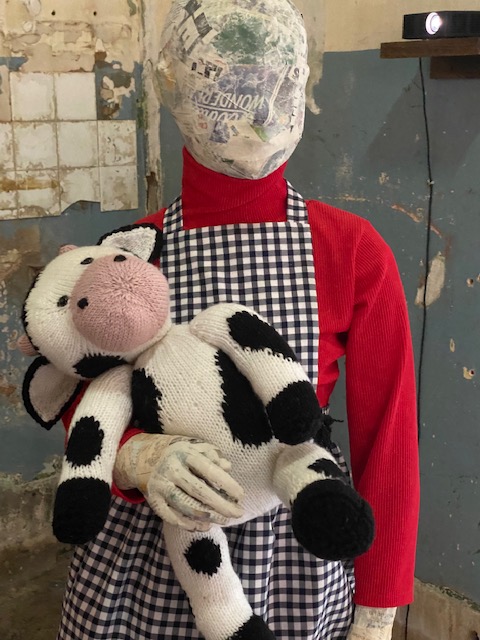
- a 54 in high girl made from Paper Mache;
- her cotton apron;
- her cotton skirt;
- an OXO cube box with the words OXO replaced with SOS;
- a video made at Skipton auction mart;
- a sash made from red cotton, with text;
- a print of the last page of the Liebig recipe book;
- a drawing of cows with Letterpress text (from John Berger) repeated and becoming invisible -‘ Nothing as marginalised and invisible as the ‘other’ animal’ (Nothing changed to None on the sash when I realised that ‘nothing’ is itself objectifying);
- recipe pages torn from a second damaged copy of the Liebig recipe book, with the Bargehouse history printed on top (using Letterpress again).
- a knitted cow made from acrylic fibre.
- Cards with image on the front, and information on the back, for visitors to take away.
Other found objects included in the installation: flowers, tin, table, storage jar, oxo (vegan) cubes, cast iron meat grinder, oilcloth table covering, plate.



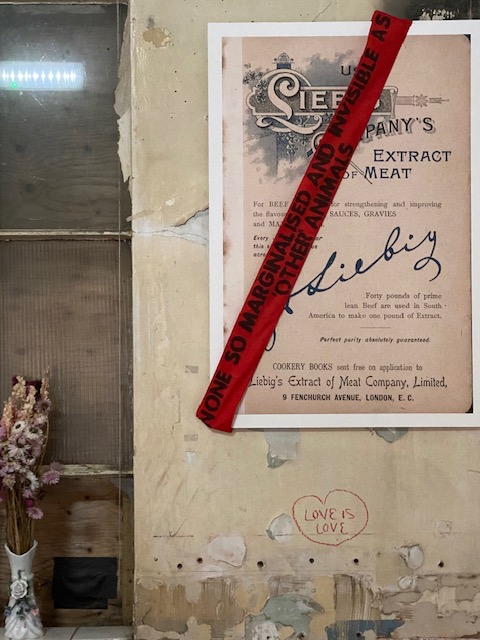
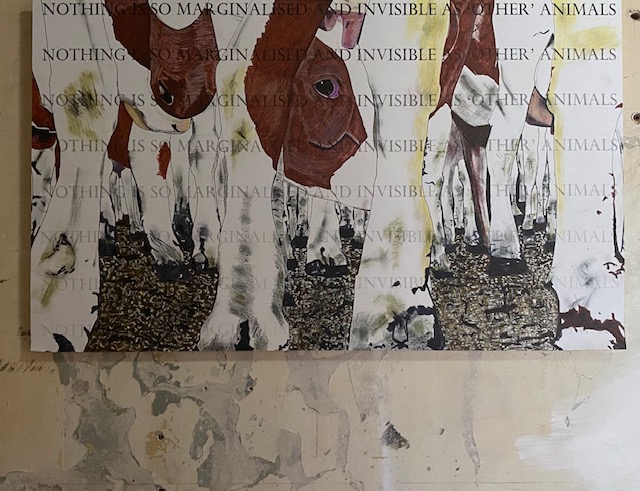
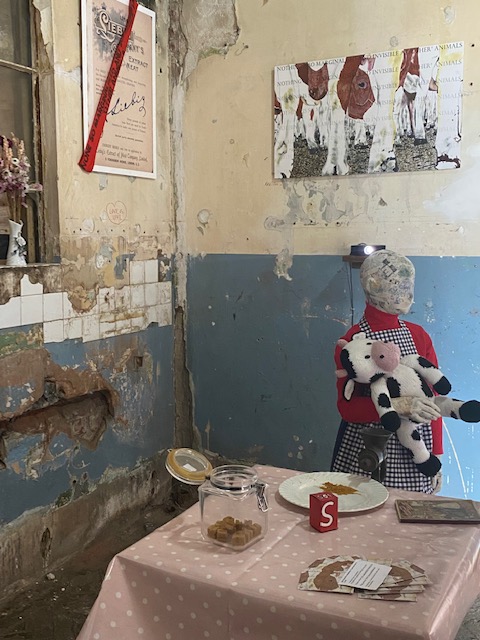
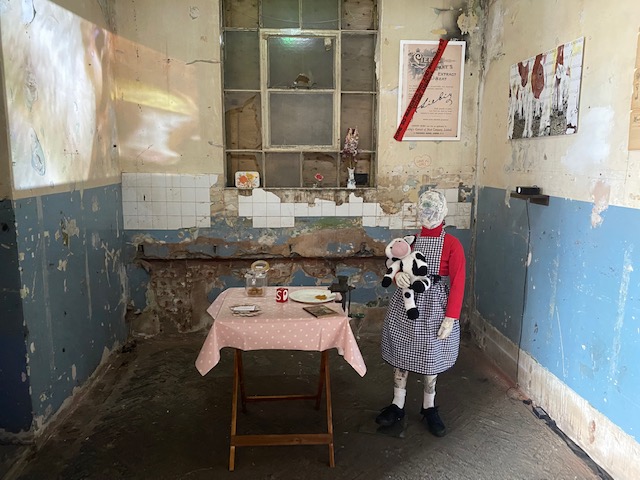



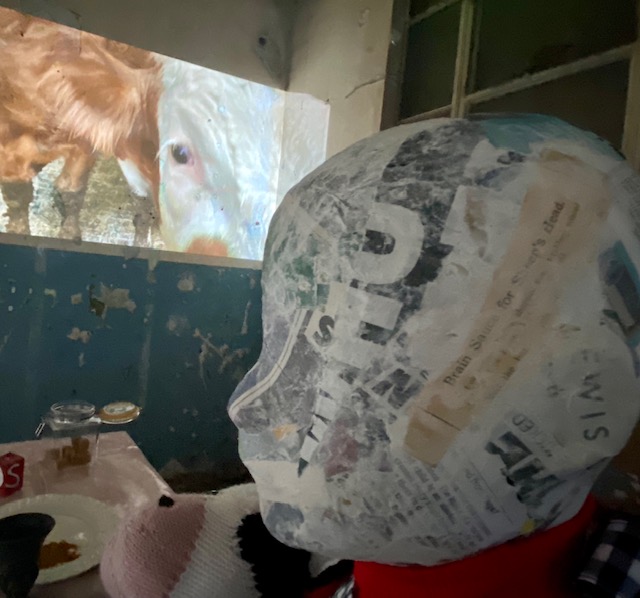
The video shown in the installation is below
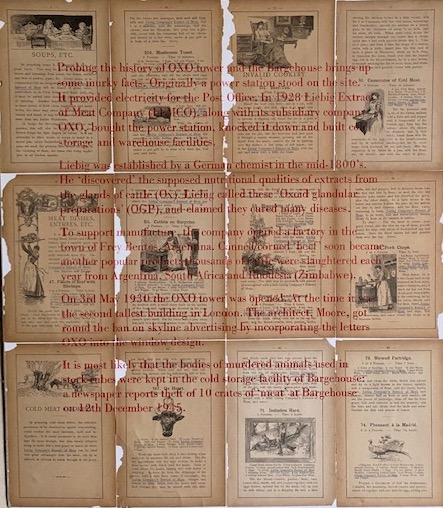
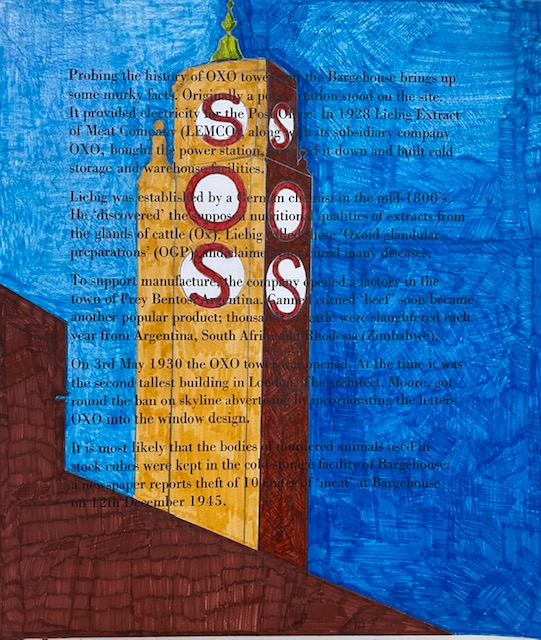
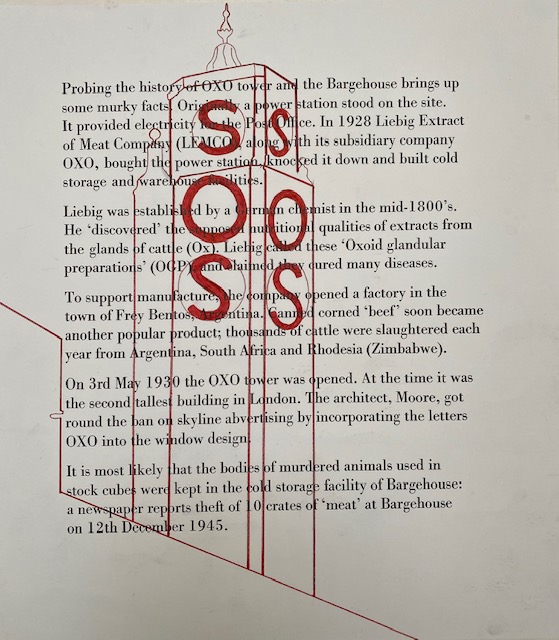
I wrote the story of the Bargehouse and OXO tower using Letterpress and printed it in black on two drawings of the OXO tower, and in red on top of pages from the Liebig recipe book. Although it is most easy to read the story on the white paper, I used the image over the recipes because I felt it’s aesthetic fit better in the Bargehouse room where I installed.
Reflection
I started my artists’ statement last September with the sentences:
S. Askew. Artists Statement
Visual Art is about looking/seeing. I am interested in those things that we are taught not to ‘see’ – where no amount of looking helps, because of the beliefs we are taught by the major institutions, from childhood
I think that this installation has made a start on exploring both the invisibility of other animals, but also the institutions that teach us not to perceive their traumatic lives: in this case the food production and marketing institutions, as well as the family. It has been a lot of work and precision planning to complete in the 5 weeks available. I am pleased with the outcome and think that my choice to make this installation in the Bargehouse building is the ‘right’ choice for me; to me it is cogent and coherent.
I had a concern that repetition of ‘LIEBIG extract of meat’ and ‘Oxo’ might normalise their use, and even advertise these animal products. I hoped that repletion of the phrase ‘None so Marginalised and Invisible as other animals’ would counter this and offer a critique. It is difficult to know how any audience perceived and interpreted the work. I made cards and left them for people to pick up and welcomed comments. I also had many good conversations with people who came to the exhibition, and many comments about the work being emotionally engaging/making them think. There is some slight evidence that the installation moved toward a discursive perception of art (a general aim for my work) in this video capture by Joseph Adamson:
I would like to start by reflecting on the title: I Learned Not To Look. I chose this after considering a number of different titles, for example, the phrase ‘None So Marginalised….’ in the paragraph above, or ‘How we learned not to see’. I dismissed the last because it generalises to everyone, and also because I felt uncomfortable using the word ‘see’ in relation to learning, and wondered whether for anyone who is blind, the idea that we might learn not ‘to see’ might be offensive. I also set out on the MA to think about how a focus on the external, political might be combined with the internal/personal, because I find dualist ways of thinking problematic, but also feel political art is sometimes difficult to relate to. Nor do I want to dissociate myself from cruelty to animals: I learned not to look, just as much as everyone else. I see the figure in the installation as myself as a 10 year old child, and this makes the work more personal for me – I feel more connected to it.
I’d like to continue this reflection by thinking about materiality and skills.
One thing I am reflecting on at the end of this installation is how it enabled me to draw on my strengths. I enjoyed the different skills I was able to use – particularly research skills, but also practical skills – sewing (apron, skirt, banner), knitting (cow) paper mache (girl) letterpress and video capture/editing. Apart from letterpress – these skills are familiar to me. I spent my childhood and much of my adult life making things, often using textiles (On leaving school I trained first as a medical secretary, but then as a Domestic Science teacher – I taught cooking and sewing in schools for 7 years, while I studied part time and eventually moved into teacher education with an initial focus on equality issues). From the age of ten, too, I was very interested in photography and saw a future for myself as a photographer/video maker (I only remembered this now). I would like to follow up the video – I found this the easiest artefact to make, and think it is successful in terms of containing some powerful images and audio. (In fact I have now followed it up – see below).
I also thought about materiality in the making. Sandino (2004) suggests that materiality in fine art has been a focus because of the interest in transience in contemporary society, and particularly transience relating to consumption and commodification (in a neoliberal society it is important that objects of consumption are transient so that the consumer keeps buying the latest new thing). She argues that, in turn, a focus on materiality has blurred the boundaries of art and craft. I can understand how this works – if ‘the material is the message’ (McLuhan, 1964) then it follows that makers interested in exploring concepts will seek the material that has most to communicate about the concept. In so doing they may choose the materials used by the crafter – ceramics, wood, fabric, metal and so on. The difference remains that the fine artist is using the material to communicate a concept, not as an object of either beauty or use.
It is the case that each of the objects I have made in the installation are more craft than fine art in its traditional (aesthetic) sense – the paper mache figure; the skirt; the apron; the knitted cow – even the use of letterpress, and even the video. All of these are mundane and easily made objects. However, it is the overall concept that brings these objects together – and perhaps the concept that makes this work ‘fine art’ (the concept of the ‘invisible’/how we make the invisible visible, and how we learn not to perceive the reality of the invisible, so that we can see it as an object, not a subject, and make gain from it – all issues discussed by John Berger, 1997 and 2009).
In addition to this the notion of a girl made from newspapers is important to me: She is made of words written on paper: directions, advertisements, injunctions. She is literally a paper girl – insubstantial, not existing outside of a specific social context, and although she feels uneasy, and knows something is wrong, she does not yet know what this something is. She ‘buys’ the social conditioning – for now (for me this raises issues of intersectionality, which I have written about on the research pages of this blog).
I am struck by the fact that making the girl from Paper Mache (made with newspaper and an old recipe book) is significant. Apart from the fine qualities of Paper Mache, (mentioned in my write-up of ‘process’; cheap, light, sustainable, biodegradable, strong), I think that a girl made of newspaper communicates something of the discourse I want to critique here – a discourse of consumption, but also the ideology that we are all taught about other animals – much of it taught through mainstream media. Some of the paper that the girl is made from is made from the LEMCO original recipe book – we also learn ideologies relating to animals from recipe books, and of course from the food on sale in shops, that we cook at home.
There is something important about the everyday aspects of the critique I am making here. The violence I expose is not a violence in a far away place, it is in our home – it is a violence to others but also to self. It is part of every aspect of our lives – at the very essence of our life because concerned with what we eat and how we nurture ourselves. It is part of what we make in every sense – it is the fabric of our being. The fabric/material itself is important, but so too is what we choose to make with the fabric and how we choose to make it and why we choose to do so. Skills, are central to all of this making and using and I am wondering about the relationship between materiality and skills, and why skills seem to be downplayed in this relationship (perhaps because skills = craft). I wonder too, if our understanding of Material (or materiality) can transcend the familiar context within which we have previously experienced it – perhaps when it is out of context we are merely confused rather than challenged to see differently? This is something I want to think more about.
The other thing this work has brought up for me is the disconnect between the ‘cute’, or ideal, and the reality that cows in real life are not ‘cute’ but ‘doomed’ (some peers commented, before seeing the installation as a whole, that both the animals in the video and the knitted cow were ‘cute’), (synonyms for doomed in wiki thesaurus – condemned, dead-meat). The toy cow in my installation is a symbol of this troubling relationship. I came across this interesting quote:
“children help us to mediate between the ideal and the real” — and nowhere is the disconnect between the two more dramatic than in children’s animal toys.
Juliet Kinchin, design history of childhood, MoMA curator
I reflect on site specific installation as a method in the final reflection at the end.
On the final day of the installation, I wondered about making a video that was ONLY about the Bargehouse internal walls and having the cows ‘imprisoned’ in the walls. On this last day I made videos of the walls of the Bargehouse and edited the video below by transposing my original video on top of these new clips. I decided to remove the audio from the original video, but leave the audio from the exhibition – first I think the sound of the cows is too distressing, but second I think this gives the cows a more ghostly presence.
2. ‘The Miniature’
I like working small, partly because I do not like the idea of leaving behind a trail of large and difficult to recycle artefacts . The images below were completed for The Miniature project, Unit two, and all are 10.5 x 7.5 cm or smaller.
I am interested in what miniaturisation can contribute to thinking about my current focus: interrupting the iconography of violence, exploitation and objectification of others, and particularly of other animals. I feel that scale is important in my work. Other animals are insignificant in terms of the importance we generally attach to their wellbeing, pain and suffering, relative to the amount of importance we attach to human suffering and wellbeing. One way forward, therefore, might be to increase the importance of my subject by making it massive. However, I feel there is a more powerful correspondence between matching the, at first glance, insignificance of a small artwork, with this insignificance we attribute to the other animal.
I started by researching writing about miniatures to see what I could find to support this idea.
The first article I came across that offered me useful insights was ‘Meaning in Miniatures: semiotic networks in material cultures’ by Carl Knappet. Knappett discusses the material cultural meaning we attribute to experiences through the example of miniaturised artefacts, and in doing so discusses scaling issues in material culture more broadly. Essentially, this paper is concerned with exploring what is signified by a change of scale from the ‘normal’ or expected: the miniature is a ‘sign’ but how do we understand the meaning of this ‘sign’?
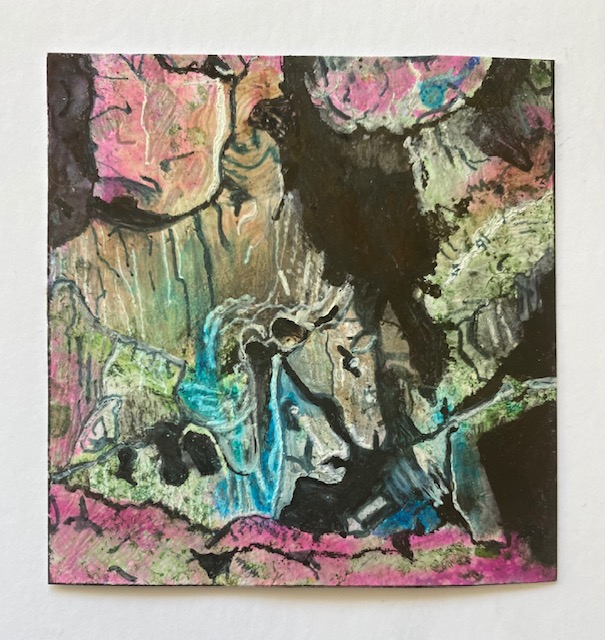
- Inside Plato’s cave
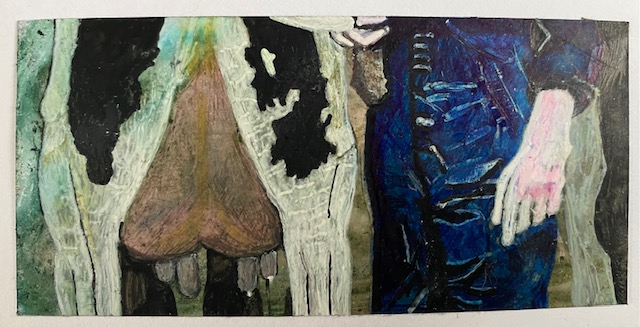
2. The Human Gaze
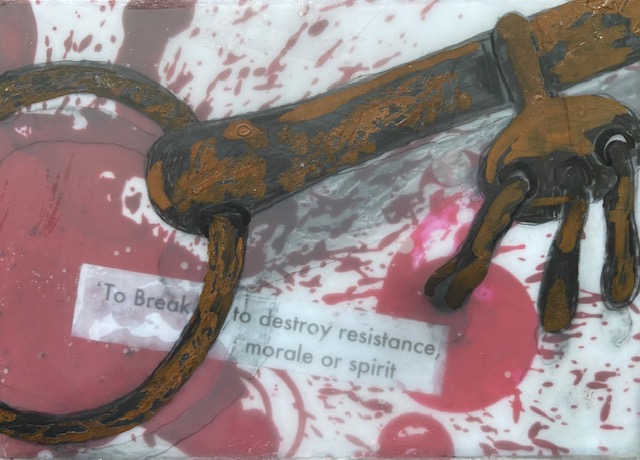
3. ‘To Break‘: to destroy resistance, morale or spirit
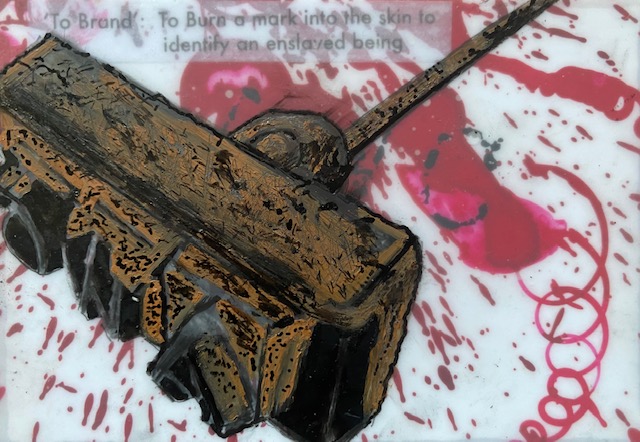
I wanted to go back to my original idea at the start of the MA: developing drawing as a method of critical discourse analysis. This series of drawing started with my understanding, gained from a lecture at Konsfact by Professor Marten Snickare, on colonial objects; the argument that colonisation cannot happen without objects. Objects are key to brutalisation and exploitation (see the post on contexts for a full account of this lecture). The lecture lead me to think about colonial objects relating to farm animals, and then to obtain some of these brutalising objects on eBay (see post on Installation/The Farmer’s Market). One of the objects is a ‘breaking bit’. The verb ‘to break’ is itself a violent description of the violent act of breaking the spirit of the horse.
4. ‘To Brand’: to identify an enslaved, oppressed, or otherwise controlled being by a burn into the skin
3. Portraits
I like the idea of subverting the traditional miniature portrait/religious icon (I have combined ideas from both here, by drawing both a portrait and using the gold leaf background traditionally used on religious icons). Here is the work, using biro, silverpoint and goldleaf.
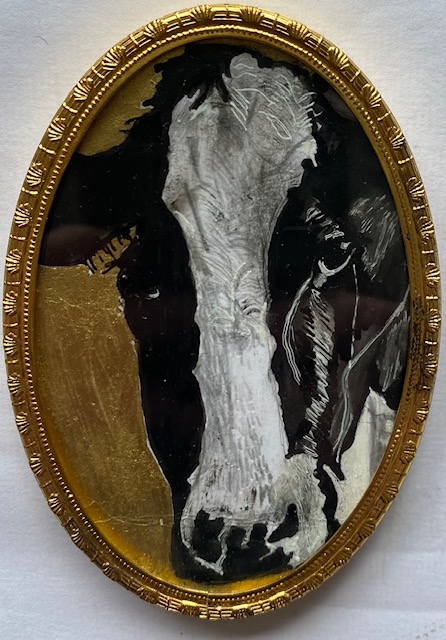
Reflection
I very much enjoyed working on miniatures. I enjoyed using materials I had not used in a few months – biro on plike, ink, the spinning top, gold leaf, silverpoint. I enjoyed thinking about the definitions and using text. I finally showed the image of cow above at the Filet gallery. I had heard that the Filet was formerly a Butcher’s shop. I do not know whether or not this is true, but felt that a portrait of a cow was most appropriate if this was the case. There were approximately 130 works shown at the Filet exhibition and I am not sure that within such a large numbers of works, my cow had any meaning at all. I have only taken part in a group exhibition once before, and then, as now, I wondered about how the context impacts any interpretation made of the work – it must do. I’m not sure that a general group exhibition is the best way for me to show work that is critical of how we relate to other animals.
In addition to raising questions about what the miniature signifies, I wonder how the sign/signified are particularly pertinent to the miniature artwork. For example, here I frame a miniaturised work in an ornate gold frame: this might usually signify a portrait of a beautiful woman – probably a woman who is part of a wealthy family. A miniature demands close attention in terms of detail, but it has also been shown that people experience time as going more slowly when involved with smaller art works (Susan Stewart, On Longing: Narratives of the Miniature, the Gigantic, the Souvenir, the Collection, Duke University Press, 1993). On this close, more careful study, I discover, not the beautiful portrait of a woman I was expecting, but a cow. My perceptions of the work itself changes, but perhaps too, so might my perceptions of the cow?
Knappett touches on the work of Le Drey in the section on miniaturisation in art. His work, Knappett suggests, is an example of miniaturisation that does not suppress detail. Knappett agrees with Ferguson (2002) who suggests, in this respect, that Le Drey avoids ‘the cute, the whimsical – and perhaps worst of all – the collectible’. (We might of course want to specifically highlight qualities of the whimsical, cute and collectible – qualities that are so prevalent in much of contemporary society – in order to critique them). For my purposes I am especially interested in Hagen’s (2002) comments on Le Drey’s miniaturised subject that is:
distilled through a reduction in scale into a more emotionally intense version of its source
Hagan (2002) qoted in Knappett, p. 102)
Further, Knappett argues, miniaturisation does not only intensify meaning, they allow distance to open up between the expected or officially accepted size and the miniature that transcends space, ‘existing in a kind of virtual space or relational network’ (p. 102). The importance of this, in my understanding and for my purposes, is that the miniature might exaggerate the relational differences in terms of size between the human and the other animal – not necessarily the size in terms of physicality, but in terms of the size of power differentiation between the human and non-human animal.
I think that Knappett touches on a similar point in the conclusion to his paper:
The links and relations that emerge inter-artefactually soon spiral out into complex webs of interconnections in which humans as well as nonhumans are of course entangled. And complex networks can have their own peculiar behaviours or dynamics – complex in terms of the unpredictable relationship between the local and the global.
Knappett, page 105
Reading this paper, of course, inspired me to take a look at the work of Le Drey. I have written about this in some detail on the ‘Process’ page for this work, as well as reviewed several other exhibitions on the miniature on that page.
I wondered whether there has always been a lot of miniature artworks, or whether there is a turn toward the small, relating to my preference for decluttering the world (video art achieves the same end). Is the notion that ‘small is beautiful’ becoming more popular in the art world? Sure enough when I googled this question I came up with yet another exhibition of the small, curated by,Courtney Harris at the Museum of fine Art, Boston, that I believe was held last year in 2022, ‘Tiny Treasures’.
Tiny is trendy: with tiny houses and minimalist movements encouraging people to live in smaller spaces with fewer belongings, small objects are attracting new attention.
https://www.mfa.org/exhibitions/traveling/tiny-treasures
3. Experiments in Imagining Otherwise
I have taken the wonderful title for this series of works from the book ‘Experiments in Imagining Otherwise’ written by Lola Olufemi (2021, Hajar Press.) In her book, the experiments that Olufemi makes are in prose and poetry, as she contemplates a future in which our modes of relating are transformed. Olufemi views the imagination as central to revolutionary movements for change. Her writing is based on a commitment to Black feminist and anti-colonial thought, and.. ‘her generative vision makes us rethink temporality – time becomes memory after one has experienced it. Olufemi confronts our preoccupation with time to go beyond the experiential and into the experimental’. (Ashtekar, 2022. (https://blogs.lse.ac.uk/lsereviewofbooks/2022/07/15/book-review-experiments-in-imagining-otherwise-by-lola-olufemi/). I am particularly struck by this – should we not, as artists, be at the forefront of thinking differently about our world, and should experiments in imagining otherwise not be as important in our making as the two other foci for contemporary art – materiality and performativity? Performativity is, I think, about temporality: about experience in the present.
I took this quote below from Ashtekar’s review of the book, chosen because it highlights that while Olufemi’s imagining starts from a Black Feminist perspective, she invites us to imagine a world in which our relationship to all life is reimagined.
Yet, for Olufemi, imagination is not solely, if at all, about a cerebrally crafted utopia. It is an exercise to extricate oneself from multiple oppressions enacted by patriarchy, capitalism and colonialism. Through her lists of ‘some places they would like us to forget’, she shakes up the reader to remind them how feminism is about ‘revolution in service of every living thing’. Herein lies the book’s greatest appeal: Olufemi is asking that we reimagine social relations and recognise the dire need to reorganise them
Avani Ashtekar (2022)
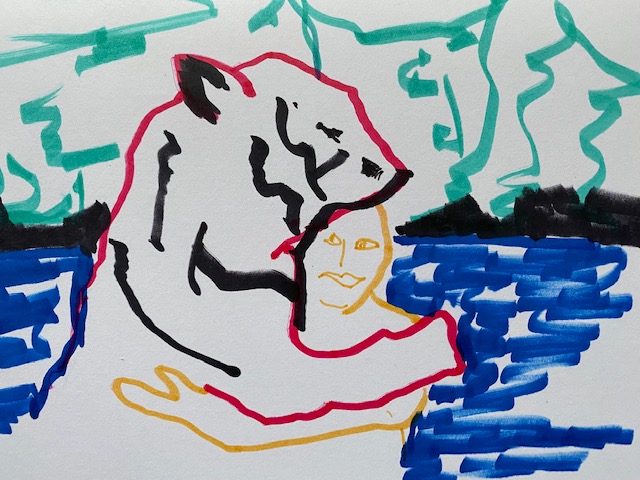
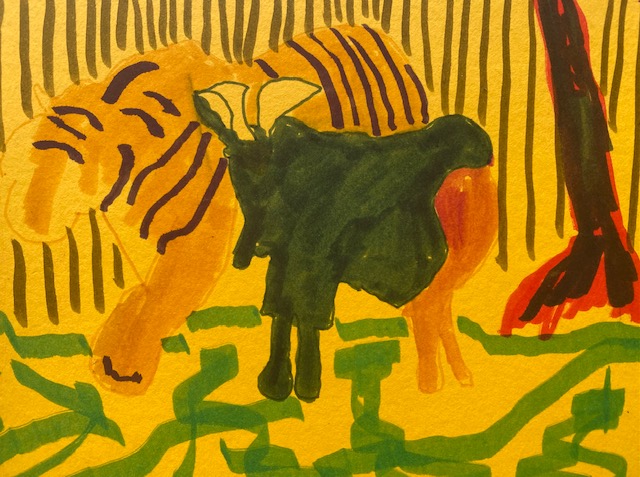
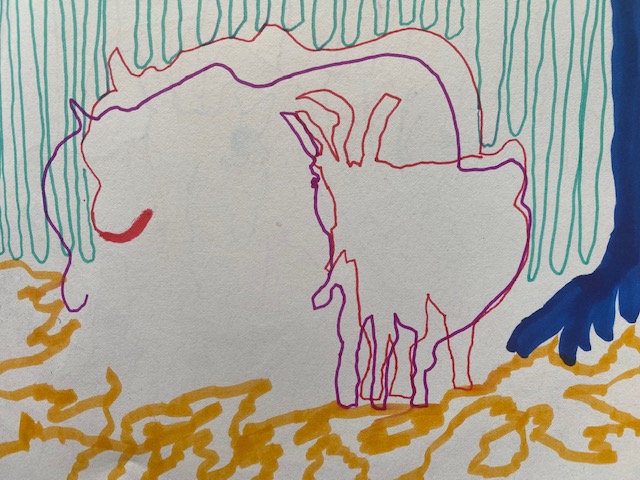
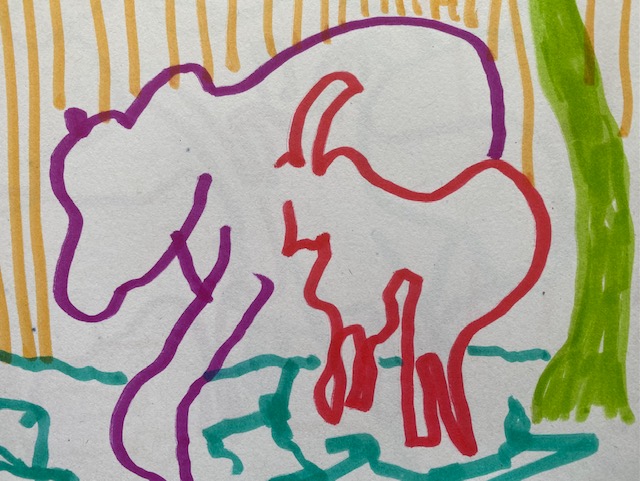
For this work I made over 20 collages in my sketchbook (see the ‘process’ page for all images) and then went on to develop two of them as screen print images (making another 20 new images).
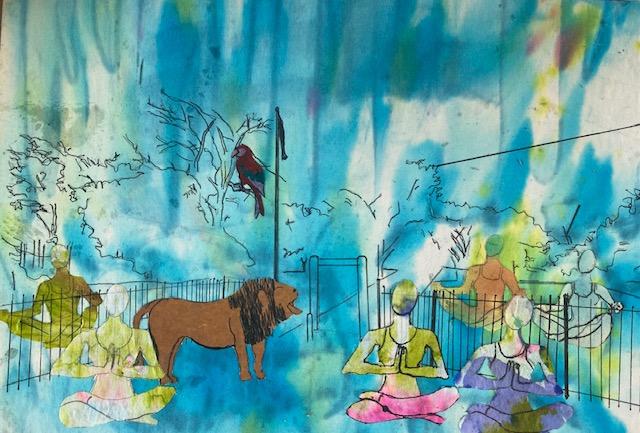
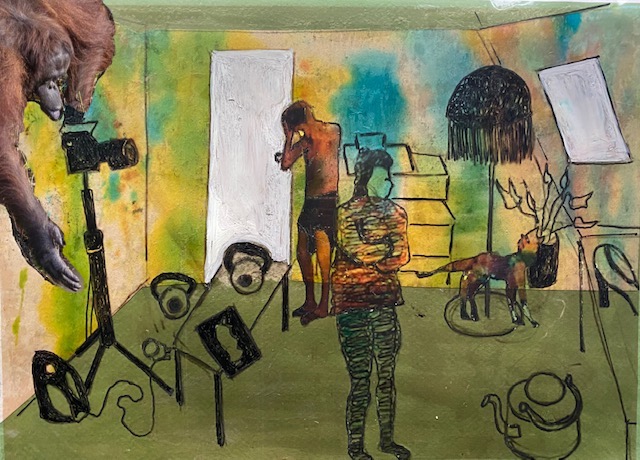
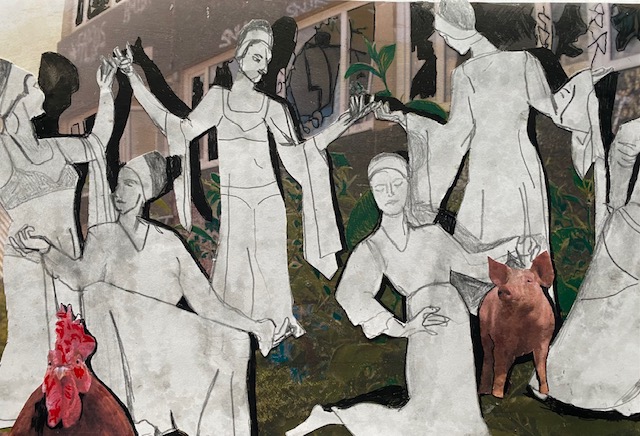
These started with ideas involving a speculative future in which the human is demoted from his privileged position of superiority. In this speculative world it might be that other animals are the ones to help humans.
A second series was about juxtaposition of different images involving other animals, taken from magazines.
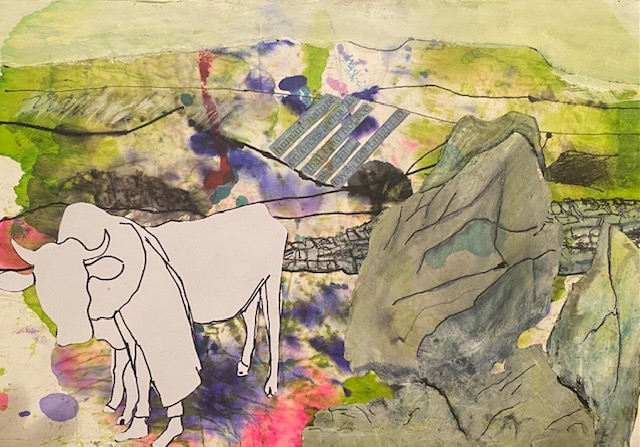
The third development came from re-imagining a different relationship between animals (including the human animal) in the North Yorkshire countryside where I grew up. This involved using previous drawings of the North Yorkshire landscape in the collages, as well as a prose-poem that I wrote during unit one about my experiences growing up in that region. This last series work best for me because they build on drawings from observation in the area, with the imaginary animals placed in the landscape.
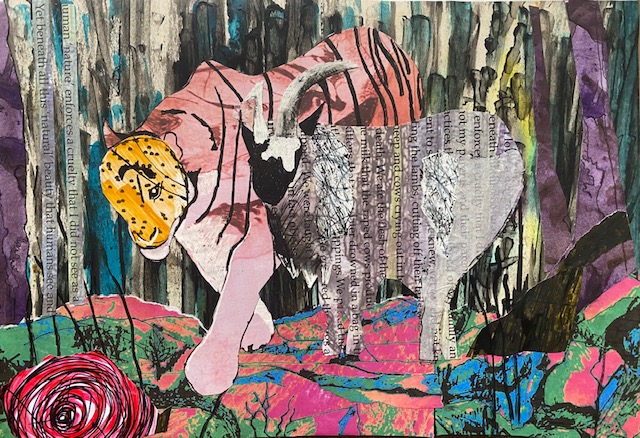
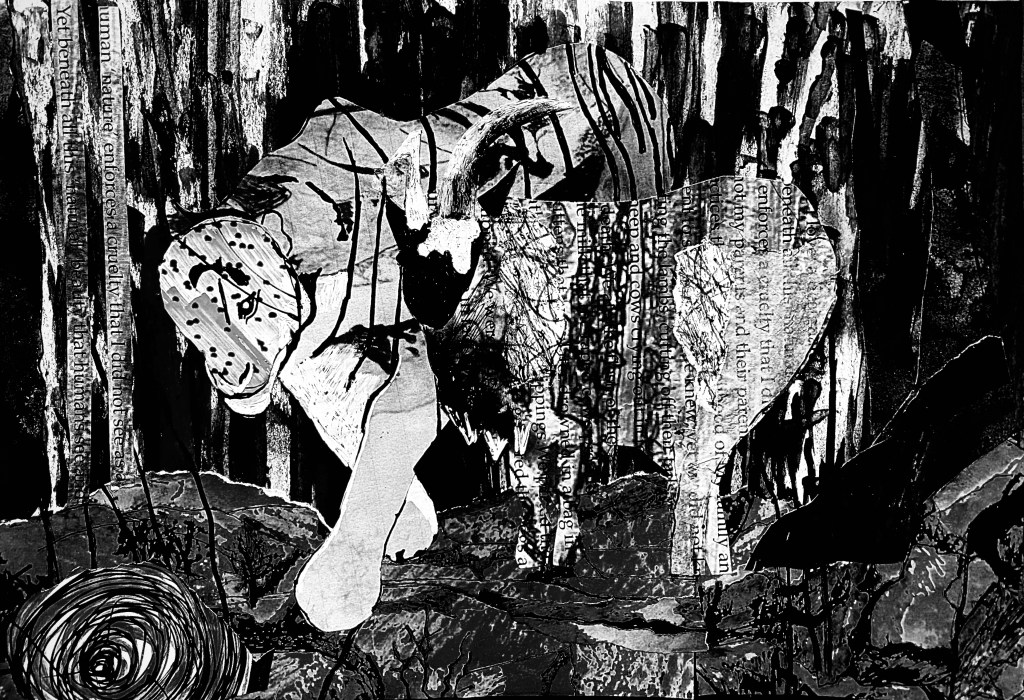
I have not done screen printing before but thought that a black and white version would be good preparation for trying this as a screen print:
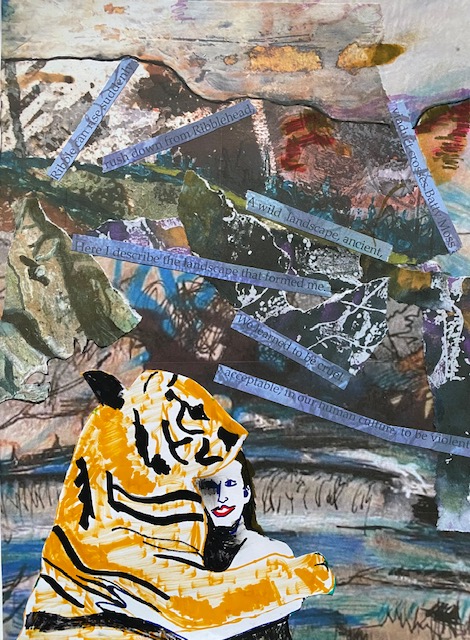
The second collage below is perhaps not as successful but I like the texture in it. I have used too much text here and the tiger/girl could be bigger.
I used the black and white version of the images above to make many different versions of both, as screen prints. Here are 2 of these 20 versions of the tiger and goat:
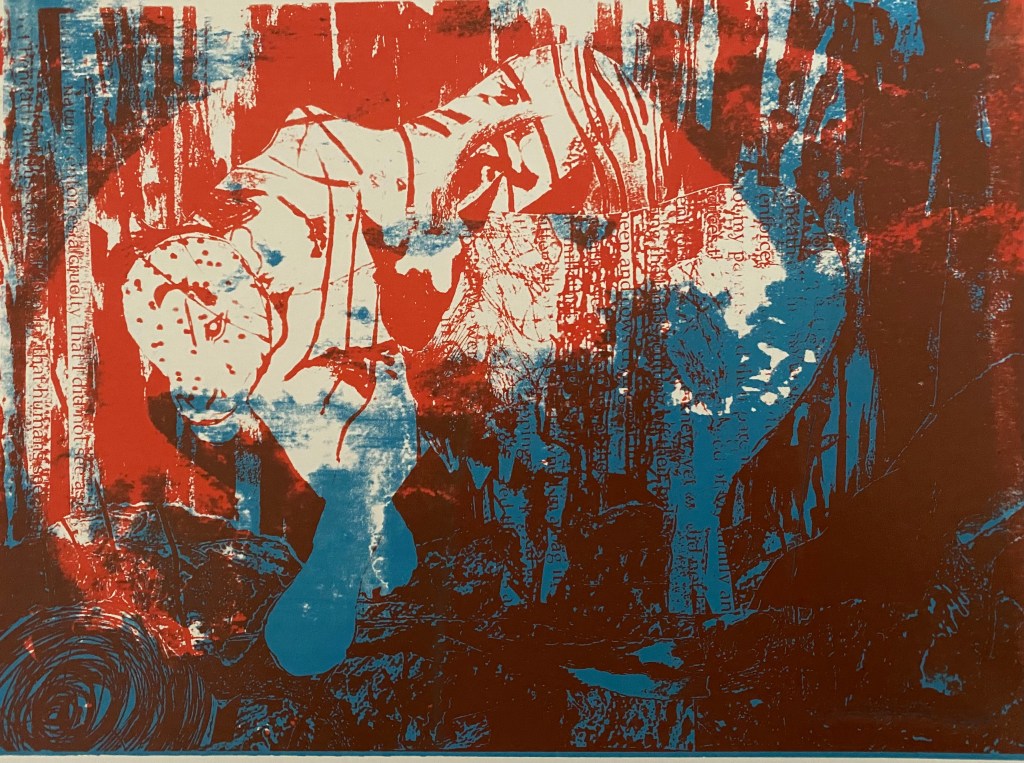
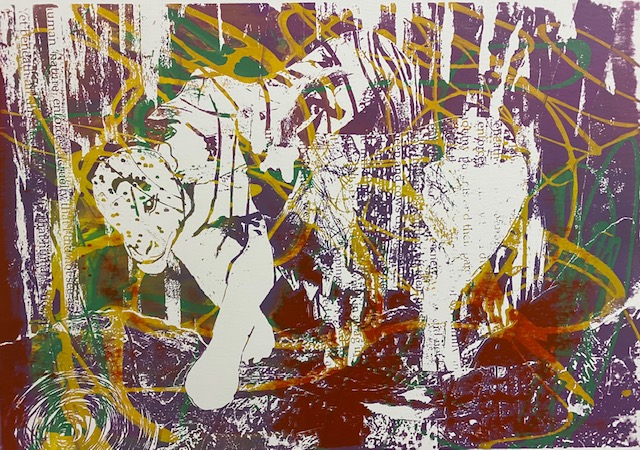
Incorporating fragments of drawings of the North Yorkshire landscape , made me think of the many images I have made of the erratics in the area (I’d previously thought erratic meant unbalanced, but looked it up and found it means something in an area where it does not belong). The collage below develop as an erratic on a background of another collage I made a few years ago of my parents sitting room.
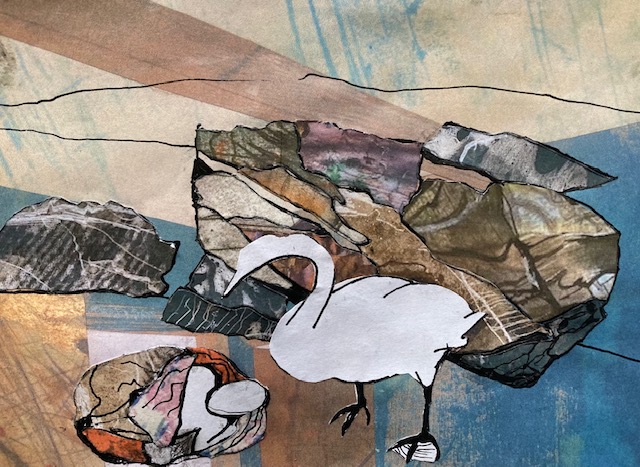
I didn’t want to stray from the idea of ‘different’ relationships between animals. So here we have an erratic in my parents sitting room, together with a swan and a swaddled baby – non of which belong there! The whole of the erratics, as well as the swaddling cloth are collaged (as is the background) from previous work. I particularly like this re-purposing of previous drawings.
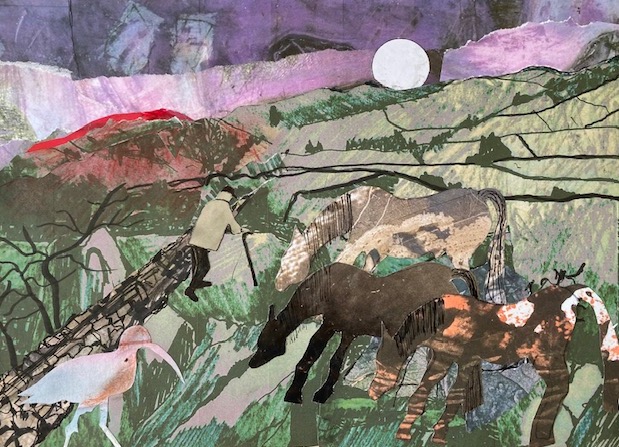
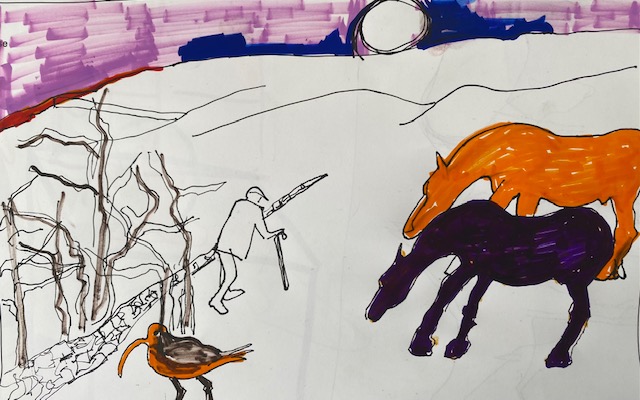
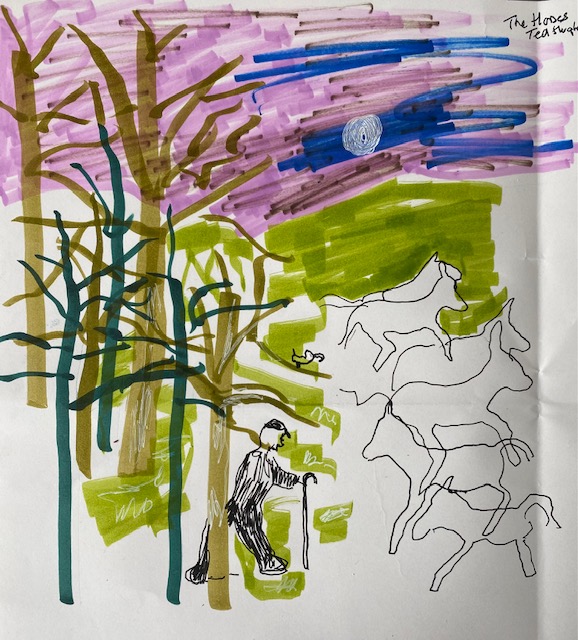
I went on to look at Ted Hughes poems about animals – he is also a Yorkshire man (he grew up in the Calder valley near Hebden Bridge). It was world poetry day when I started this collage (21st March 2023). I do not know his poems so I chose 3 at random (Horses, Amulet and The Thought Fox) and began by drawing a 10 minute response to each.
I decided to develop the work by focussing on the first poem – The Horses – again using cut up drawings that I have done previously of the North Yorkshire Dales. There are some erratics in the foreground, but these are largely covered by the horses. To me this has a strong feeling of Norber because of the background drawings used in the landscape. There is a lot of pattern and perhaps too much but I think it is a little balanced by the black horse in the foreground and the plain jacket the man wears. Perhaps the horse in the foreground far right should be white and perhaps that would make the whole composition stronger. I like the addition of the curlew on the wall foreground – a curlew call is mentioned in the Ted Hughes poem. I could easily glue a white horse on top.
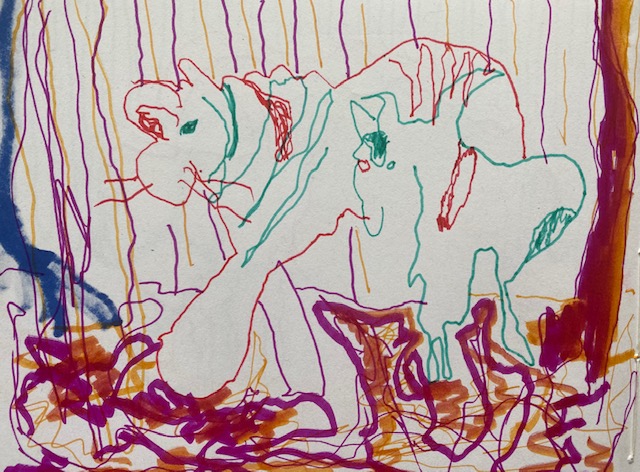
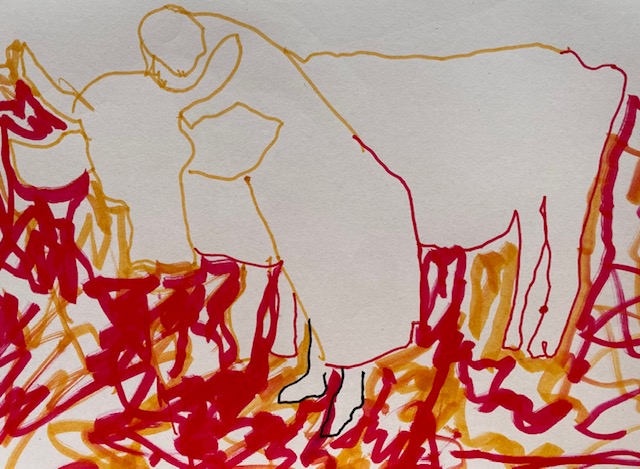
All the collages started as quick sketches, sometimes multiple quick sketches, and I include some of these here because I think they work in their own right. And below the sketches – other less resolved collages that I’ve made during unit two. The third panel is a gallery of the collages made on the workshop with Kate.
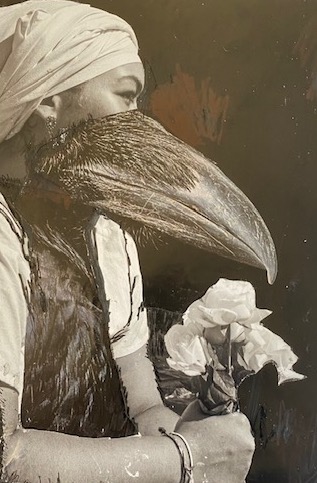
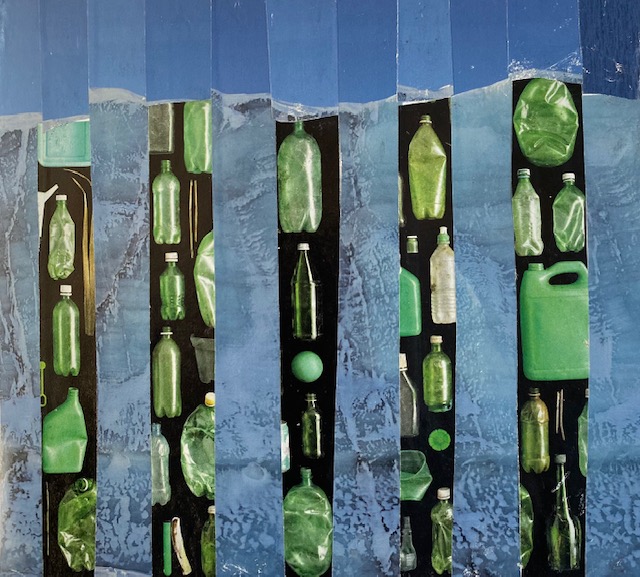
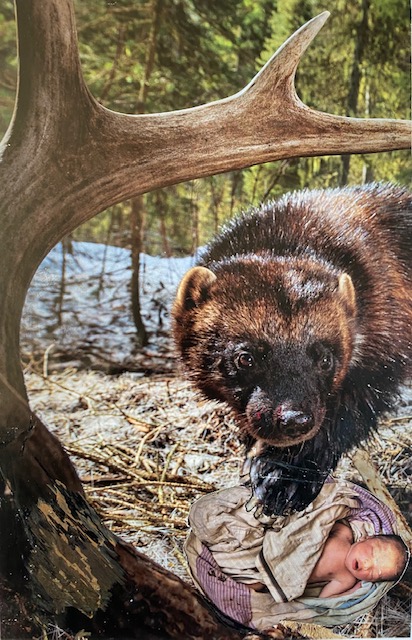
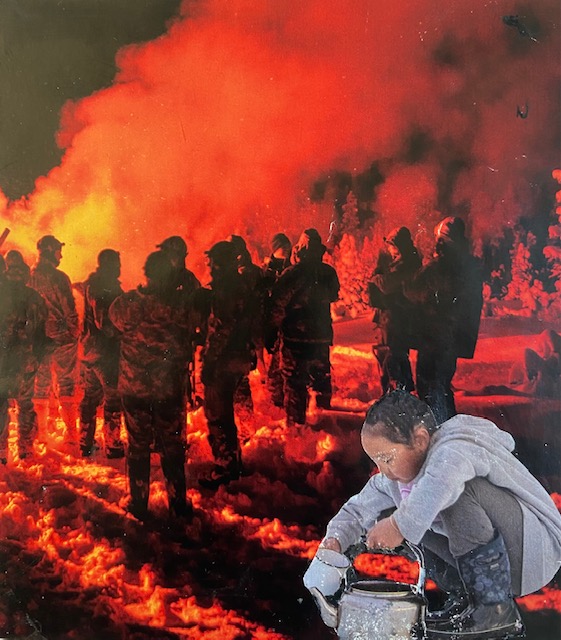
Reflection
It seems to me that Collage offers a great opportunity for imagining otherwise. Some have categorised our contemporary cultures as ‘a crisis in imagination’. For example, in his book, ‘Crises of Imagination, Crises of Power,’ Max Haiven (2014) argues that capitalism has colonised how we imagine and express what is valuable: creativity itself has been privatised. Haiven argues that capitalism is not in crisis – it IS the crisis. I would agree and argue that any solution to the problems we face, including our relationship with ‘other nature’ including ‘other animals’ cannot be a technological solution based in a capitalist expectation of profit arising from the technology. As Heiver argues, moving beyond capitalism is the only key to survival. I have not included reference to capitalism in my collages above, but I could do, especially using text.
With regard to a reflection on the collages produced here – for me, work that relates to my own experience allows for a personal connection and emotional content, in a way that the other collages I made before bringing in these references (see ‘process’ page), did not. I enjoyed making these works very much, and I’d like to develop them into larger pieces. I think that using torn-up former drawings from previous drawings of North Yorkshire is a good way both to situate the ‘imagining’ in a familiar and emotionally connected location, as well as to repurpose and develop those former drawings. Former drawings of the rocks, caves, erratics and land are based on observation: in fact there are few animals in the landscape higher up in North Yorkshire, and I had not formerly imagined animals in this landscape, particularly in unusual relationships. I am also reminded about how much I enjoy using poetry/narratives in my work – using both my own poem (written during unit one), as well as the poetry of Ted Hughes) was inspiring.
Overall critical reflection at the end of Unit Two
During unit two I have produced work using three different methods: site specific installation, the miniature, and collage using repurposed drawings based on observation of the North Yorkshire landscape. On this page I have included images that I think are further resolved. Other works, (especially more collages) are on the ‘process’ parts of my blog. The works on ‘The miniature’ also include some drawings of archival objects following a lecture I attended at the research festival in Stockholm (see the ‘Contexts’ pages for a report of the lecture on colonising objects).
All the methods I have used are ‘tests’ to exploring the research question for my focus this year on interrupting the violent iconography of other animals.
For me all the methods are useful in questioning our relationship to other animals. Perhaps because the site specific installation was more immersive, and more immediately concerned with the environment to which it responded, it generated more discussion and feedback – it appeared to produce an emotional reaction. I guess, too, that this was not only because it was site specific, but because it included a video of cows in an abusive/exploitative, and likely deadly situation, and also included a figure of a child holding a cow, which might also be relatable for the viewer. Finally the context was familiar to all of us – a kitchen where food/nutrition/nurture is the fundamental purpose.
This makes me think about making further site specific work, but it does depend on me being able to find, or be offered locations for this . Additionally, my research in the past has used Critical Discourse Analysis as a research method, and I am interested in how site specific work can challenge discourses of human superiority. I have some initial ideas about how to focus this in unit three.
However, while I feel excited about such a proposal for unit three, I also feel slightly disappointed not to develop the Collages. I have some feelings of tension regarding future work. On the one hand, while I am very pleased with the installation work, and particularly the responses I had in relation to it, I found the actual making easy; I have some strange feeling it should be difficult. It did require many decisions (about placing, colour, design, setting up), and while I found it challenging in relation to time available; it drew on skills I already had. Additionally the outcome did not pose any big surprises for me – it developed as I went along, but not in hugely unexpected ways.
In contrast the Collages did develop in unexpected ways – I had not expected to use repurposed drawings of the North Yorkshire Dales. I had not considered developing my observational work in North Yorkshire along the lines of ‘imagining otherwise’. I had not considered incorporating my own prose-poem into the collages. These ideas were the outcome of making many different drawings and collages as ways of thinking. In fact I enjoyed making the collages BECAUSE they developed from a process of drawing and re-drawing/making and re-making, so that the outcomes were unexpected and contained some surprises for me. I think this element of surprise, and delight is important.
I’m left with a conundrum. Site specific work is exciting for the opportunity to critique discourse (drawing as a method of critical discourse analysis was a focus from the start), as well as to draw the audience into a more immerse experience. I also like the opportunity site specific installation brings for making works using many different mediums – including video.
Collage, based on the North Yorkshire Dales is exciting for me, as an artist, to produce visual work that I did not know was inside me. A focus on the North Yorkshire Dales is also very emotive for me personally.
It’s hard to see how these two methods can be combined – in a way they are both site specific and the sites are totally different/separate. But in addition they are based in different notions of what ‘art’ is. I am struck that this tension relates to one of the overall research questions about all my work that I flagged on my Artist Statement page:
‘How can I bring my drawing into the public sphere and move toward a dialogic practice (Kester, ‘Conversation Pieces’ p. 23: dialogic art necessitates a shift in our understanding of what art is – away from the visual and sensory (which are individual experiences) and toward discursive exchange and negotiation).
Perhaps site specific, or installation work generally, is more dialogic involving discursive exchange and negotiation, while collage is more personal, visual and sensory. Perhaps I can continue developing them both side by side – if time allows. And perhaps I can think about whether the two necessarily must be divorced in our understanding of what art is – I think this has been one of the struggles I have had in site specific work – I find myself asking, ‘but is it art?’
I realise I have not mentioned the miniature in this final reflection. This is because, while I very much enjoyed working on the miniature, and particularly enjoyed returning to experiment with combinations of different medium e.g. biro with silverpoint, gold leaf, experiments in layering with Dura La – I do not feel it is the most effective method for addressing my research question.
At the end of Unit Two I have a number of ideas for taking my work forward during unit three:
- Exploraton of the tension in contemporary culture between the ‘cute’ animal toy or animation, and the reality of violence toward other animals.
- Further exploration of the violence at the heart of the home – the kitchen as a place of violence AND nurture.
- Further exploration of John Berger’s statement that none are so marginalised or invisible as other animals, with work specifically focused on these concepts.
- Response to the Welcome institute’s current exhibition – ‘MILK’ – recognising the exploitatoin, abuse and killing involved in production and the milk industry.
- Further development and investigation into collage as a destructive/relational methodology giving entrance into possibilities for ‘imagining otherwise’. Perhaps also a methodology that can combine the visual/sensory with the political? Perhaps, too, working on a larger scale.
- Continue work on the idea of colonising objects. Adding to my collection of objects of violence – archiving them and possibly using them in installation (as I used the mincer in the bargehouse work)
NB. At the end of Unit Two, I have decided to continue working on an installation called ‘The Museum of Human Violence’ in unit three. which will critique discourses that underpin our values, beliefs and practices regarding non-human, and Hunan animals and the land. My focus will be ‘Schooling’. I see how The Bargehouse site-specific installation, ‘I Learned Not To Look’, could be a ‘Gallery’ in the larger idea of ‘The Museum …’ (I would take away some elements, and add to it in a way that focuses it more on the Home, and specifically the kitchen, and removes its site-specificity).
References
Avani Ashtekar (2022). https://blogs.lse.ac.uk/lsereviewofbooks/2022/07/15/book-review-experiments-in-imagining-otherwise-by-lola-olufemi/. (Accessed 1 March 2023)
Berger, J. (1977) Ways of Seeing. London: Penguin.
Berger, J. (2009). Why Look At Animals. London: Penguin
Ferguson, R. (2002) ‘Attention Level.’ In C. Gould (ed.), Charles Le Dray, Sculpture 1989-2002. Philadelphia: Institute of Contemporary Art, 13-24.
Hagan, S. (2002). ‘The Bone Collector.’ Review of Charles LeDray, Sculpture 189-2002, Institute of Contemporary Art, Philadepphia, May 10-July14, 2002. Philadelphia City Paper. May 30, 2002.
Haiven, M. (2014) Crises of Imagination, Crises of Power, Canada: Fernwood publishing.
Kinchin, J. A design history of childhood, MoMA curator. https://www.themarginalian.org/2013/03/18/century-of-the-child-moma-book/
Knappett, Meaning in Miniatures: semiotic networks in material cultures. Conference Paper.
McLuhan, Marshall (1964). Understanding Media: The Extensions of Man
Olufemi, Lola (2021) Experiments in Imagining Otherwise, London: Hajar Press.
Sandino, L. (2004) Here Today, Gone Tomorrow: Transient Materiality in Contemporary Cultural Artefacts. Journal of Design History. Vol 17. No 3.
Stewart, Susan (1993) On Longing: Narratives of the Miniature, the Gigantic, the Souvenir, the Collection, Duke University Press.
 Drawing As Critique