This was a small but beautiful exhibition of many different kinds of Artists’ books. I am particularly interested because I would like to make a book for unit three, that summarises my research.
Below I have chosen books that most interested me for the way they were made or for the subject matter. Often I have chosen a book because it contained text in one form or another – I have not included all books in the exhibition.
I’m interested to see that the majority of books I have chosen are by artists from the Middle East (I am not sure whether this reflects the exhibition as a whole, but I have noted before that UK artists as well as artists from the USA tend in the last 30-40 years to be less concerned with political and social justice issues. I am not sure whether this is changing – certainly many artists in developing countries are now concerned with ecological issues- sometimes from a political perspective). In fact I think there was a section of books that specifically focused on conflict, violence and displacement and it may be that I gravitated toward that section. (Jim Dine seems to be the exception!)
The books are in glass cases which means that the photographs are poor with light reflection in some.
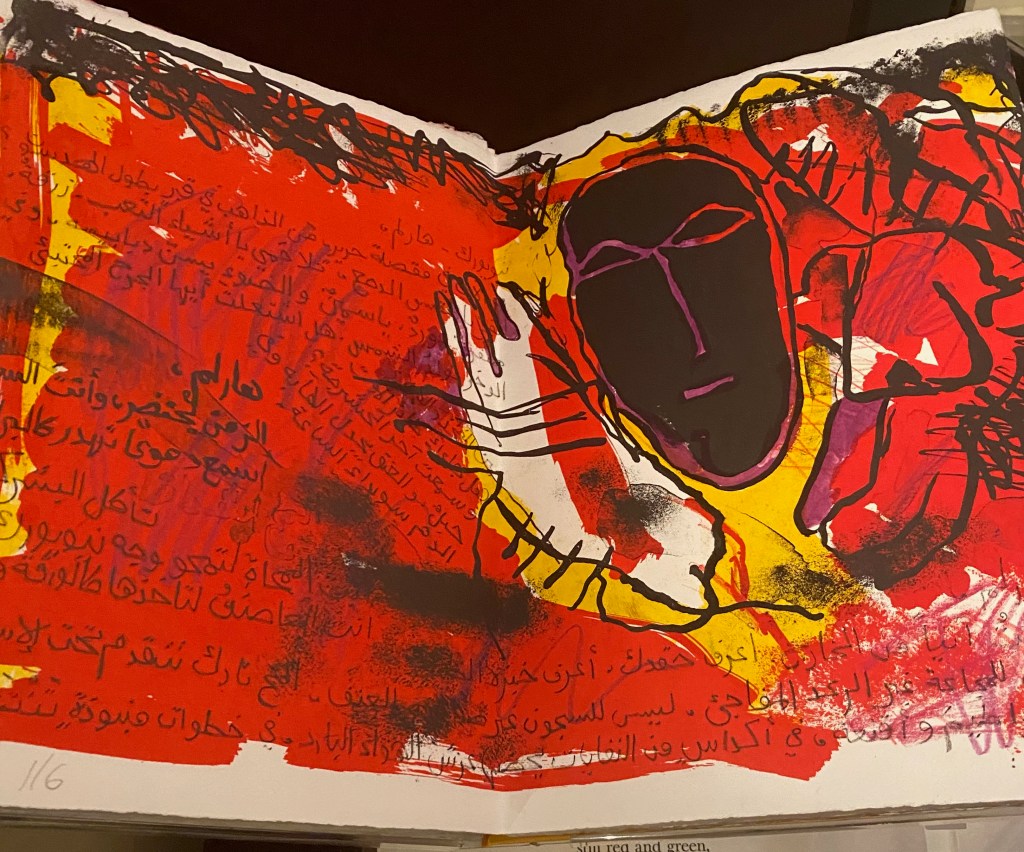
Dia al-Azzawi made Adonis LX to celebrate the 60th birthday of the Syrian poet Adonis (Ali Ahmad Said, born 1930). Each page is inspired by a different poem, extracts of which Azzawi has written in his own hand. Each composition is abstract and in bold colour with a face.
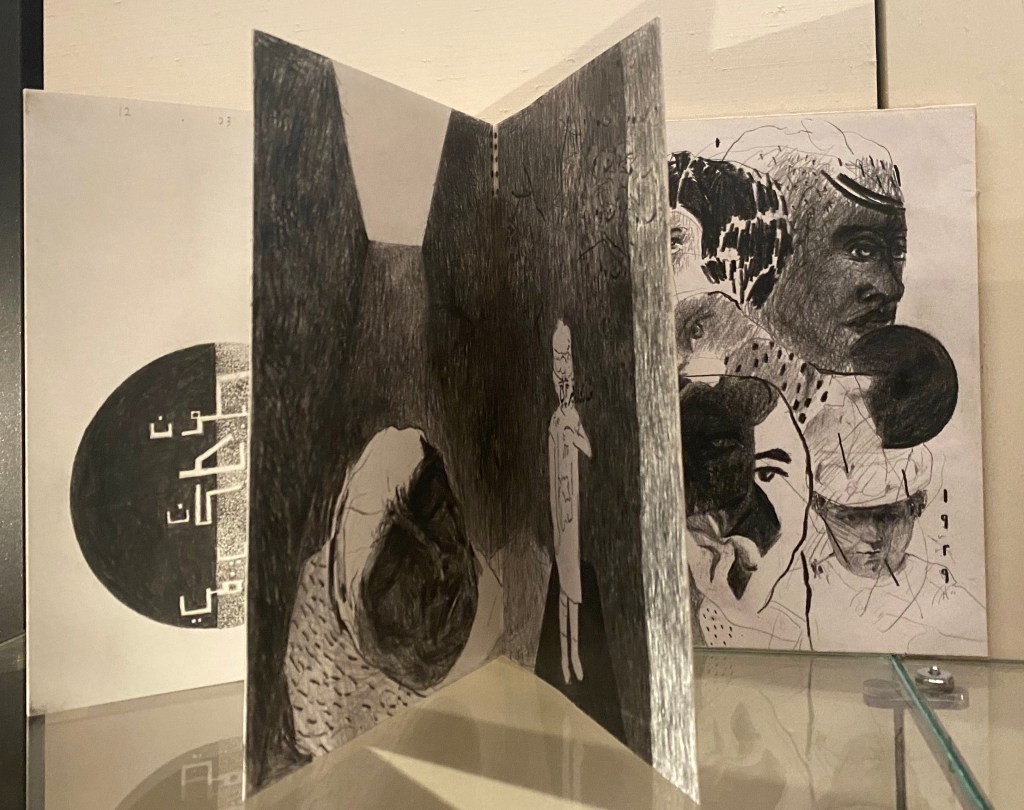
This autobiographical artist’s book explores the artist’s family history, and shed’s light on his complex relationship with his father. It revolves around an archival photograph taken about 1934 in Beirut. The broken up arabic text contains the words ‘one day I will visit my father’s grave. It will be like it used to be in the past when he was alive. We won’t exchange a single word.’
I chose the book below because it has a dialogue running through it. It’s possible that my artists’ book may have the same:
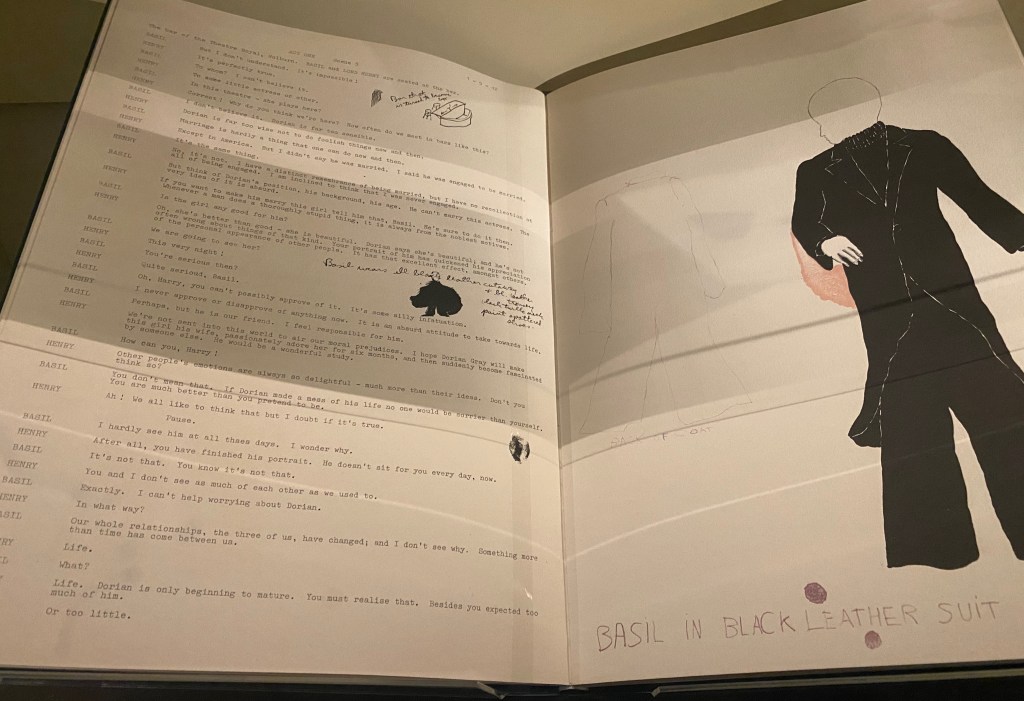
I chose the book above because it is made by Jim Dine, an artist I am already interested in and have written about previously, but also because it is Dine’s script adaptation of Oscar Wilde’s 1891 novel ‘The Picture of Dorian Gray’. Robert Kidd, director at the Royal Court theatre, London, asked Dine to design the costumes and sets for a play based on the novel. The project was unrealised and Dine used the drawings as the basis for a series of lithographs to accompany a typewritten text of the script in this book.
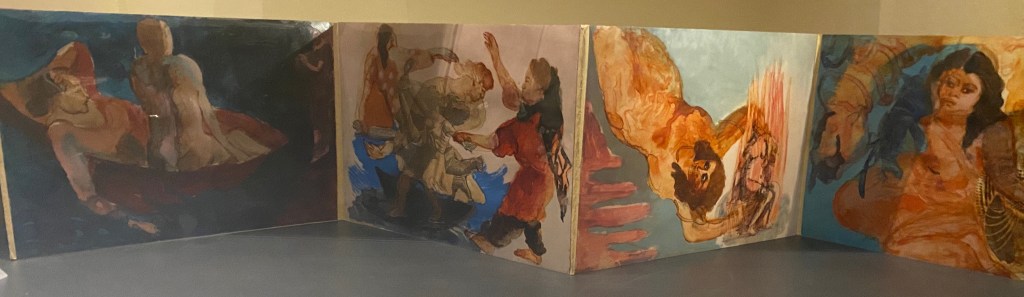
Malani is a video artist as well as book artist. Her drawings extend along both sides of the book – on paper on one side, and onto mylar on the other. They reflect her experience of partition, as well as themes of violence, feminism and racial tension.
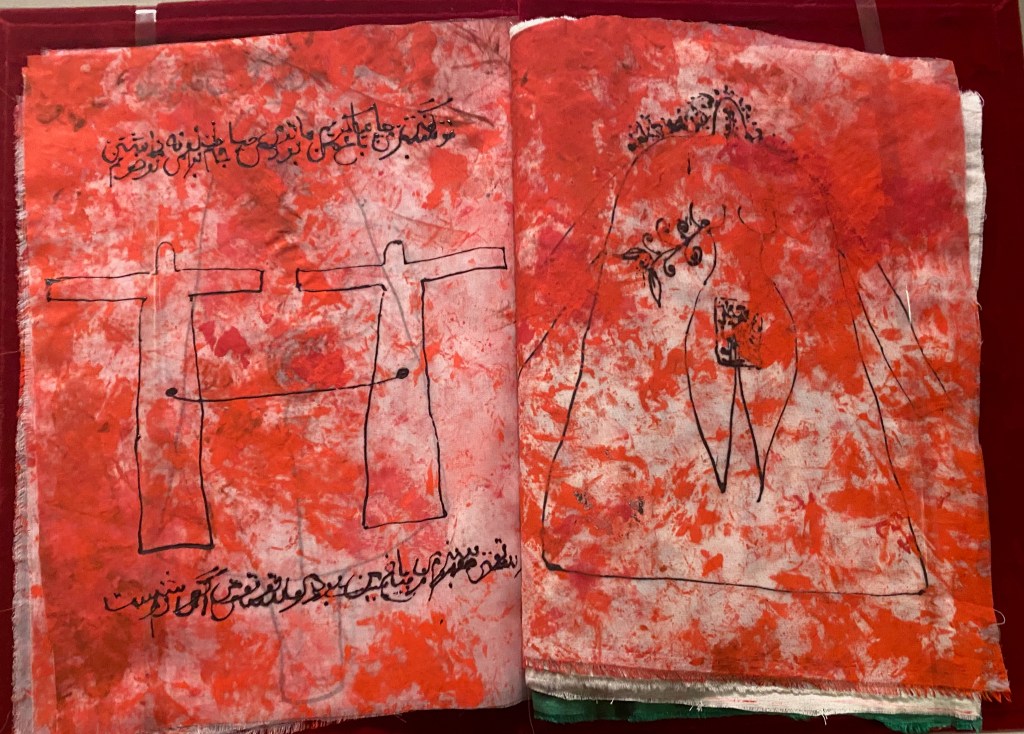
Here I am interested that Shahroudi has drawn on different fabrics and used both drawing and text. She questions the stereotyped representations of women in Iranian. society. Her figures are rendered as simple shapes and her words are not intended to be read.
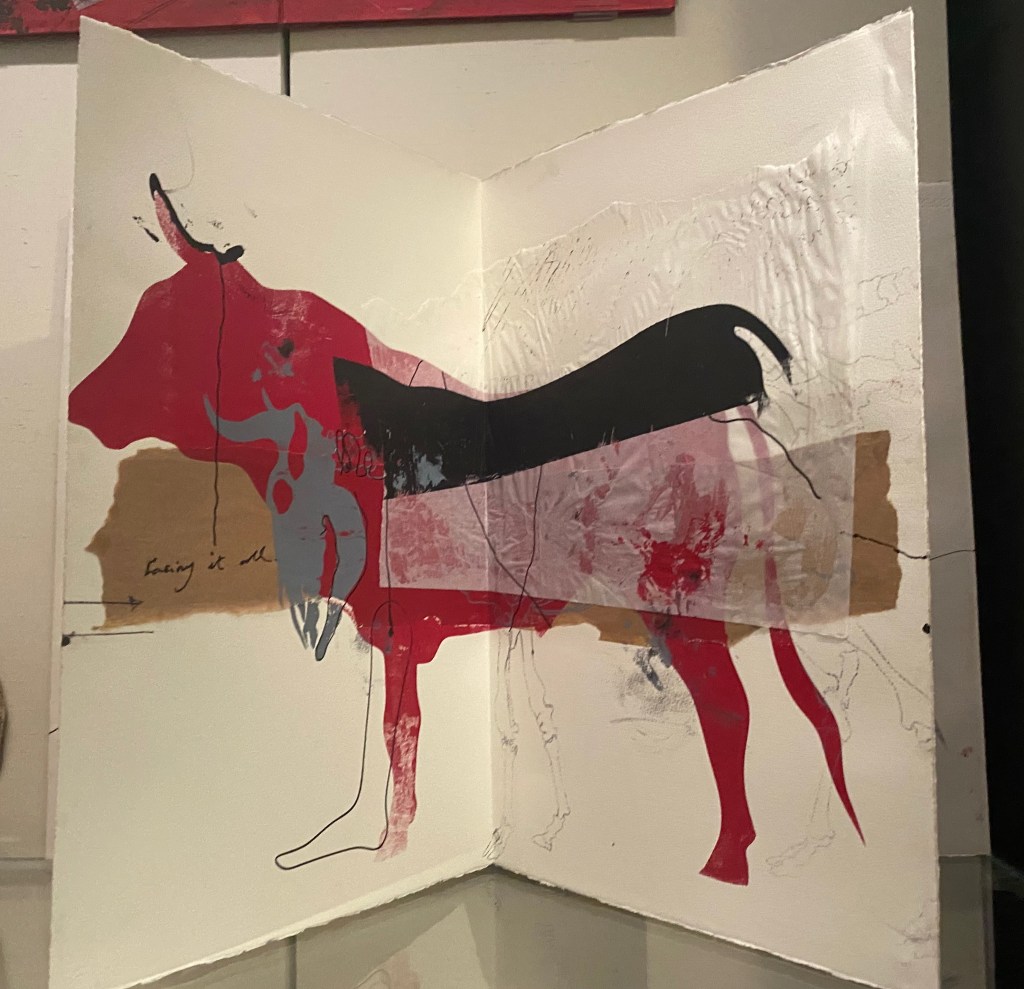
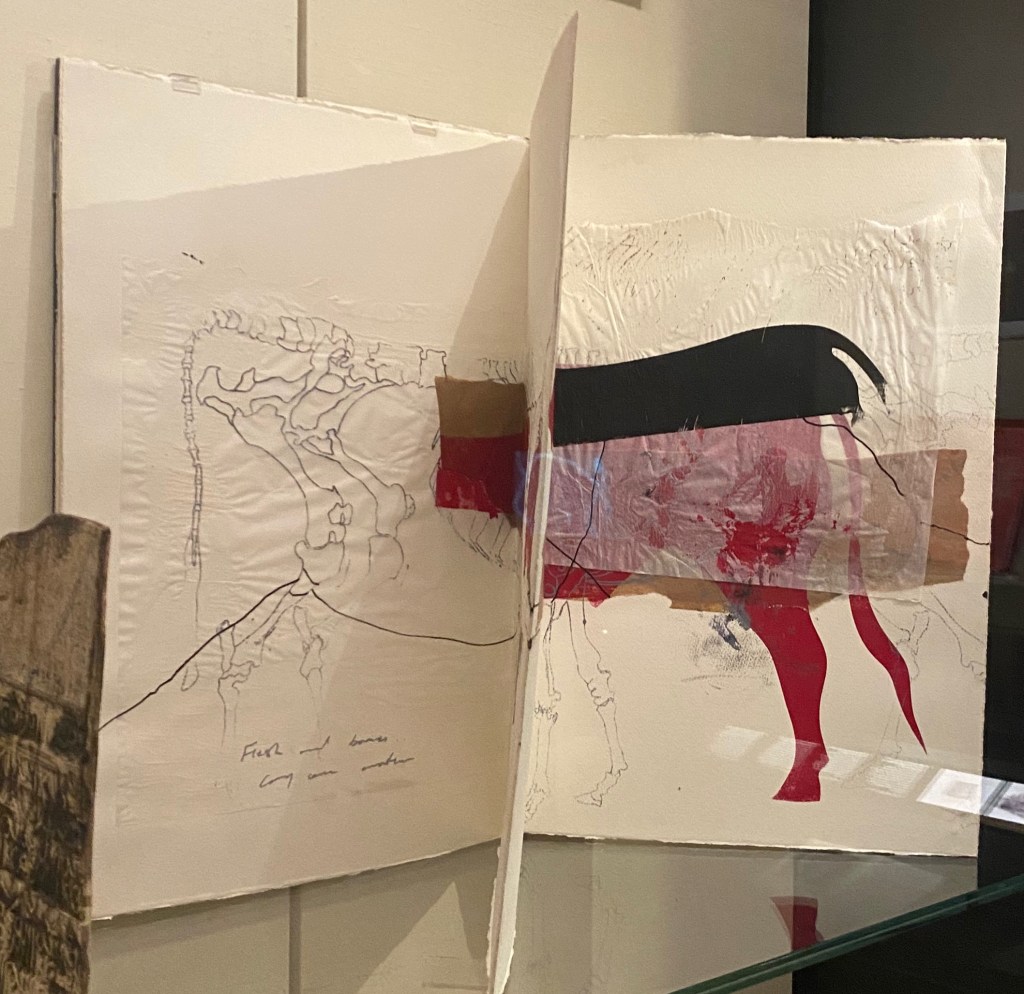
As the book unfolds one figure of the bull meets another. The artists explains that she imagines life and death meeting. The bull apparently represents a burdened human who takes more and more upon themselves.
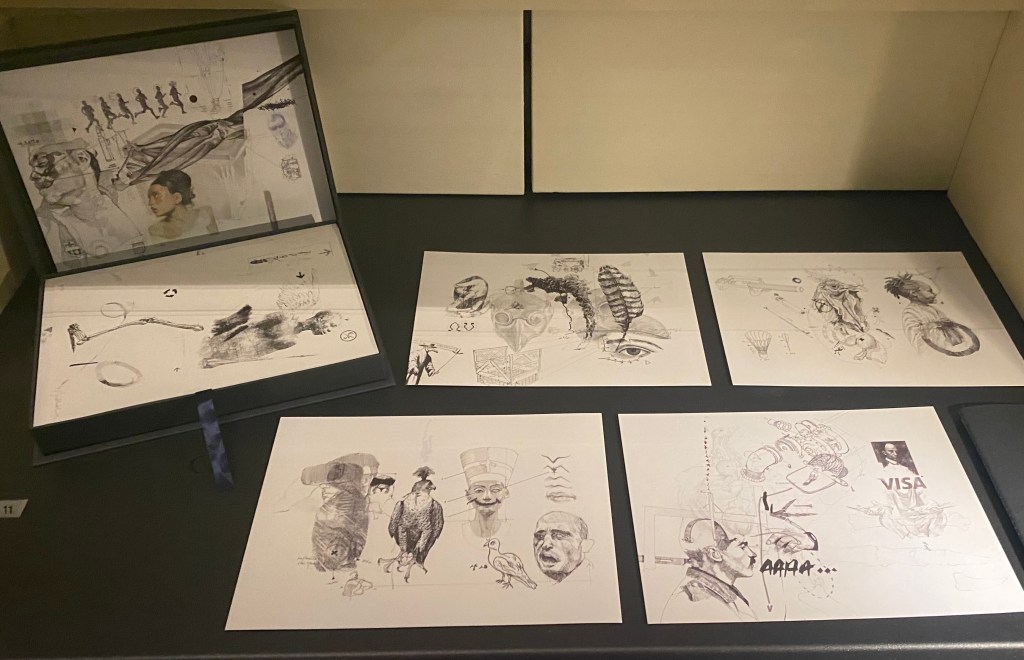
The collection takes its name from mneme, The Greek word for ‘memory’ which sounds like the Arabic word for sleep or dreaming. The work reflects upon colonial domination and Tunisia’s recent history. Birds, scenes of violence and faces emerge as tough random images in a dream.
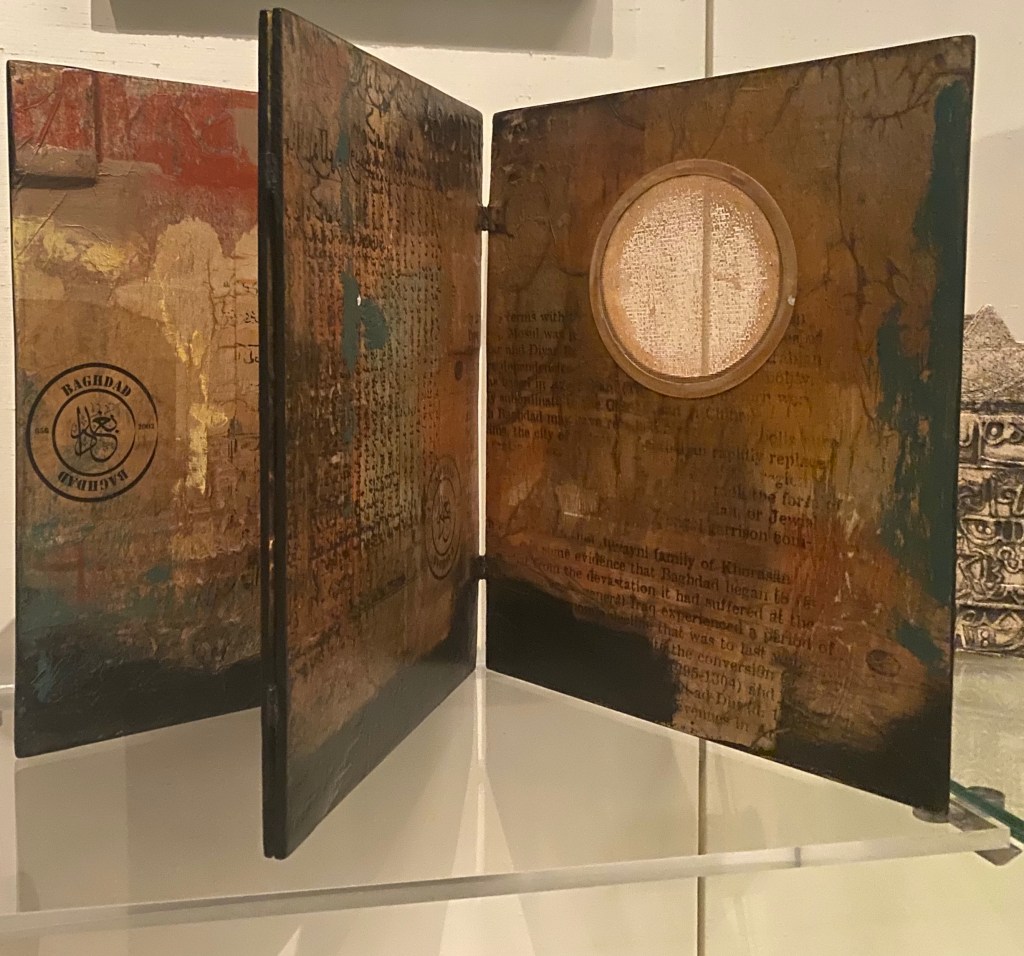
Shammarey places the attacks on Baghdad during the Draw War of 2003 with a historical context. Against a fiery background phrases in Arabic and numerals are placed. The stamped English text is from an account of the siege of Baghdad in 1258 when the city fell to the Mongol ruler Hulagu Khan. This cataclysmic event ended the centuries old caliphate.
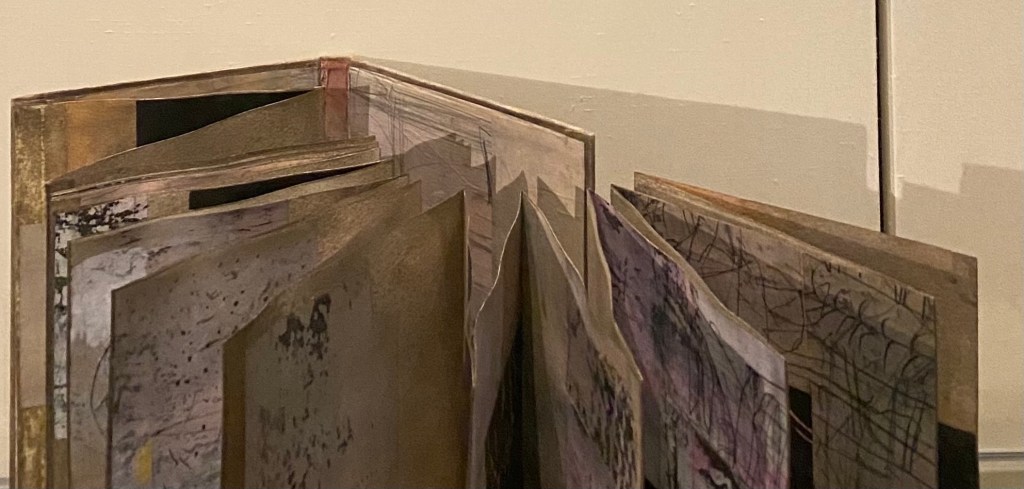
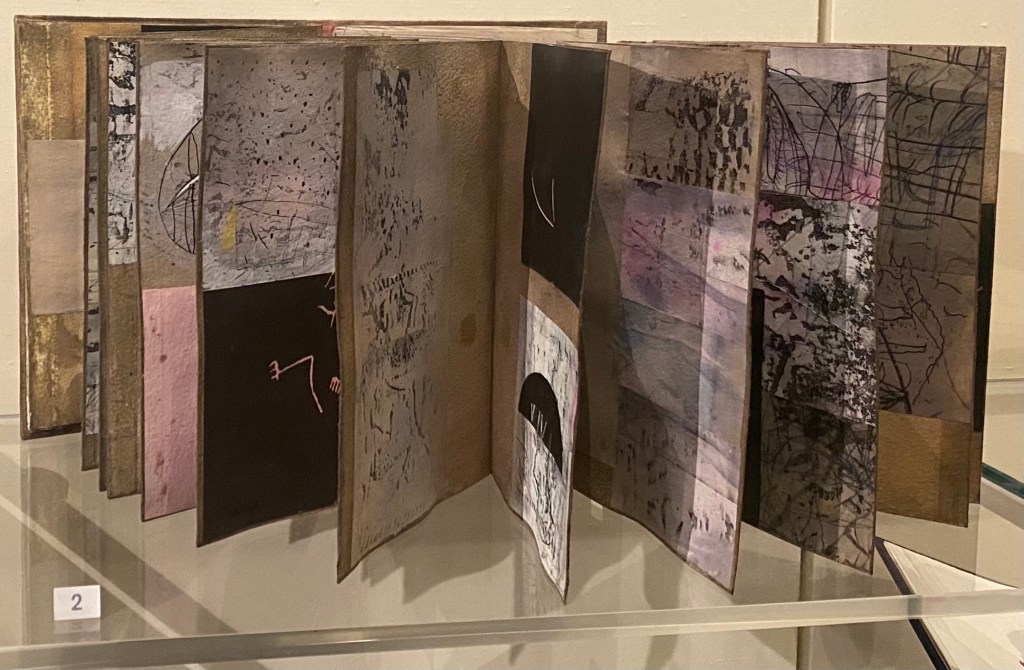
Dawood has drawn inspiration from the writings of Sufi mystic al-Hallaj (858-922). Abstract motifs, lines and signs are found on the pages. Dawood explains that these are not an explanation or visual rendering of the visions, but ‘communications and ambiances that resonate within it’.
I like the format and colours of this book. I wondered whether the drawing are on each Side of the page, but the top photo seems to suggest they are not.
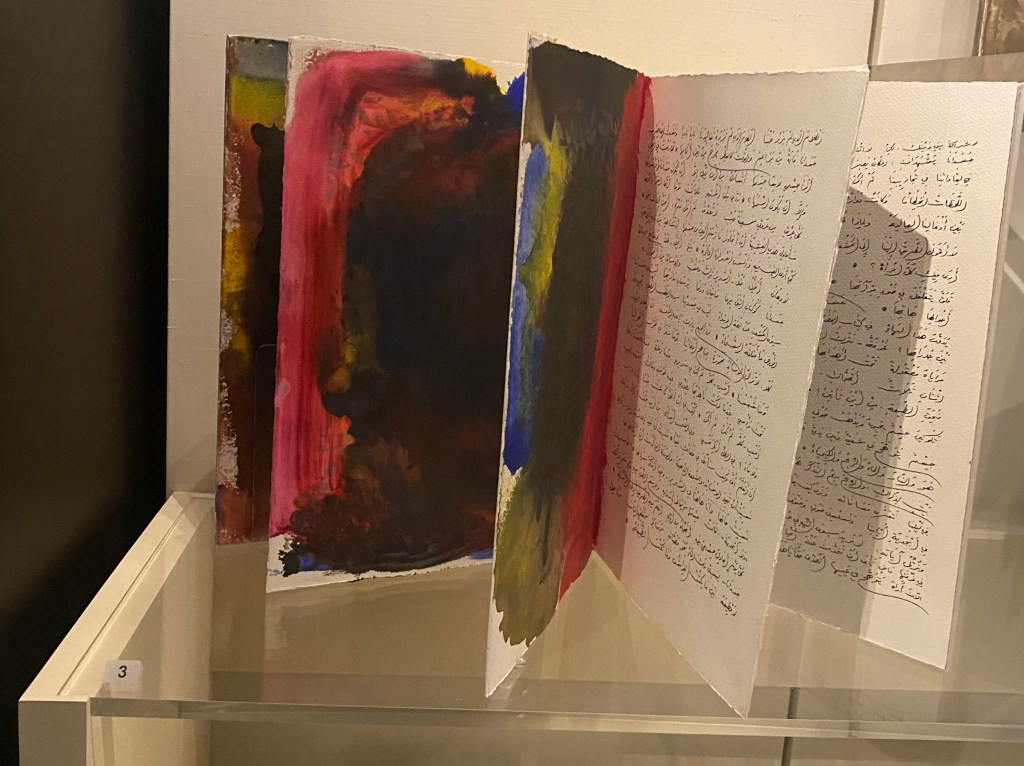
I note too that quite a number of books I have selected combine poetry with visual art. I am currently exploring the animal poems of Ted Hughes and this could be one way forward for me, although I feel I would want to go further than ‘illustrating’ poems, and bring some of the theoretical research I have been doing into the book. I could do both. Or I could leave out the Ted Hughes poetry and concentrate on imagery with theoretical writing.
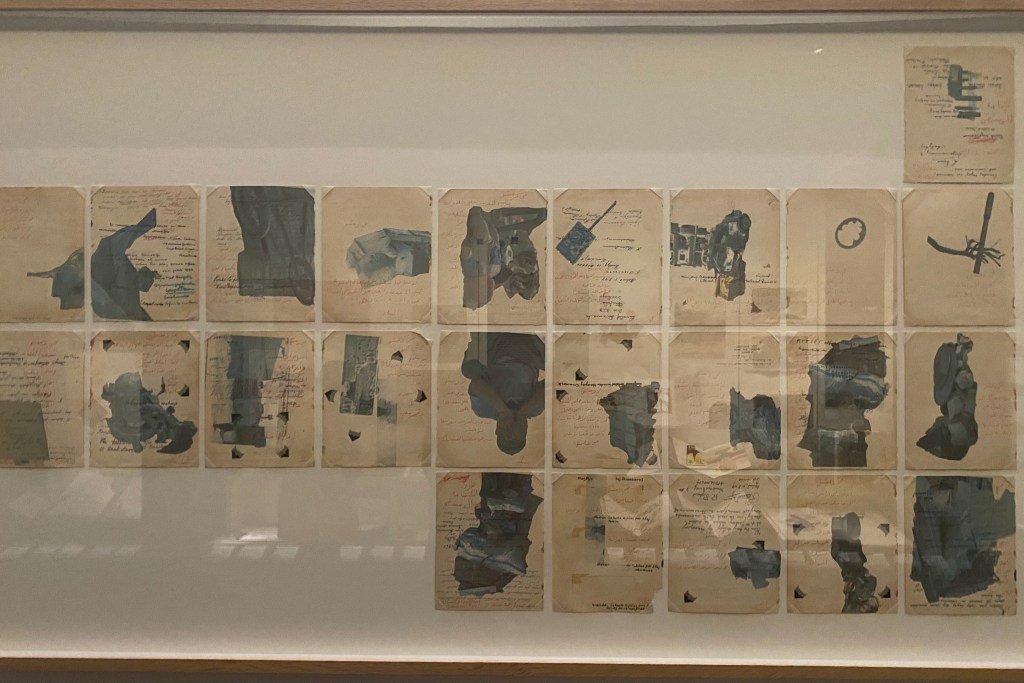
Kourbaj explores the effects of the civil war in Syria that began in 2011 to 2012. The pages are from a found diary, some of it written in Esperanto. In red crayon are the verses, in Arabic, of Darwish’s ‘The Damascene collar of the dove.’
I like the idea here of the pages from the book being displayed individually rather than in book form.
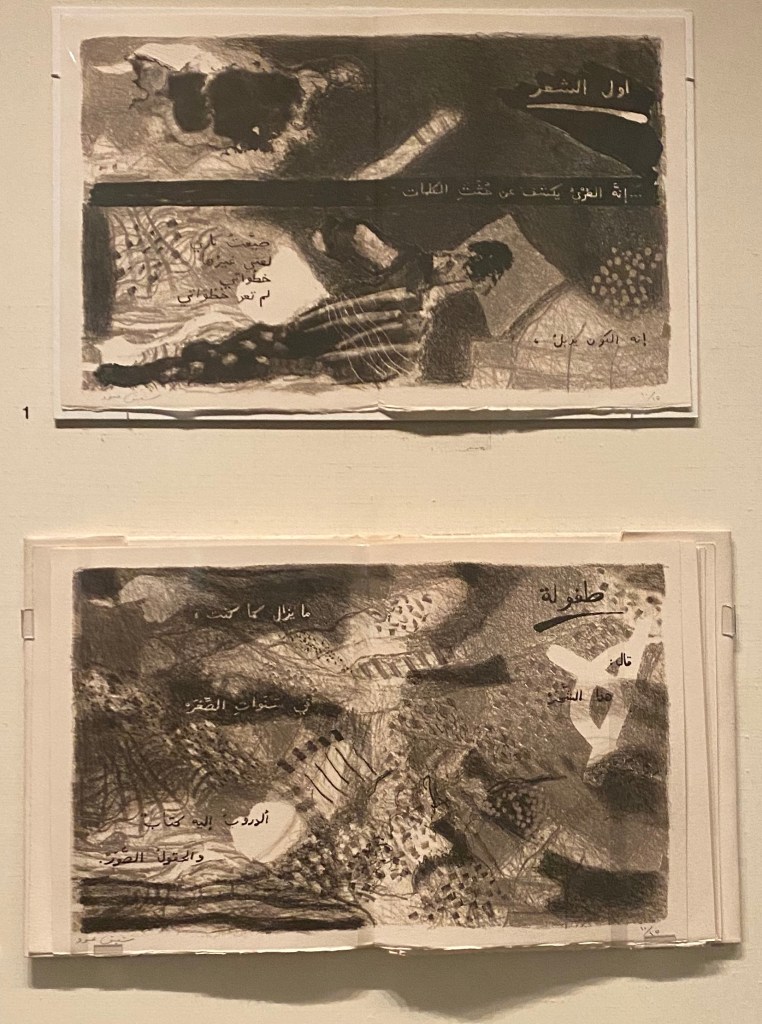
Here Abound has handwritten text from Adonis’ poems on top of lithographs. I think this is powerful – the words of the poem are equally powerful – …it is the nakedness that uncovers the corpses of words/ it is existence that shrivels/I lost my fire/ my language is another one/my footsteps/are no longer my footsteps…
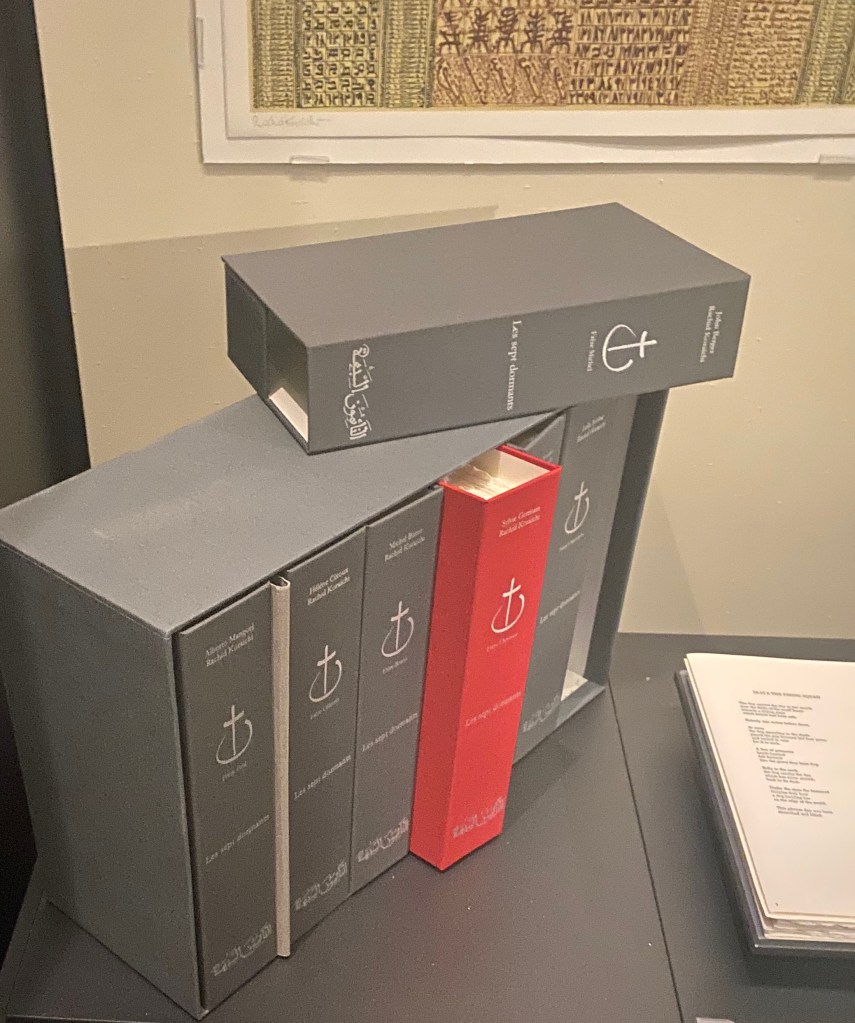
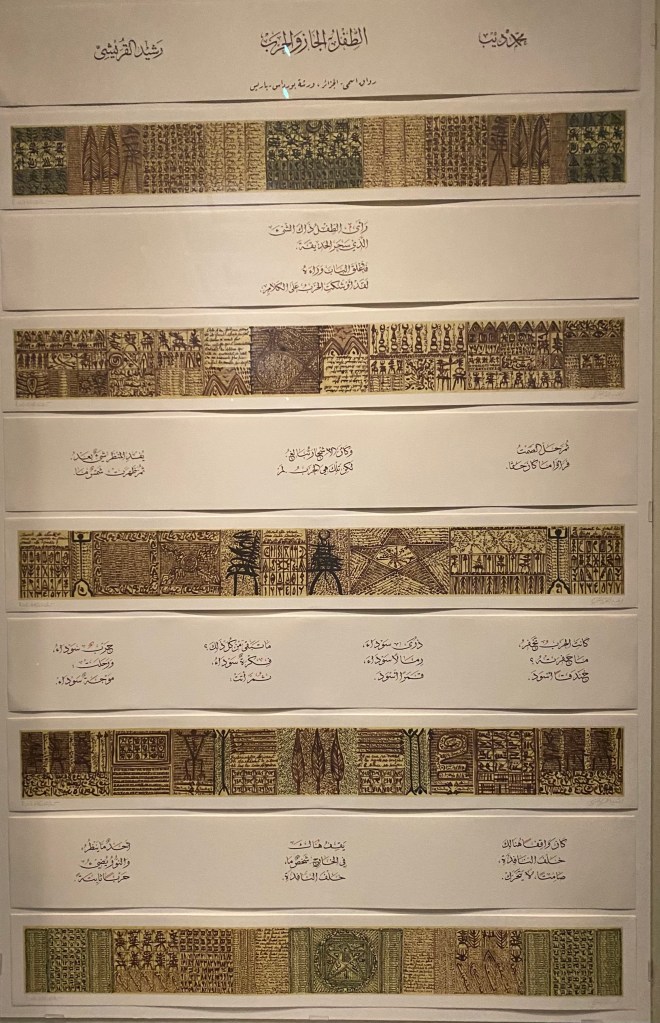
Koraichi is a textile, ceramic and installation artist, who also makes books. He uses Arabic text combined with magical signs and symbols recalled from traditional facial tattoos or pottery designs from the district where he grew up. He works with writers and poets and the books here are concerned with two major events in the recent history of Algeria: the war of independence with France and the assignation of 7 monks in 1996. The first, ‘Jazz boy and war’ is a story told through the eyes of a boy and is an abstract narrative poem about loss, written by Mohammed Dib.
Reflection
I am very keen to make an artists book. There are a lot of ideas for different ways of presenting the pages of the book here. Poetry and text are used together in many of these books, and I think I would want to do the same – whether my poetry or someone else’s. I could use my North Yorkshire poem, but I am wondering how I could combine with that some text from philosophers on violence toward animals?I am wondering too about using collage as my method, drawing on the ideas I have been exploring in the ‘Imagining otherwise’ series’. I guess the thing about using poetry is that it does not need to be sequential. It can be interspersed amongst other kinds of writing. I will continue to think about this. I like layering, alongside text, used in the Shawa book. I also like the idea of one thing becoming another in the same book (I’m thinking here of the Ted Hugh’s poem: enigma).
 Drawing As Critique