Proposal title: I Learned Not To Look: A site specific installation to interrupt the violent iconography of ‘other nature’ – specifically, farmed animals.
Please see the page on ‘resolved work’ for installation photographs, aims, discussion of ethics, and final reflection on this installation. This page is in the form of a diary with research information, discussion of ethics, and notes on the process of making/thinking.
OBJECTIVES: (at the start)
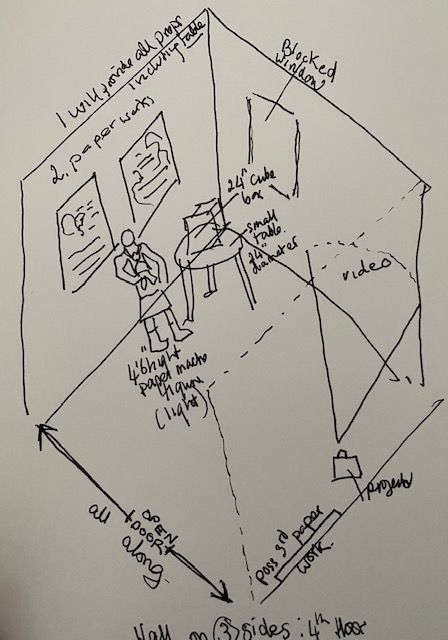
- A life size paper mache figure of a child (ME) . Wearing the jumper I still have that my father gave me at age 11. Holding a knitted cow (which I will knit) to represent the tension in our culture between the ‘toy’ animal that we love, and the real animal, that we kill and eat. I am interested in how we learn to dissociate and in how violence to other animals is normalised. I learned not to see violence or to see it and believe that violence to other animals did not matter – they did not feel pain or fear as I did.
- The figure stands next to a small table (that I will provide), covered in oil skin cloth.
- On the table is an oxo box (I will buy veg stock cubes and paint the box), and ground up stock cube on a plate
- Up in North Yorkshire this weekend I found an old ‘meat’ grinder in a second hand shop.
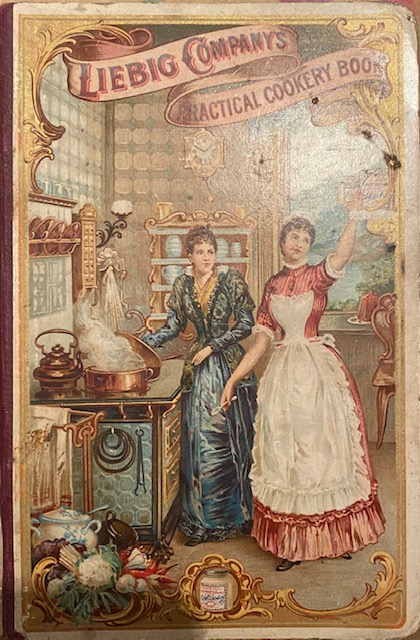
- I have also found a second hand copy of the recipe book published by Liebig and will use part of this in the installation
- The rest of the installation is not yet certain but I hope to include a drawing and video and soundscape of cows from the auction mart I will visit on 1 April 2023 (the same auction I visited as a child).
Research
I started by researching the Bargehouse and Oxo Tower and discovered they were bought by a company called Liebig in 1928. I disovered this by searching first the Metropolitan archives (which drew a blank), and then the National Archives, which brought up the fact that Liebig documents are held in a private collection held by the National Archives in Kew. I have written to ask if I may have access to these documents.
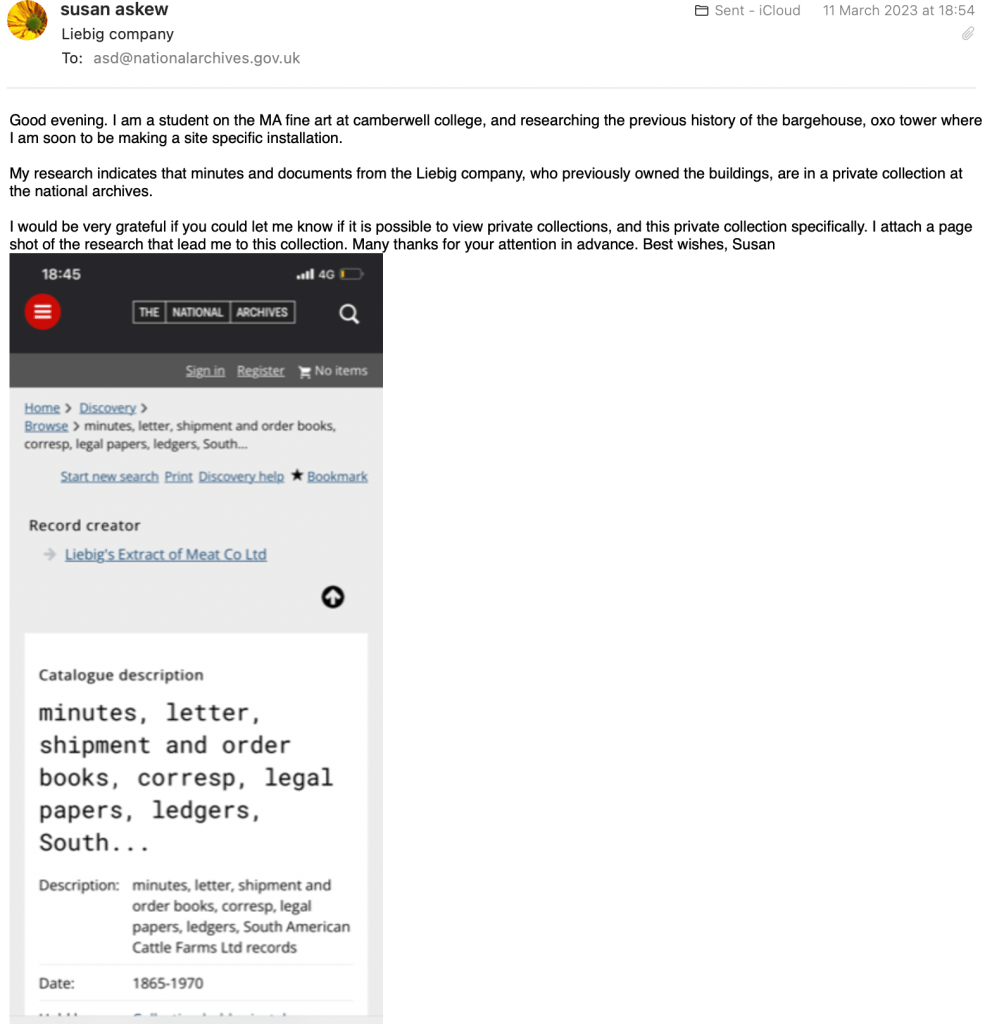
I also wrote to the Coin Street group who hold records of the South Bank area, but they seem not to have documents from before they took over the site in the 1970s.
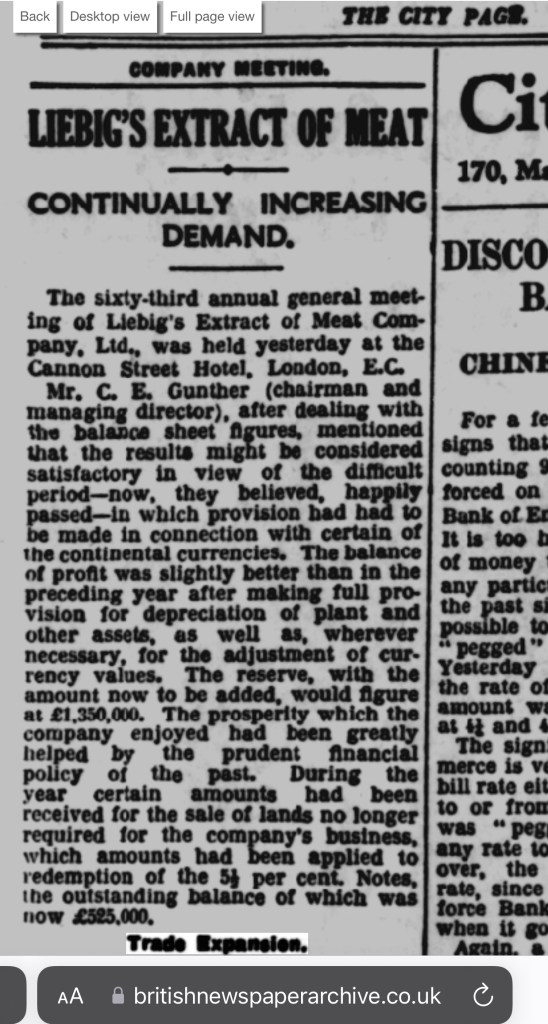
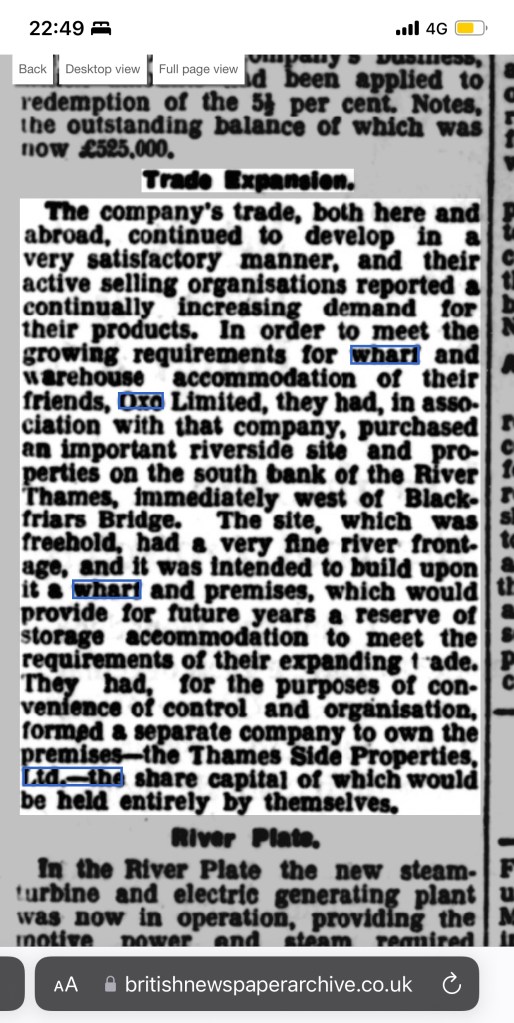
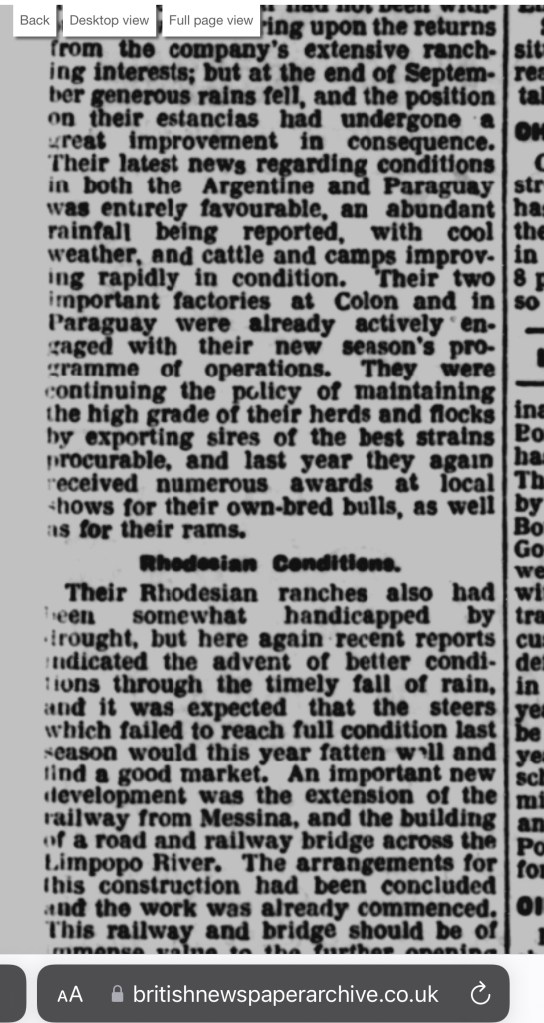
I found a search of the National Newspaper archives the most successful. A search of these brought up the report of the 1928 annual general meeting of the Liebig company (Liebig Extract of Meet Company – LEMCO for short). This was published in the city page of The Daily News and Westminster Gazette, Friday January 18th 1929, and gives information about the 63rd annual general meeting of Liebig, including the acquisition of what we know called ‘the Bargehouse’ in 1928 by their subsidiary company ‘Thames Side Properties’ (At this time the Bargehouse and buildings around it on the site were called ‘Stamford Wharf). At the point of buying the site was a power station producing electricity for the post office. the power station was pulled down and the remaining buildings extended and redesigned, including building the Oxo Tower.
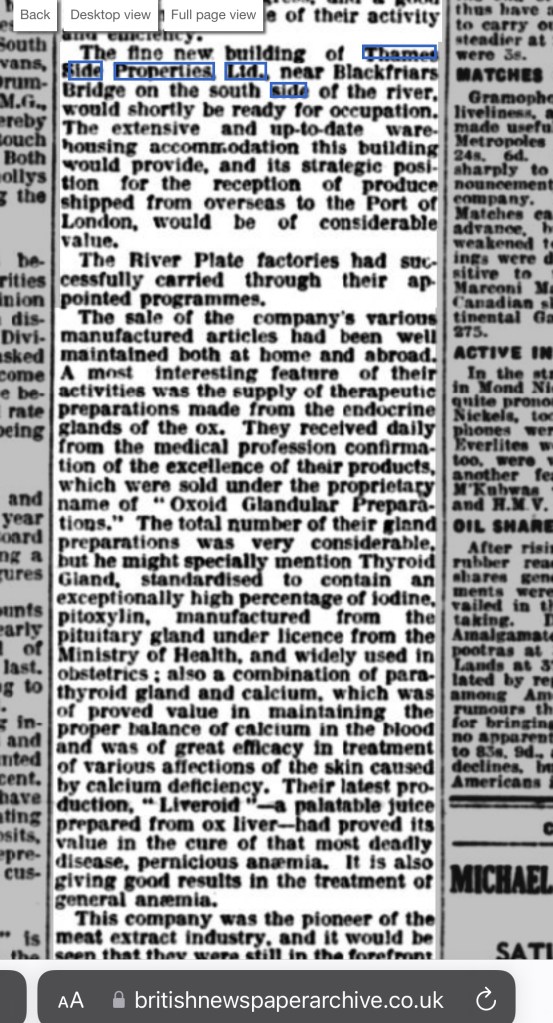
NB. The company was originally set up by the chemist, Liebig, to produce ‘Oxoid glandular preparations’ as medicines: see below.
It also refers to Liebig’s production of its ‘Extract of Meat’ in Frey Bentos in Argentine. Presumably Argentina was chosen because of the numbers of cattle ranches, but in addition cattle from Rhodesia (as it was called then, now Zimbabwe), as well as South Africa were also slaughtered. ‘Frey Bentos’ is the name of another Liebig product – Frey Bentos Corned Beef.
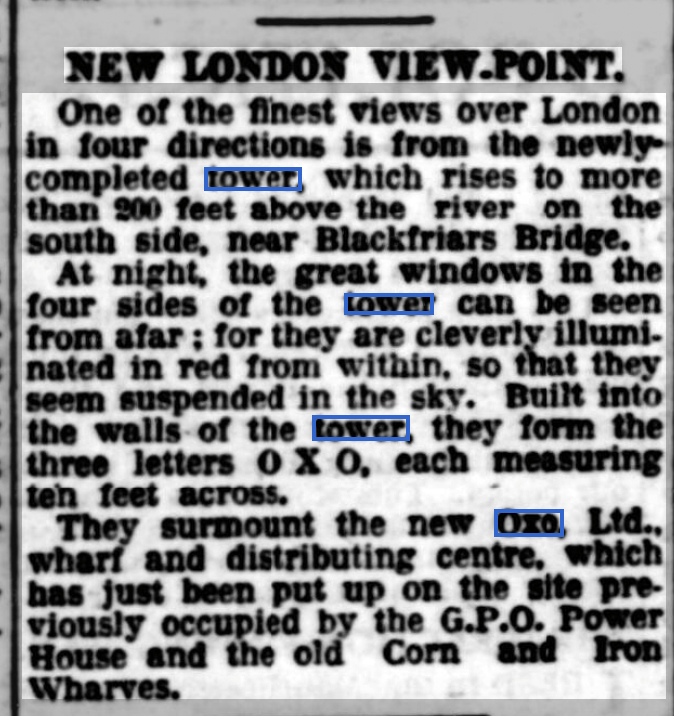
I also found a report of the opening of the OXO Tower:
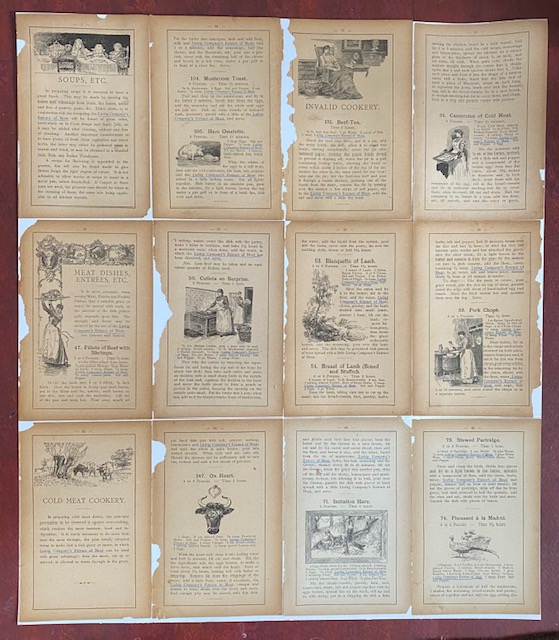
My research into the company also brought up various products made to advertise their products, including a cookery book which I was able to find and buy second hand online:
Making Work for the installation.
I started with a rough sketch of the site specific installation. Preiously I had visited the Bargehouse and I have requested a small, rather dark room on the attic floor for it. This is because I felt the very rough brick walls and wood plank floor would suit the period, and I think the atmosphere is ‘dark’. As one BA student, exhibiting at the time of my visit said, ‘It feels like a slaughterhouse’ (this was before I mentioned my work).
Work 1. Recipe book inside back cover and banner
Below is the last inside page of the Liebig cookery book. 2 copies were digitally printed on Somerset paper measuring 50 x 70 cms. I’m wondering about drawing or printing on it. In fact today I was thinking I may highlight specific words (Liebig and the para on how many animals killed) by gluing coloured tissue paper on top so the words show through. (It could even be white tissue).
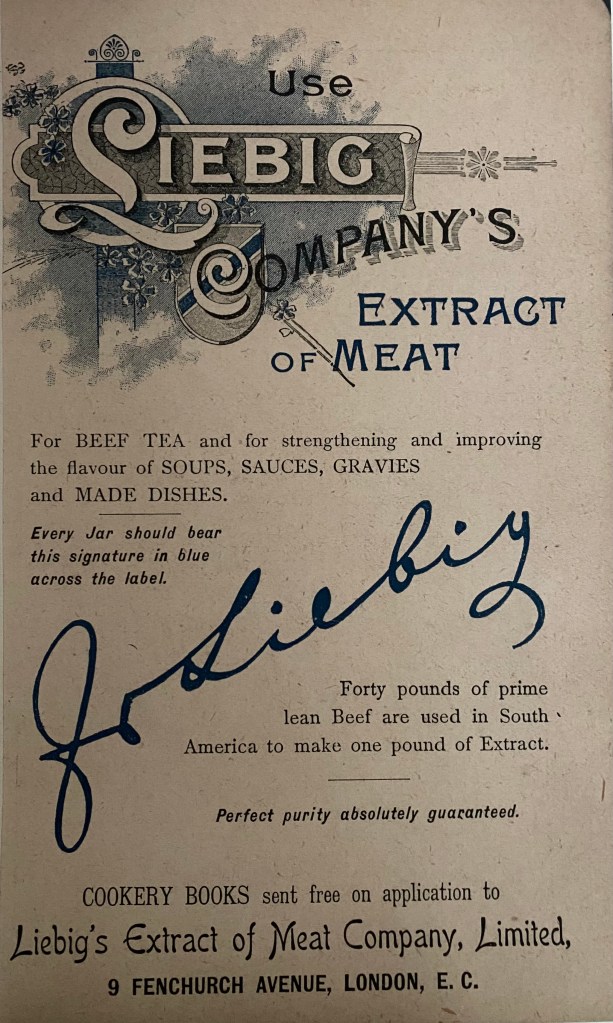
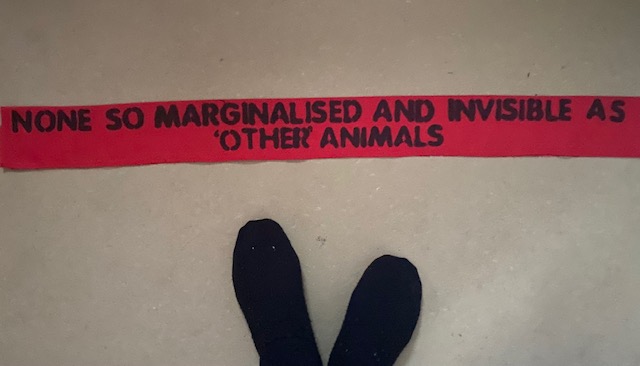
Draped across this will be a banner, reminiscent of the sash hung around the prize cow at the annual country show, with the same or almost the same lettering used below over the drawing. In fact I realised almost at the end of this project (after I had finished ‘work 2’ below), to my shame, that ‘nothing’ is so marginalised…’ (which is a quote from John Berger, but I need to check if I have misquoted him) objectifies other animals by turning them into things. Better to use No-one or None, as I have below. This also saves space and allows me to use larger lettering:
Tuesday 14th March
Today its 5 weeks until the show is put up at Bargehouse.
work 2
I’ve had two further ideas today for the installation. 1. another work alongside the recipe book extract above could be a drawing of a cow (or colonising objects) with letterpress printing over the top: ‘nothing is so marginalised or invisible as the animal’ (text from John Berger) . This could start off black and the lettering become less visible as it progresses. A second idea is to write a newspaper story about the acquisition of bargehouse – printed to look like a newspaper.Yesterday I spent all day in the Letterpress workshop, which is a great place to work. Freddie very helpfully showed me how to set the text (using Perpetua capital 72 point) for ‘Nothing is So Marginalised and Invisible as ‘other’ Animal‘. I intend making a drawing and printing on top of it. My idea is for each line of the text to fade until it becomes almost invisible, to mirror the invisibility of the murdered cattle.
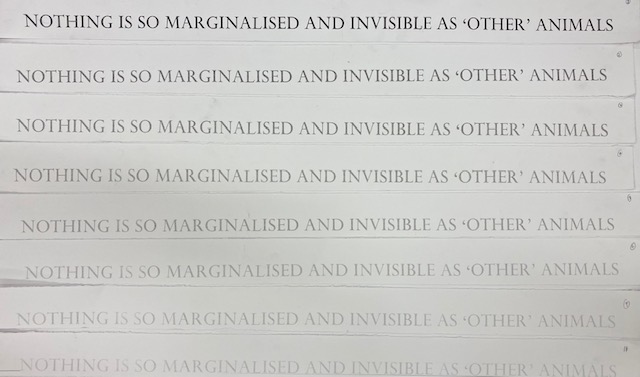
We printed it off several times on newsprint and white ‘Munken Lynx Rough 170 g.) paper to see if we could get the ink to fade as it was reprinted 10 times. It faded well on the newsprint but not so well on the white printing paper. I wondered if this is because the 5 sheets of newsprint used as packing were taped around the drum (but when I asked Freddie later, he says not – it’s because newsprint is very absorbent)
Today I am thinking about the drawing underneath the print. I haven’t decided what to do yet, and will draw it over the weekend for printing off next Monday. However I did make a quick sampling sheet on the paper that will be used (cut in the letterpress studio to 33 in x 21 inches to accommodate the whole sentence across one line and 10 rows of print). Below – the paper holds up fairly well to the medium – I have used collaged papers (both photocopy paper and Washi paper with inks on it), pencil, biro, tomboy felt tip pen, acrylic paint, gouache, water based inks, alcohol inks, Jackson’s black ink, felt tip pen on photocopy paper, `Karmin red ink. I’m imagining that because the collages papers mean the surface is not totally flat, the lettering will be uneven.
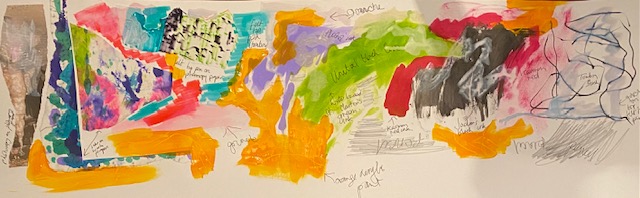
I did a second sample sheet with only dry medium including pencil, felt tip pen, biro and alcohol ink (which seems not to affect the paper)


We did put it through the press. Unfortunately because I had rolled the paper up to bring into college the rolled edge flew off the roller and didn’t print but generally it was a success and printed fine. This is goods to know for future work.
Friday 17th March
Unfortunately the strikes meant that the letterpress workshop was closed yesterday and today. However, I did make a start on thinking about the drawing underneath. I need to avoid large areas of black so that the writing stands out (although I think it will be fine if some letters do not stand out well given the stress on ‘invisible’). I will probably stick mainly to brown and white, with some blue and only a little black. I also think I should keep to dry medium so that the paper remains absolutely flat – so felt tip pen, biro, graphite, coloured pencil and charcoal would be ok (although maybe not charcoal because I think it might stick to the letterpress – and I didn’t try it out on the samples). This is a fairly large drawing and I only have two days to do it if I am to print it before the Easter holiday, and so it needs to be fairly simple I could use resist to get some more interesting texture.
I started by thinking about composition. I decided against drawing the colonising objects used on cattle, that I have been collecting (my first thought) because it seems important for cattle themselves to have some visibility here.
I decided on the composition below because a. it gives the sense of how crowded the conditions are, and b. I want to leave a lot of white on the page.
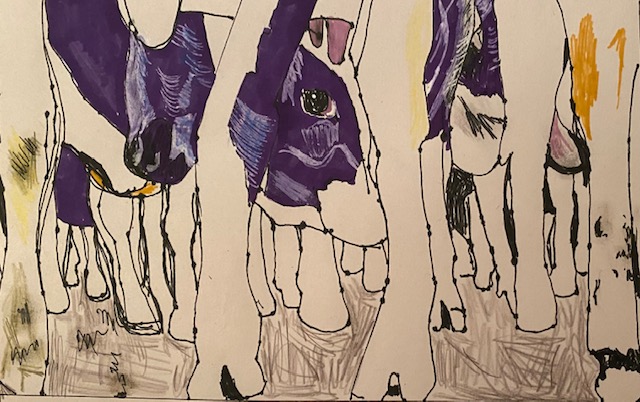
The eye is too big, the gap between two central legs slightly too wide. All the hooves could be slightly bigger. All the legs could be slightly wider. The bottom of the head on the left is too long – start it slightly higher up. I rather like the purple (maybe I could use a touch of it). I’ll try a second brown one and see what I think. I also want to do some resist experiments. I note my white biro works really well over felt tip pen (I’ve found it does not work well over other biro). generally I am pleased with the composition in relation to the text – there is also a sense of the cow hiding from us, and making him/herself invisible as possible out of fear of us which is a different way of looking at the ‘invisibility’ of the animal – not from the human perspective but from the perspective of the animal themselves.
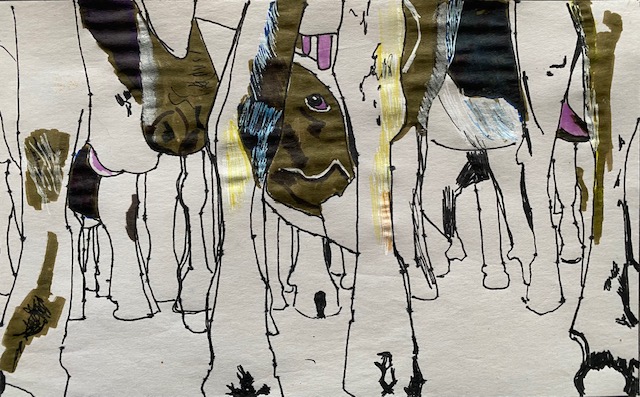
The size of the eye is better – although loses some impact – try to make it between the two! . The gap between eye and leg on right is too narrow – if I move it over slightly there won’t be such a large gap between legs on the right.All legs could be wider all the way from top to bottom. the colour is a little too green (it’s tomboy 027), rather than brown. It could work though if the ground is darker brown. . I think I will definitely lose all text if the two patches of very dark blue at the top remain this dark – keep to same paler colour. I’m not sure that the two middle hooves are any bigger than the first drawing – they need to be. Maybe start the drawing with the eye and work out.(instead of hooves which is where I am starting).
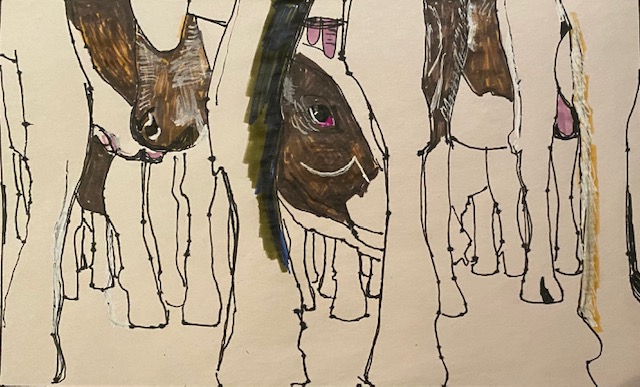
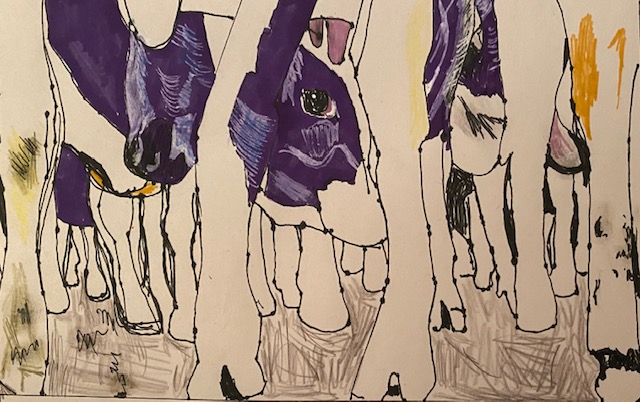
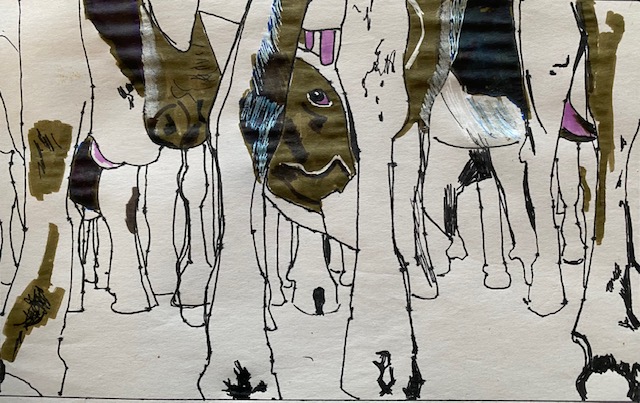
I have almost enough information to start the large drawing and I must finish it tomorrow if going to print it with letterpress before the end of term. I will do a few tests on the actual paper used for printing – the above are all on newsprint. It’s a pity not to use ink, but I don’t want to risk affecting the texture of the paper, or my medium sticking to the letterpress. So I think felt tip pen, coloured pencil and biro are the safest options. (along with leaving a lot of white nb make sure the light in eye is in the right place so the cow looks at us, not forward). The last drawing is brown faber and castle dark sepia felt tip pen with yellow 991 tomboy on top. I should not use as much black as I usually use in drawings either.
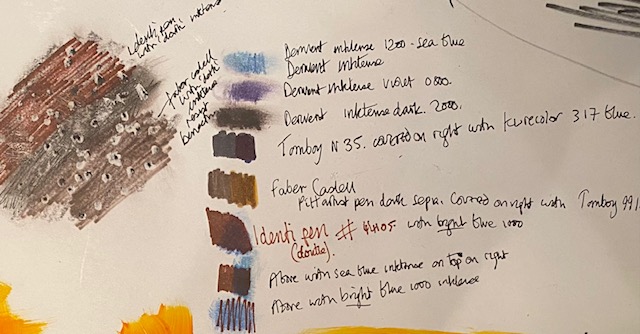
Here is the limited palette I’m going to use, tested on the printing paper: Munken Lynx Rough 170 g:
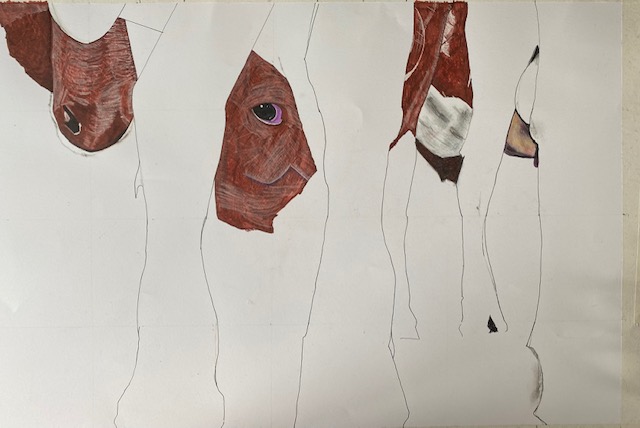
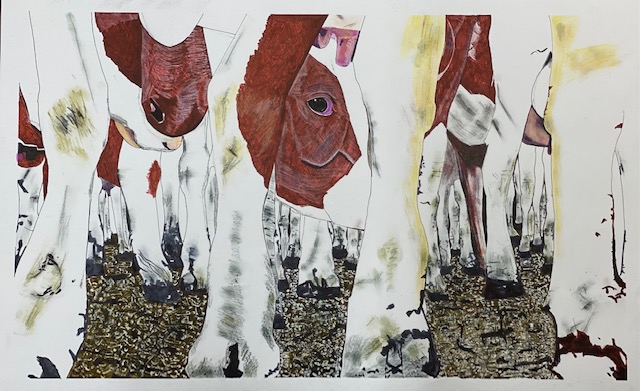
The image above is ready for printing. It’s taken me 11 hours and I’m nervous. It has to go through the roller 8 times.
Monday 20th March.
Freddy did the working out to get the distances between printing correct, with only a little double checking from me. I could not have achieved this project without Freddy’s help. Putting the same drawing through the press 8 times did feel stressful, since I only had this one drawing, and at any moment it could go wrong – the paper could get caught, the lettering may not fade as planned, the paper may get smudged from the ink already on it, the distance might not be correct between lines or the ‘furniture’ used to space the lettering might be incorrect. However, with Freddy’s help, it worked out perfectly!
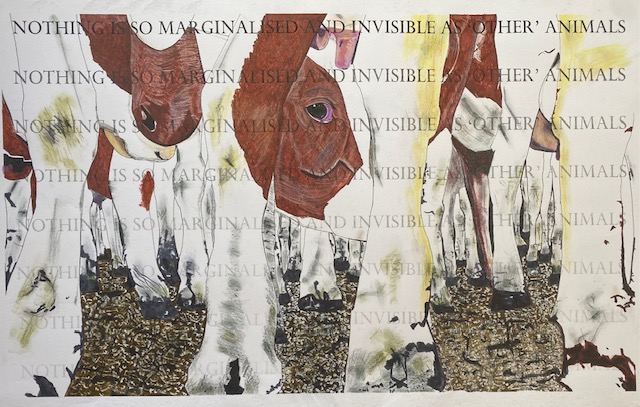
I think the choice of medium and composition are right for this work. More importantly they are right for the Bargehouse.
I am pleased with this work. I am pleased with choice of text, from John Berger, and I am pleased with how I have used it – to go from more visible to almost invisible. I am also pleased with the drawing – not only does it show the crowded conditions under which the cows live, it also shows the fear of the cow, as she hides and peers out at us from between the legs of another cow. I’m pleased that this eye is at the centre of the drawing. This makes me want to do more reading from John Berger, and to think more carefully about the human/animal gaze (I have ordered his book). I have already this morning found quite a few videos and bloggers who comment on the animal/human gaze and it seems fruitful to follow up – perhaps in unit three. I also think that the line of text itself is fruitful for further work.
Work 3.
I wanted to write a newspaper story about the Bargehouse and it’s history. However, apparently setting letters that are justified on the right is a difficult and very time consuming process and I have one week left until the end of term. 4 weeks until the exhibition).
Instead Freddy suggested I don’t make it look like a newspaper but just print it straight. Therefore, to make it a little more interesting, I am again going to attempt to draw underneath. This time I’m thinking of a very simple drawing and so perhaps I can make several copies. It will also be smaller – not certain yet – possibly A3 or A2. I have written the story and am setting the type this week. I will need to complete by the end of term. (In fact this didn’t work out – I will have to return to the studio during my holiday).
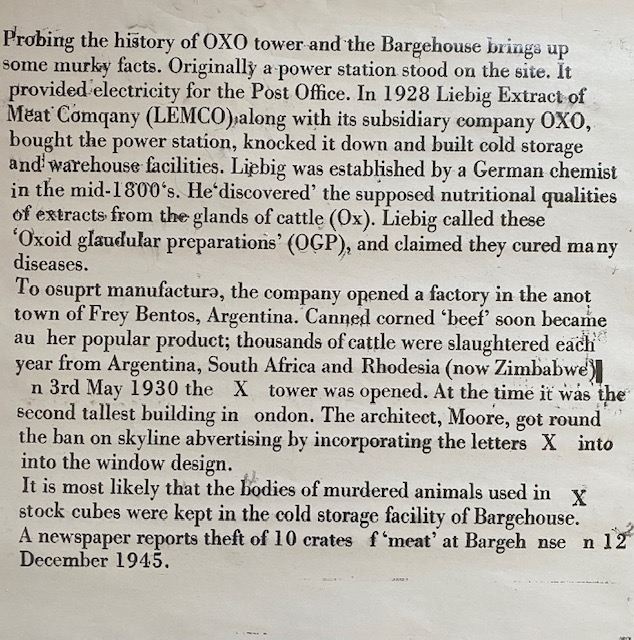
I needed to cut down the words to adjust to the fact that I am running out of some letters. The text is going to be quite dense and I’m wondering about making all the background drawing in red/teracotta. Alternatively I could make the letters red, and the drawing black.
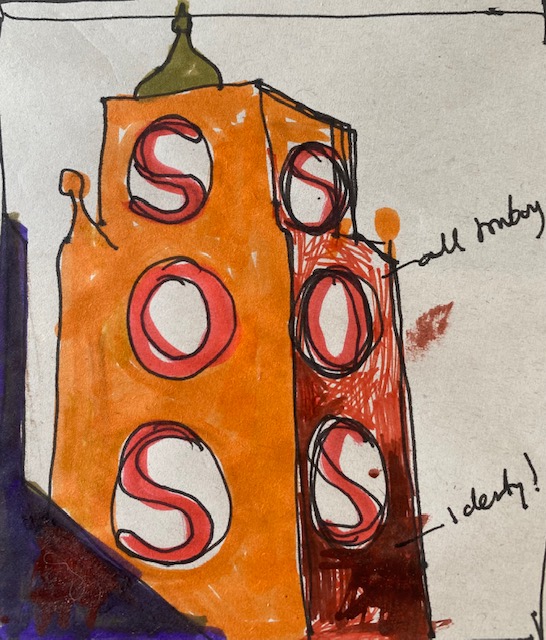
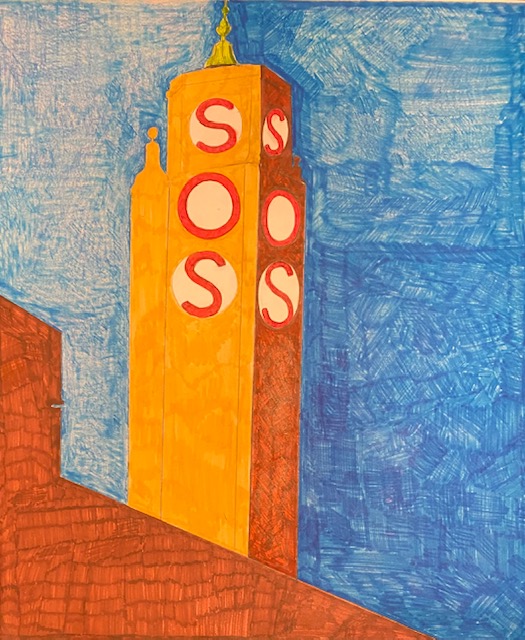
In the end I decided to use the experimental work I did on collage with Letterpress on top of it, and to use pages from the LieBig cookery book. I intend printing this one in red. I am a little concerned that this will come across as an advertisement for Liebig extract of ‘meat’, but I’m hoping in the context of the overall exhibition it will be clear that my intention is to critique the murder of other animals. I also remind myself that this module is on ‘testing beyond subject’ and that my intention is to test out how best to make our abuse of other animals visible, as well as how we learn to treat them as invisible (through constant cultural repetitions of words, behaviours, and beliefs so that we adopt them unquestionably).
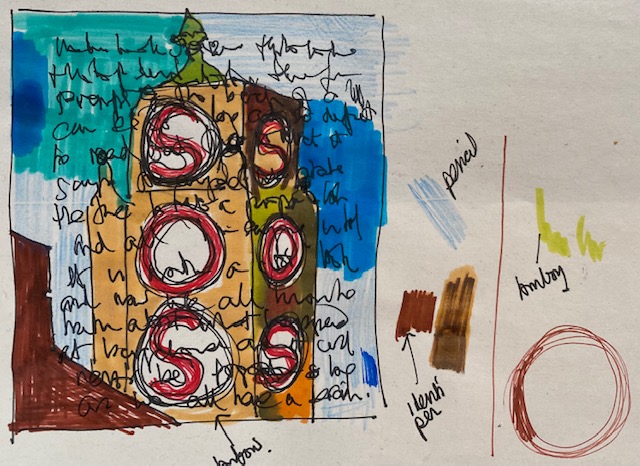
I doubt very much that much of the drawings or text above will show through the letterpress text, which is a pity. I made a second drawing, which I think will show through better because I’ve kept it very simple – drawn in felt tip pen to prevent the paper buckling, and no black used. The drawing doesn’t look great at the moment (I prefer the quick sketches) but I’m hoping that with the letterpress on top it will be ok.
Work 4. the cow.
I imagine a girl, holding a toy cow, standing in the centre of the installation. My thinking here relates to the exploration of how we are dissociated, in our relationship to other animals. On the one hand we have ‘pets’ and toys that we love, animals feature in games and on films as central characters; yet we kill and eat them.
The toy cow in my installation is a symbol of this troubling relationship. I also came across this interesting quote:
“children help us to mediate between the ideal and the real” — and nowhere is the disconnect between the two more dramatic than in children’s animal toys.
Juliet Kinchin, design history of childhood, MoMA curator
The toy cow is a Freisian. Freisians are always black and white, and they are the breed of cow that we used on the farm I grew up on.
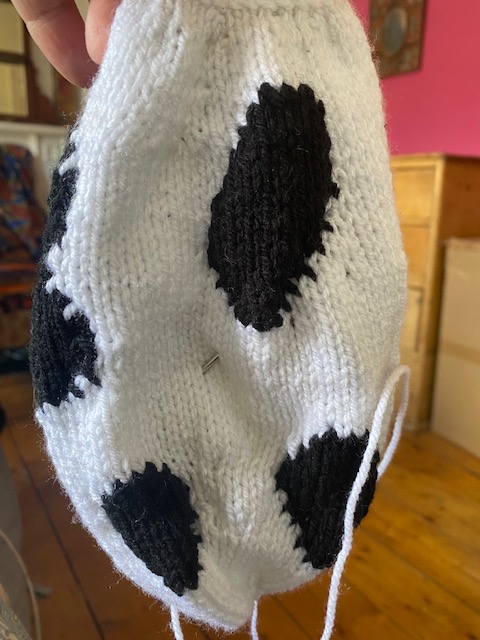
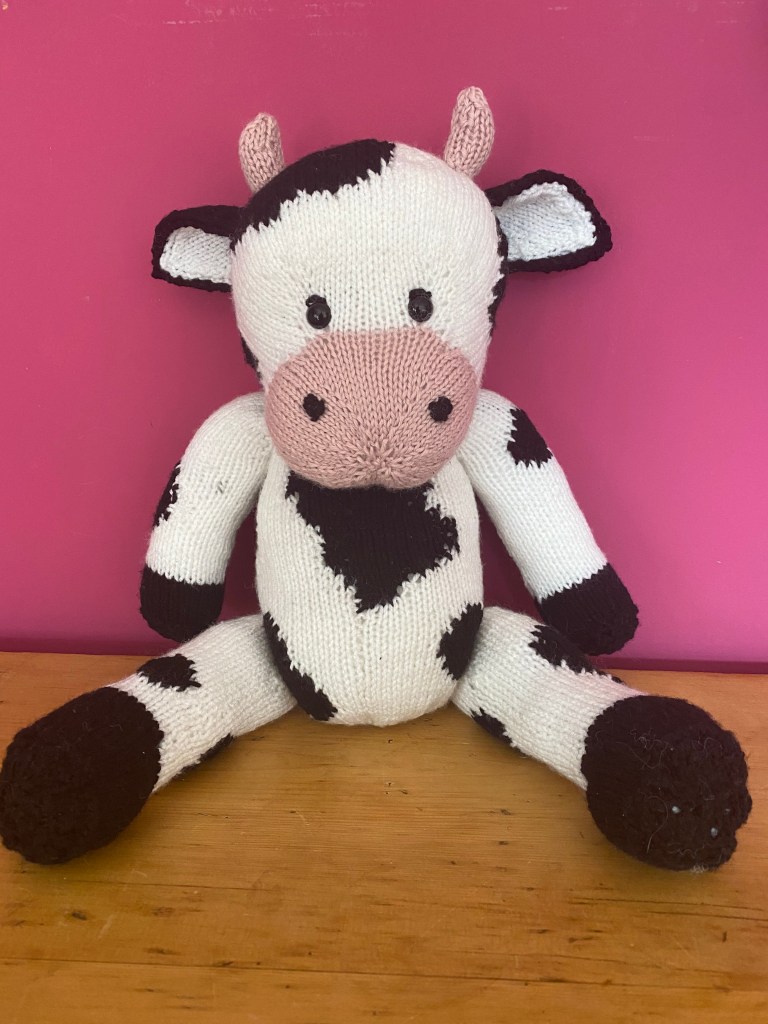
Disconnection: above – the cute – and the doomed – see video below.
Work 5. The Girl
I am making the girl as a life size 10 year old. About the age I took over cooking for the then family of 8 (soon to be 9). I’m imagining the girl as being fond of animals (as I was), but cooking them (as I did). She is made of paper mache, and this is taking a long time! I chose paper mache because it’s a sustainable material – made from recycled newspaper and flour and water glue. I have made several paper mache objects before, and I know how to use it – I once made a flying fairy who was 7 feet long with her arms stretched out before her in flying mode – she hung out in the garden for about 4 years before she gradually turned to slime and generally dissolved. Paper Mache is also very light (so east for me to transport to Bargehouse), yet it is not fragile, and very strong. It doesn’t cost anything. I think it’s a great material to use for any 3 dimensional object.
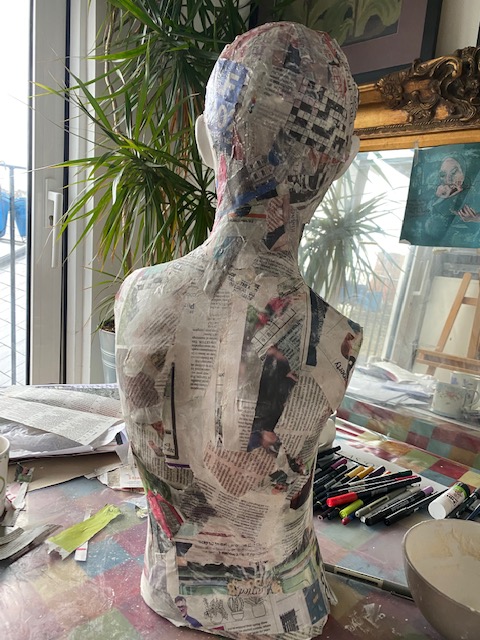
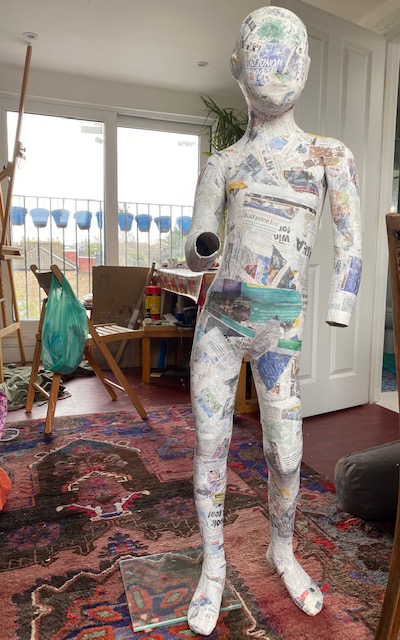
and I am putting off doing. c. 54 in high.
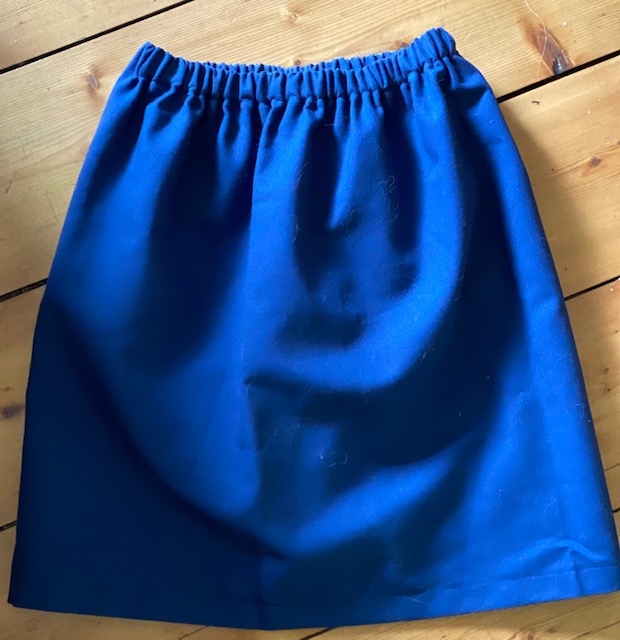
Work 6 and 7. The skirt and apron.
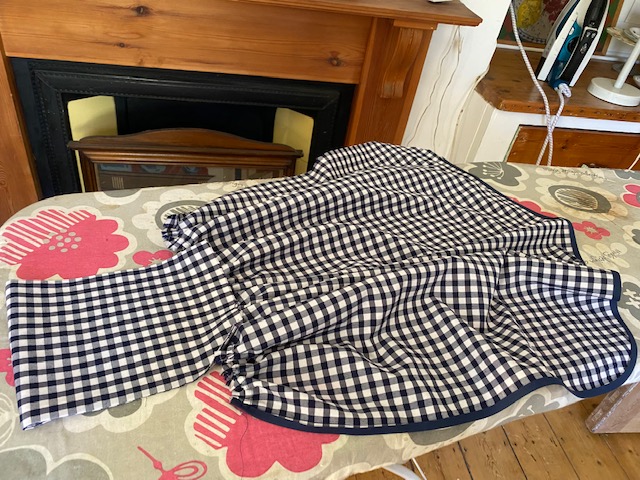
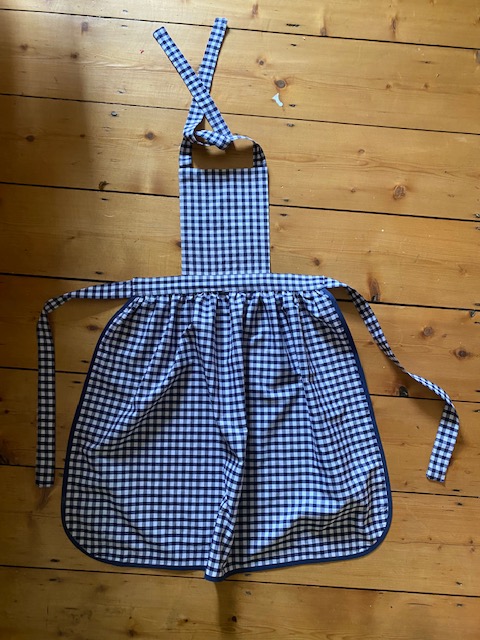
April 1st: work 8
I have come up to North Yorkshire to visit the craven auction mart in Skipton this morning – there is a sale of cattle. I used to visit it with my Dad but remember it being in a different location.
I am anxious. I’m hoping I can walk around the stalls/shippens. But I am likely to get some suspicious looks. I want to capture the eyes of the steers. I’m also anxious about how this is going to feel.
The video capture went well. There were no access issues. I shot about 20 minutes of video. I have edited it down to 8 minutes using iMovie.
I underestimated the impact on me. I find the video footage very upsetting. This makes be think of 2 further ethical issues – harm to self and harm to viewer, which I should also consider in my work since ethics is about non-harm in all interventions.
References
Berger, J. (2009). Why Look At Animals. London: Penguin
McLuhan, Marshall (1964). Understanding Media: The Extensions of Man
Sandino, L. (2004) Here Today, Gone Tomorrow: Transient Materiality in Contemporary Cultural Artefacts. Journal of Design History. Vol 17. No 3.
 Drawing As Critique