In the parallel post on other artists in unit one, I wrote about other artists who are influential for me, including writers who are concerned with social justice issues of freedom and equality, and I only touched on visual artists exploring animal liberation. Here, I specifically search for examples of artists who are working from a post-humanism/critical animal studies/intersectional perspective that is concerned with critiquing our anthropocentric view of the world and relationship to other animals.
In the contextual studies section I show a number of example of work from the Science Friction exhibition in Bilbao. However the majority of the works in that exhibition examine post humanist ideas with regard to life forms other than animal (plant, bacteria, insect, fungus), and here I am looking for artists focusing on non-human animals.
I start with artists who do not explicitly state that they work from within a post-humanist or critical animal studies framework, nevertheless their work seems to recognise these concerns. I move to look at the work of artists who very firmly state their critique of the anthropocentric world we inhabit, in which other animals are relegated to the status of ‘things’ to be used for human gain.
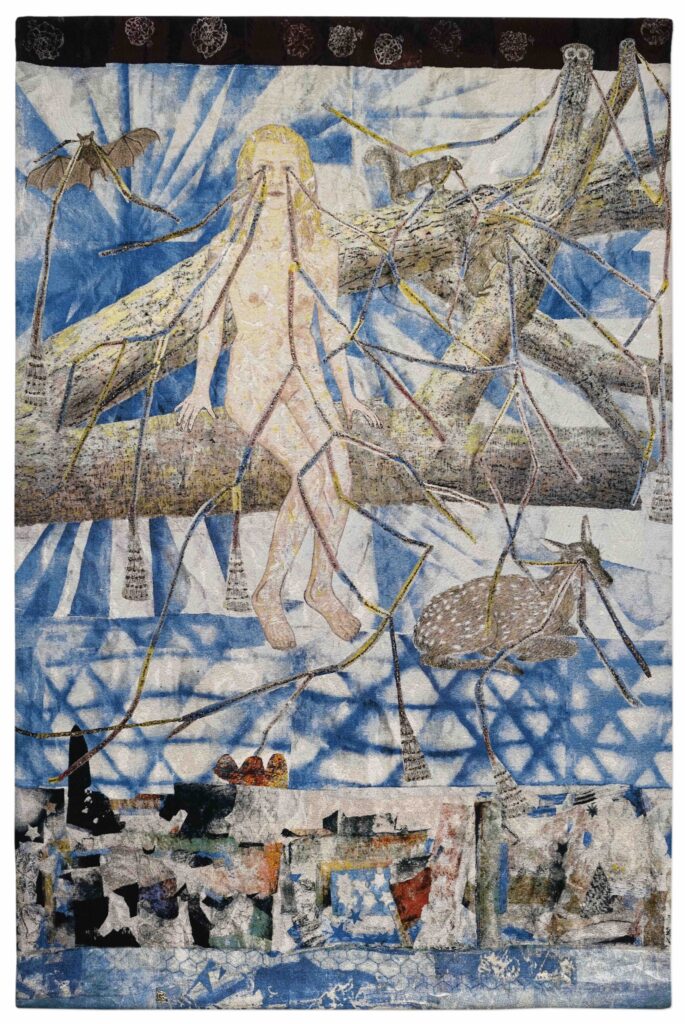
Kiki Smith makes tapestries using cotton (the fact that the tapestries are cotton rather than wool is important since the production of wool involves much cruelty). Much of her work is focused on relationship with the natural world, and the tapestry below is focused on interconnections between animal species. Interestingly she draws attention to eyes and looking. My site specific installation is titled: I learned not to look, and I think that looking/seeing/visibility/invisibility is central to any work critiquing anthropocentrism. The work below is taken from her exhibition, ‘Hearing you with my eyes.’
Another artist whose work explores the relationship between human and non human is Maria Berrio. I love her strong use of colour and collage. I read that she builds up images using hundreds of fragments of Japanese papers. They are, like Smith’s work, beautiful. It is interesting that one uses tapestry – the other collage – both concerned with adding fragments to a support directly using the fingers and both using materials not traditionally considered as ‘fine art’ mediums. I wrote in the Research (A) section about Ranciere’s regimes of art – the ethical, the descriptive and the aesthetic – I feel that these two artists produce work that achieves the fine balance between the ethical and the aesthetic – (I wonder if this balance is more difficult in installation art, which perhaps has a less ambiguous, more ‘readerly’ intention?)
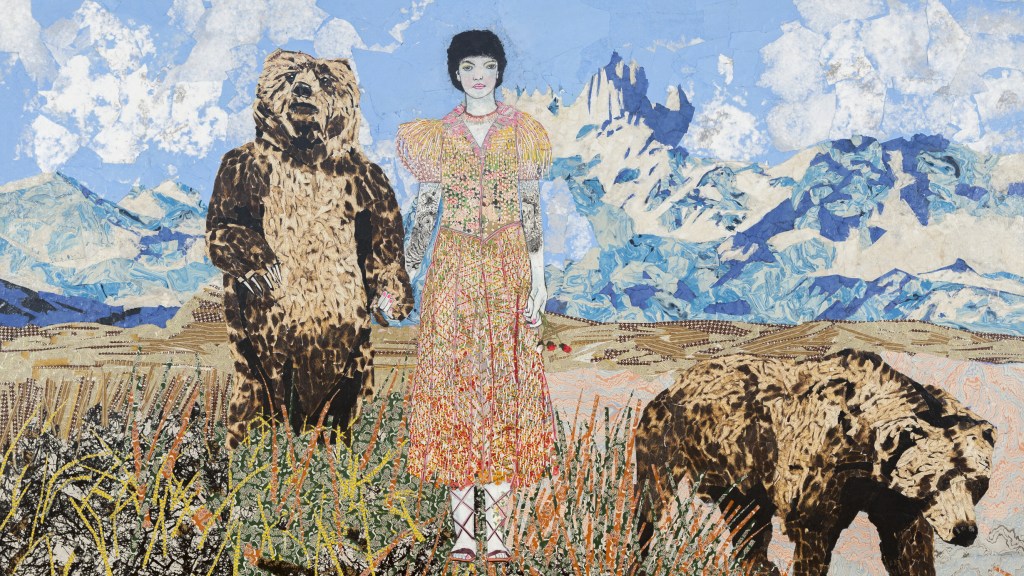
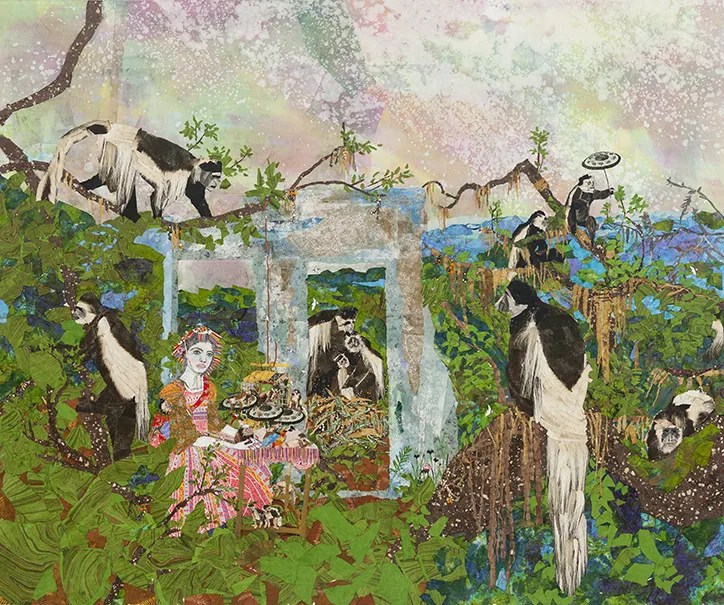
Both Smith and Berrio use pattern and texture in their work, and I think my own collages have features in common including the depiction of human and non-human on a collaborative, equal footing.
Next I looked at artists who feature in the book, ‘Vegan Art: a book of vegan protest’ by Tommy Kane (2022). The book features works by Tommy Kane, Helen Barker, Caroletta, Sue Cole, Cynical Coyote, Dana Ellyn, Tommy Flynn, Jo Frederiks, Melinda Hegedus, Hartmut Kiewert, Jane Lewis, Rob MacInnes, Jo-Anne McArthur, Phillip McCullock-Downs, Mike Dong Comics, Cameron O’Steen, Dan Piraro, Chantal Poulin Durocher, Kate Louise Powell, Roland Straller, Andrew Tilsley.
It’s good to see so many artists making work for animal rights. Almost all of the work shows graphic and horrifying images of animals dying, being mutilated and eaten. I’m not quite sure how I respond to this. I’m wondering two things – first if I find it hard to look at, will a non-vegan audience look at it at all? (who is the book published for?), second I wonder if there are ethical issues relating to the non-human animals. I’m thinking for example, that we do not make art showing graphic details of women being raped, or children being abused, or extreme violence to black people (we might allude to these violences in art but not usually depict them). The reason, I think is that we feel to depict this violence would be to objectify the victim, and worse, reenact the violence by making a spectacle of it. Three artists who do not depict violence are Cameron O’Steen (photographer), Chantal Poulin Durocher and Hartmut Kiewert.
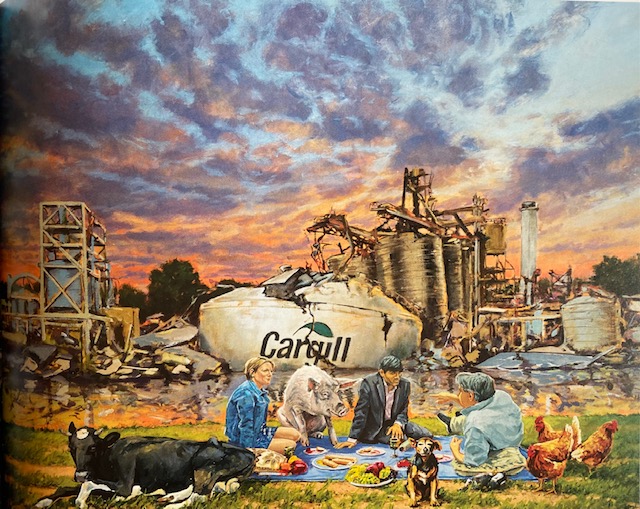
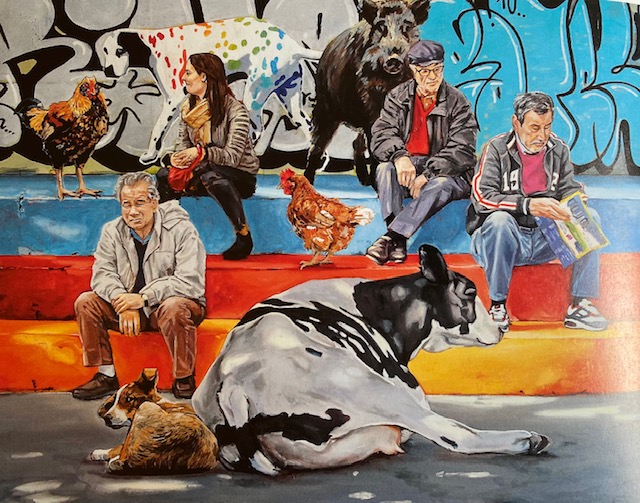
Kiewert makes paintings about a utopian future. In the painting below he shows a picnic shared between animals in a post apocalyptic landscape in which Cagill, the giant USA agricultural industry, has collapsed. And below, that, another painting just showing different species hanging out together.
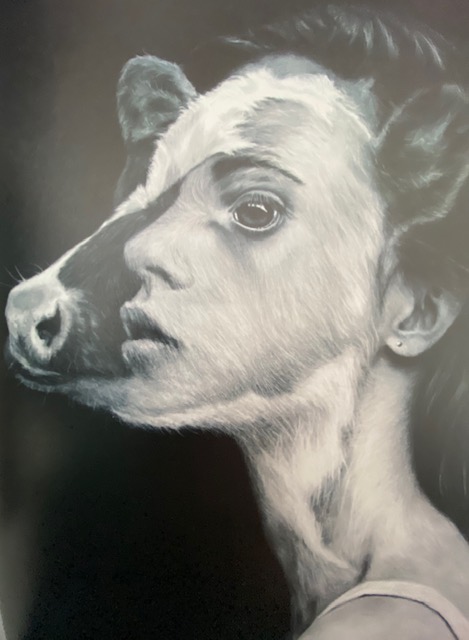
Chantel Poulin Durocher makes beautiful portraits both of non-human animals, as well as non-human animals transposed on top of humans:
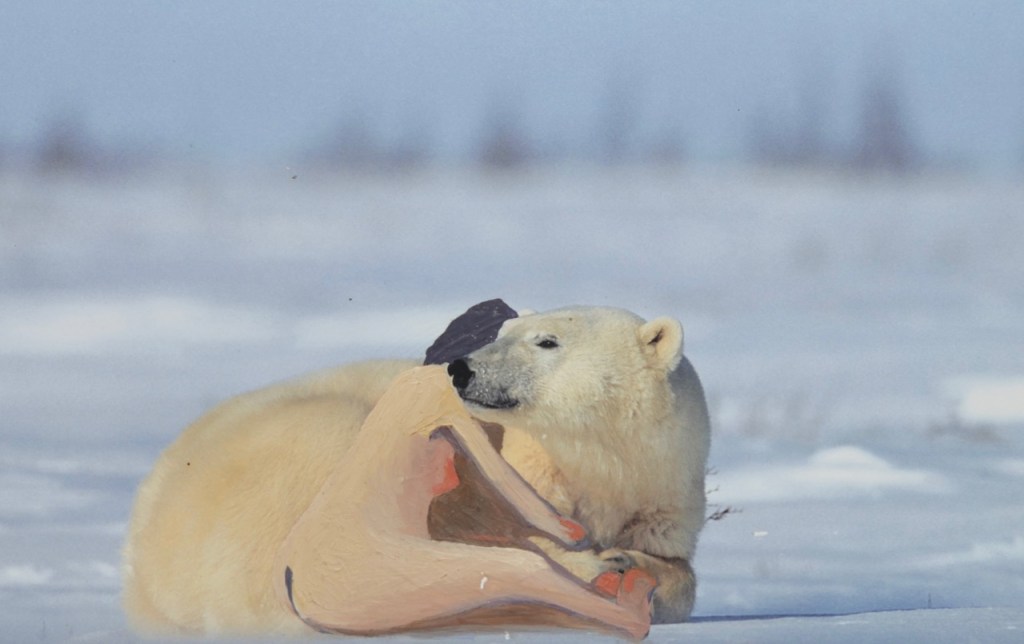
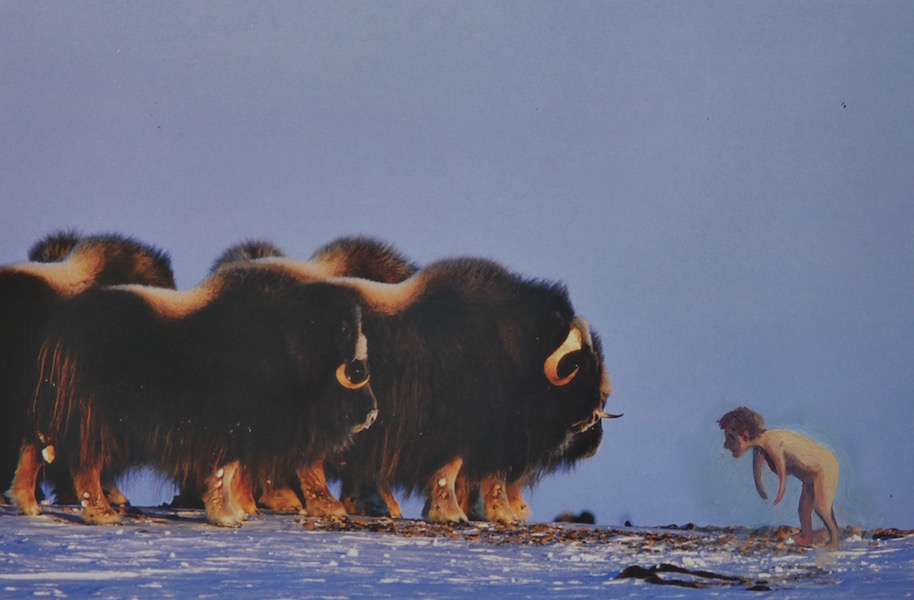
As I explain in Research (A), Intersectionality is central to Critical Animal Studies, and intersectionality also lead me to looking in more detail at ecofeminism, and other intersectional writing for this unit. I looked for artists who take an intersectional focus and came upon the work of Sunaura Taylor. See:
Taylor is assistant professor in the Department of Environmental Science at the University of California, Berkeley, a painter, and an animal rights and disability activist. She published ‘Beast of Burden: Animal and Disability Liberation’ in 2017. Taylor was born with arthrogyrposis, and argues that widespread prejudice against disability lies at the root of humanities relationship to other animals. She reminds the reader to attempt to consider an animals’ experience on its own terms rather than from an anthropocentric perspective.
I like her work a lot. It avoids depicting cruelty to other animals, and instead depicts the human-non human animal relationship as one of compassion and respect – she portrays an Ethics of Care, which is something I intend reading more about. This is an approach I was thinking about in relation to my own work during unit one. I think that it is also the approach taken by Kiki Dee in her work). Most importantly for thinking about intersectionality, Taylor draws on her experience of disability in her painting to explore perceptions of both other animals and of disability, and finds an empathetic response. Commenting on the lives of farmed animals, she writes:
“The more I looked, the more I found that the disabled body is everywhere in animal industries,” she recalls. “A thought struck me. If animal and disability oppression are entangled, might not that mean their paths of liberation are entangled as well?”
https://inthesetimes.com/article/sunaura-taylor-beasts-of-burden-disability-justice-animal-liberation-vegan
Taylor also points out that studies show how other animals with disabilities are helped by family members: she argues that humans seem to be unique in creating ableism – ableism is a cultural not a natural phenomenon.
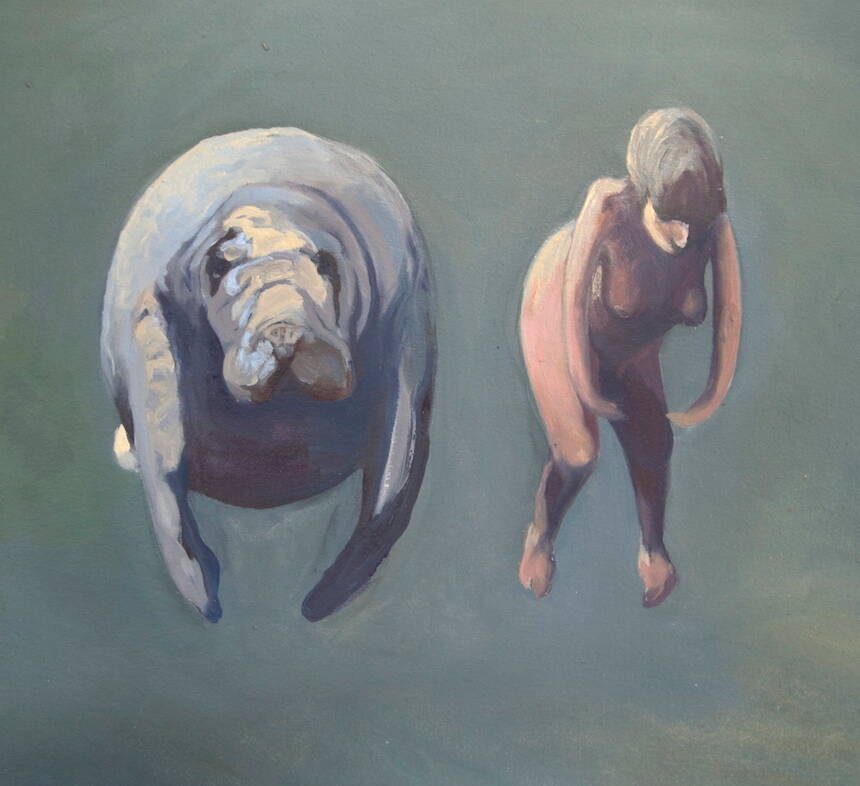
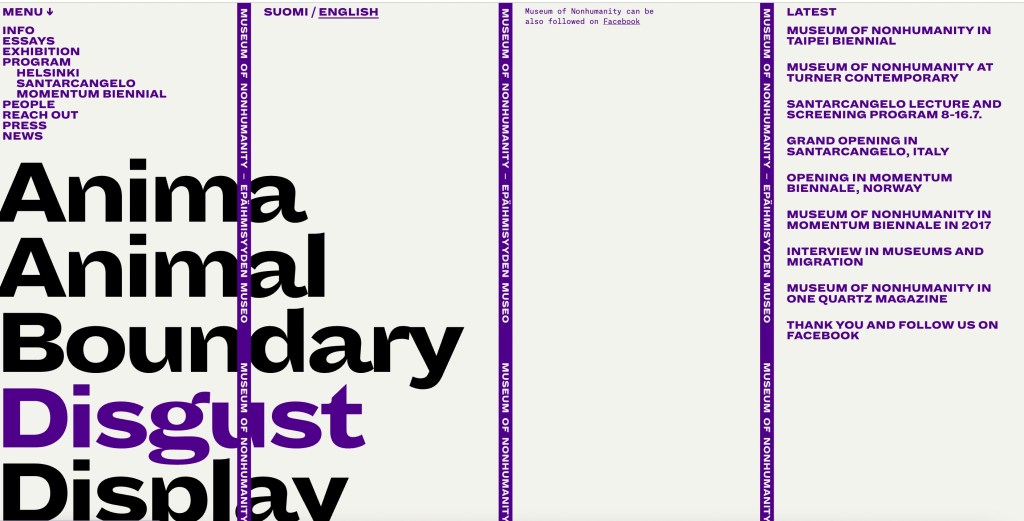
A very different kind of approach to human-animal relationships is found in the installation and performance work of two Finnish women – Terike Haapoja, visual artist, and Laura Gustafsson, writer. They explore ethical ways of interspecies coexistence and have produced a number of works with this focus, including The Trial, a participatory performance on the legal personhood of non human animals and an installation and lecture series, Museum of NonHumanity, also published as a book in 2019.
The Museum of NonHumanity is described as follows on their website:
Museum of Nonhumanity is a 11-channel, 70 minute video installation that presents the history of the distinction between ‘the human’ and ‘the animal’, and the way that this imaginary boundary has been used to oppress both human and nonhuman beings. Throughout history, declaring a group to be nonhuman or subhuman has been an effective tool for justifying slavery, oppression and genocide. Conversely, differentiating humans from other species has paved the way for the abuse of natural resources and other animals.
Museum of Nonhumanity approaches animalization as a nexus that connects xenophobia, sexism, racism, transphobia, and the exploitation of nature and other animals. The touring museum hosts lecture programs in which local civil rights and animal rights organizations, academics, artists, and activists will propose paths to a more inclusive society through an intersectional approach. The Museum also hosts a book shop and a vegan café.
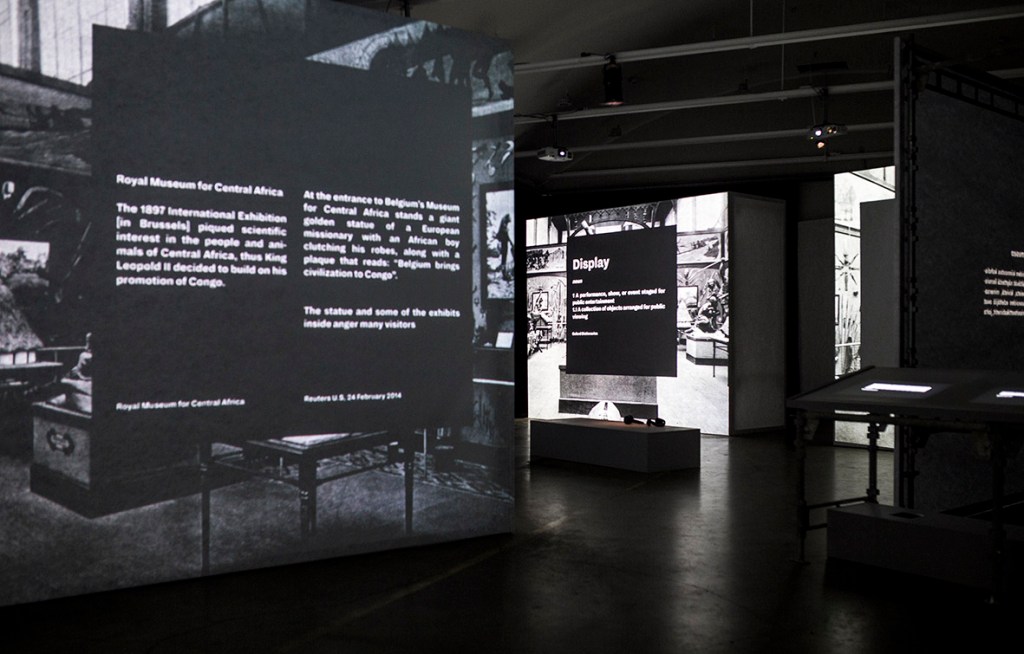
I like that the exhibition is divided into ‘chapters’ and that these chapters are defined by a word, e.g. Disgust, Boundaries, Display (I’d like to know how they decided on these specific words). Varied definitions of these terms are included. This is similar to the way I have approached working on several projects in the past – for example, the miniature work I did on this MA started with definitions of terms relating to animals e.g break, to brand. I think that this kind of deconstructive work can help us rethink the deeper meanings underpinning the words we choose to describe our experiences/behaviours and to me it is an example of Artist Critical Discourse Analysis.
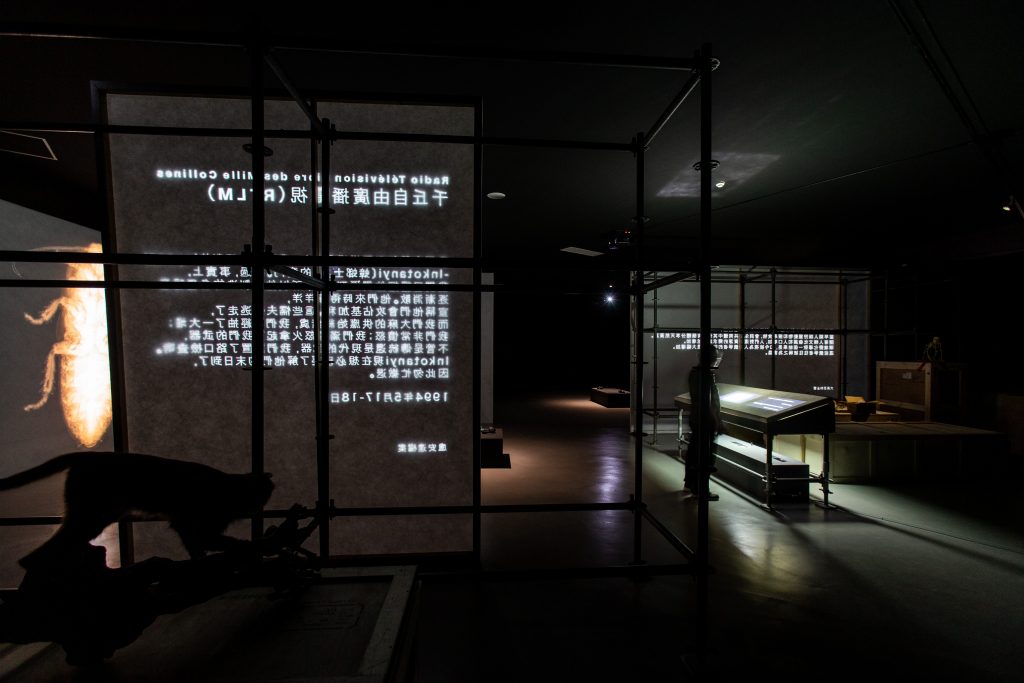
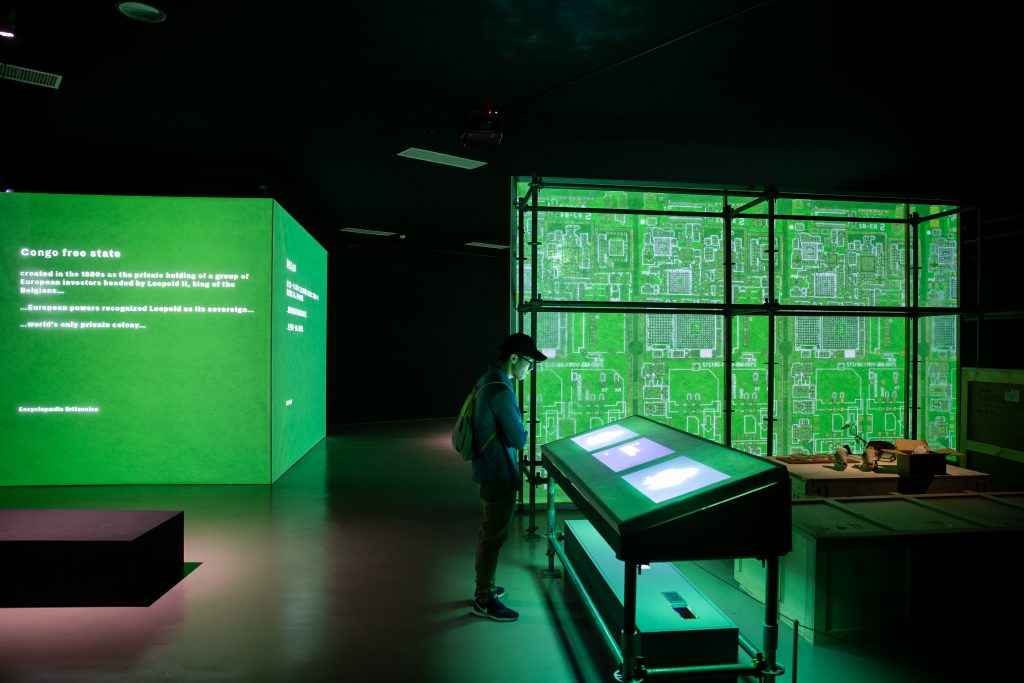
I would love the opportunity to see this touring exhibition and to meet the makers/be involved in some way. It’s interesting too that the ‘museum’ includes open lectures and critical essays.
Finally a challenge to the anthropocentric of artists and Art Institutions themselves: artist, Eva Maria Lindahl completed a PhD thesis in 2022 titled, ‘Resistance within the museum Fauna: Challenging Anthropocentrism through counter art histories and non human narratives,’ in which she took a performative approach to critiquing the invisibility and marginalisation of other animals in art works hanging in several museums. So far as I’ve been able to discover, Lindahl works at the Munka art school, part of Skanes Konstforening (a centre for art events, workshops, exhibitions and performances) in Malmo, Sweden). One research method was to conduct tours/interactive workshops around the museums as a way of making the non human animals subjects rather than objects of the paintings. She also made a video collage and a performance focused on the use of painting pigments made from non-human animals:
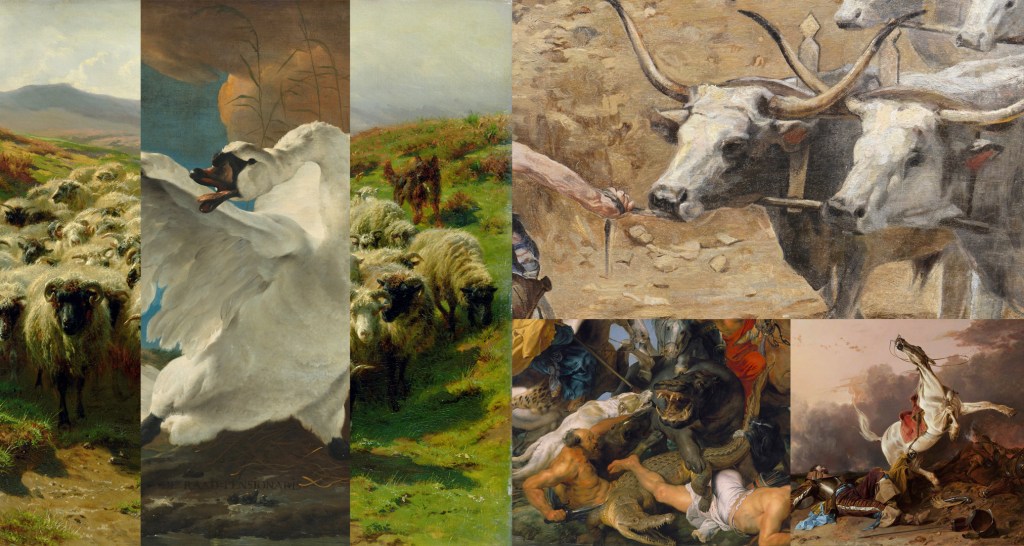
In the abstract Lindahl writes:
The theory and practice of this thesis is committed is committed to finding ways of challenging an anthropocentric art world, and therefore the research is qualitative, meaning that it is not trying to measure, but rather re-think art historic narratives while concentrating its attention to the lives and histories of non-human animals on display at the museum walls.
The fauna of the art museum is not only the title of the thesis, but a term developed because of the necessity to hold space for a group of non-human animals whose commonality is that their habitat is the art museum, some are portrayed in paintings, while others are grinded to become pigment, glue and paint. Moreover one of the core strategies of this research is the refusal to view portrayed non-human animals as symbols for human affairs but instead recognise them as individuals with agency and relationships. To do this anthropomorphism is used as a radical and empathetic tool to envision and imagine new art histories where non-human animals are at the centre.
https://www.evamarielindahl.com/phd-thesis/
With regard to my own work, I am most interested in work that go beyond describing violence, to understanding how that violence is part of interconnected cultural systems and how, and why, it is normalised, particularly within capitalism/neoliberalism . This is nuanced and complex and I wonder whether installations can offer more in relation to this complexity . I also feel that works that imagine a caring relationship, rather than an exploitative one are more hopeful and emotionally engaging and in this regard I particularly like the possibilities of collage.
 Drawing As Critique