(written for the joint MA Drawing publication, ‘When Drawing Becomes Research’ following MA Drawing class show, ‘I Don’t Understand Your Drawing’ in October 23).
There are different views of drawing as research. Here I present a position based on my experience this year as a full-time MA Drawing student, as well as my previous experience: before joining the MA Drawing, I was an MA Education programme leader. In this role I taught MA research modules (mainly qualitative) and supervised hundreds of theses on education. I therefore came to the MA Drawing with a clear view of ‘research’. During this year I have struggled to understand how drawing is understood on a Fine Art programme. To help my understanding I read widely and attended three conferences on Drawing As Research over the year. The position I now take is based on these experiences, along with using drawing as a method to address the research question adopted at the start: How can artistic interventions interrupt the iconography of oppression, objectification, invisibility (as subjects) and discourses of violence, in our societies, towards non-human animals? I recognise that the conclusions I have reached may be quite different if my focus was not on a political, social justice issue (for example, if my research question was about drawing medium or drawing processes). The conclusions are that a) Drawing can be but is not necessarily a research method b) Something else must happen before claims can be made that new knowledge has been produced from drawing. I illustrate these ideas with a case study using works that I made throughout the MA as I moved toward identifying knowledge about how to use drawing to interrupt discourses of violence toward non-human animals.
What is research?
‘Research’ in any discipline is, by definition, always to contribute knowledge to the world. See for example the UK Quality Assurance Agency doctoral benchmarks. (https://www.qaa.ac.uk/docs/qaa/quality-code/qualifications-frameworks.pdf: page 30). Lewandowska et al (2023) point out that traditional academic conventions may not be suitable for evaluating the outcomes of research in the creative arts whose outputs may include dance, or painting or music. This might be the case but does not detract from the fact that whatever the outcomes they must include the creation of new knowledge – otherwise the outcome is not by definition a research outcome. In any case, here Lewandowska et al (2923) are not arguing the outcomes should not be new knowledge, only that the way the knowledge is evaluated may need to be different. This is a similar problem to the kinds of practice-based educational research I supervised for so long (the knowledge in this case was knowledge of pedagogical practice).
Research is not the same as critical reflection. The latter involves looking back on our work and evaluating the outcomes, including what we may do differently going forward. Critical reflection will hopefully be a stage of research and will always occur at the end of any research phase. Research, on the other hand is about looking forward – it involves identifying a question or problem about ourselves, our practice and/or our environment and devising a plan to collect information to tell us more about it. At any stage of research, we read relevant literature – for example, has someone already identified this problem and found an answer to it?
I have seen it argued that in the creative arts we may not start with a question. In fact, the question might come at the end of creating works (Sullivan, 2006). I disagree with this – of course we may make creative work with no question in mind, but at this point we are not doing research. When our making leads to a problem, and we set out to examine this problem in a systematic way, then at that point we may start researching. Similarly in my former context, teaching is not research: it may well raise a problem that I want to research. Equally I may decide being a teacher-researcher takes me away from my main concern – being a competent teacher – or in this case – making drawings. My basic argument here is simple – we may at any point in creative works decide to embark on research, equally we may continue making wonderful creative work and decide never to do any research, and either is completely acceptable (unless we are doing a research degree).
Traditionally research was positivist requiring the collection of quantitative data – data that could be measured. It involved developing a hypothesis about a phenomenon, and devising experiments or observational studies to prove or disprove the hypothesis. Theory was then developed to explain the ‘findings. The results were generalizable. Later in the second half of the 20th century interpretivist research was developed to understand how people experienced phenomenon. This involved developing qualitative methods for example using interviews or creative means to collect data, to understand how people understand and make sense of experience. This kind of ‘subjective’ evidence was not generalisable but used to help understand human relations and behaviours. Both kind of research were to develop new theories, or explanations about how the world worked and about humanity.
Crucially an experiment is not research; an interview is not research. They are the methods of collecting information. Information is not research until it is analysed in relation to other existing theory and the research question, and new theory is developed. In all cases theory is always subject to change when more evidence comes along.
Drawing as a method
Over the year on the MA Drawing the question for me about drawing as research has been: ‘How does drawing fit into the dualist conception of research?’ These two models are based on different views of knowledge (objectivist – subjectivist) and different views of how the researcher relates to the researched (neutral analyst – subjective interpreter). There are clearly different answers to this conundrum, and it is outside the scope of this paper to discuss them. Instead, I will argue that for drawing to be considered research it must fulfill two basic criteria introduced above:
- It must contribute to new knowledge/understanding not already in the public sphere (Simonti, 2021). This assumes the new knowledge/understanding will be made public.
- It must contribute to theory – about drawing itself, and about the subject being investigated, if this is not only the subject of art (for example I hope to contribute to theory both about artistic methods for interrupting violent discourses to non-human animals, but also to theory about those violent discourses themselves).
This raises the questions of ‘what is meant by knowledge’ and what is meant by ‘theory’ and are they separate? Could say developing new knowledge about how one medium interacts with another medium in drawing be considered research? My answer is ‘No’. In my understanding theory is an explanation for a phenomenon. The new knowledge expected in academic research is explanatory knowledge that builds on theory already in the public sphere. Practical knowledge of how to do something, or embodied knowledge (where the body knows how to do something like how to ride a bike) is not in itself the kind of knowledge that is expected in ‘research’. An example of practical knowledge might relate to cake making. I might be a practiced and expert cake maker. I might decide to experiment making a turmeric and lentil cake with avocado cream filling. This recipe is devised by me. It has not been made before. It is experimental and creative. It gives me new skills and practical knowledge. It is not research. It could be a part of research into, say the culinary and medicinal uses of turmeric/the colonizing spice trade. But for now it remains a cake making method. (Dishing the cake up for you to eat hopefully gives you pleasure, but it does not share the new skills and practical knowledge I have gained).
Similarly drawing is not research. It can only be a research method.
Case Study: History of an idea – how drawing lead to a practice that supports engagement, justice, and hope.
This year my research focused on how drawing might interrupt objectifying, violent discourses of non-human animals. From the start I identified my methodology as critical discourse analysis: I am interested in how drawing might make visible the beliefs and ideas we are taught, as well as in whose interests they operate (Arribas-Ayllon and Walkerdine, 2008). Beyond this I felt clueless about where to start. I set myself some more questions:
- How could my work engage people?
- How could it move from an individual visual sensory experience toward dialogic practice (Simonti, 2021)
- How could it question the human gaze and not replicate violent images of non-human animals?
- How could it contribute new knowledge not already in the public sphere?
- How could the materials I use add to the theme?
I started by drawing non-human and human kidney cells. I thought that, perhaps, shining a light on the internal beauty of cells of all animals might highlight our similarities and diminish our differences. I also thought this was better than replicating violence. I made a number of these drawings using Biro on PLIKE and then biro and enamel paint on copper.
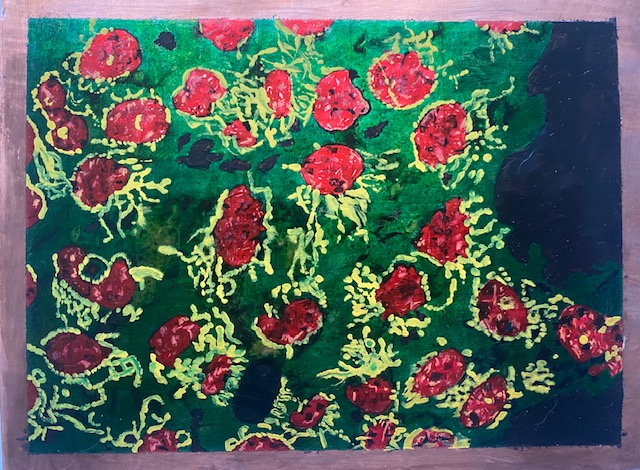
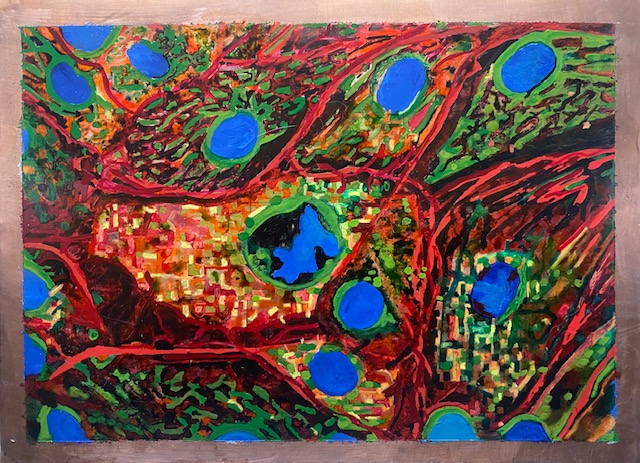
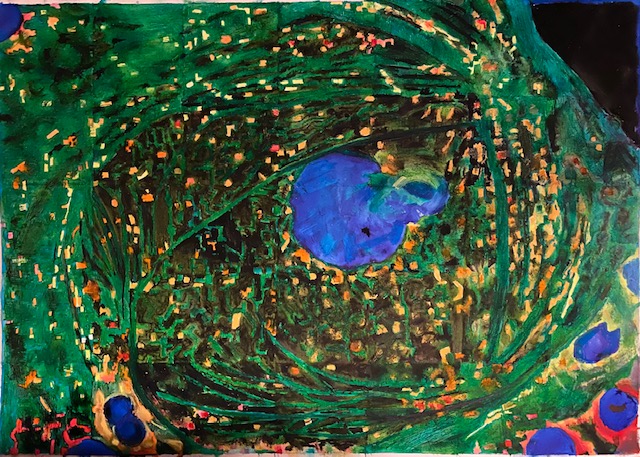
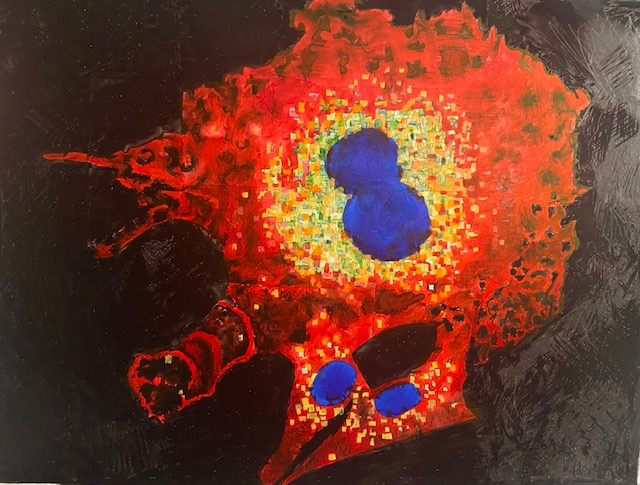
I soon abandoned these drawings because a) they do not move toward discursive practice, b) they did not lead to any knowledge not already in the public field c) the materials do not add to the theme, and e) perhaps most importantly they do entrench the human gaze in the sense that some of them replicate the cells of murdered animals without raising that as an issue, or questioning the discourse of other animals only being alive for human purposes.
I next thought of making visible, or ‘bearing witness’ for both non-human and human animals who had been killed by the animal agriculture industry. Below are six of the twelve small 4 x 4 in biro drawings, again on PLIKE that I intended making into 24-inch portraits. They are quick experimental 4 in sketches:
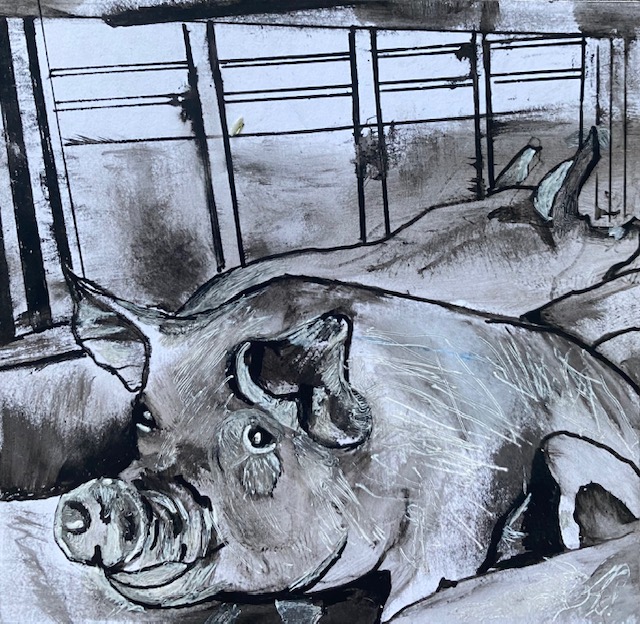
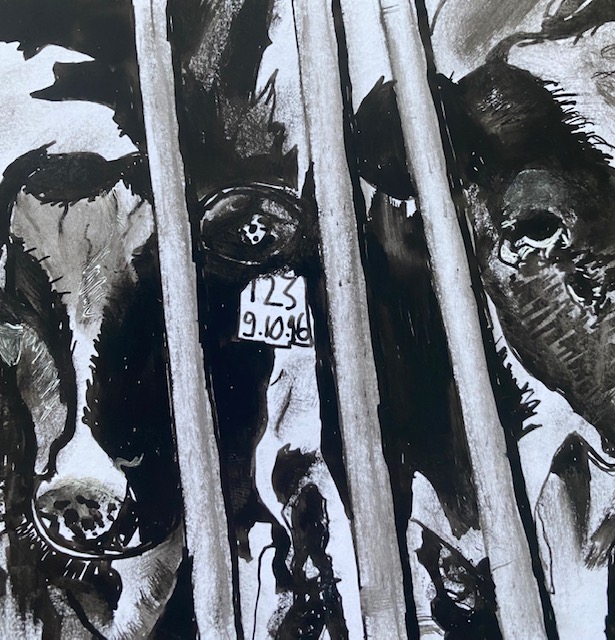
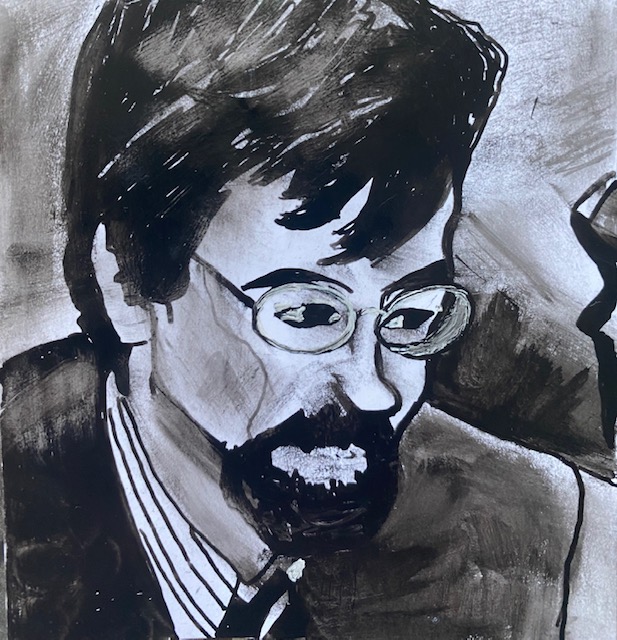
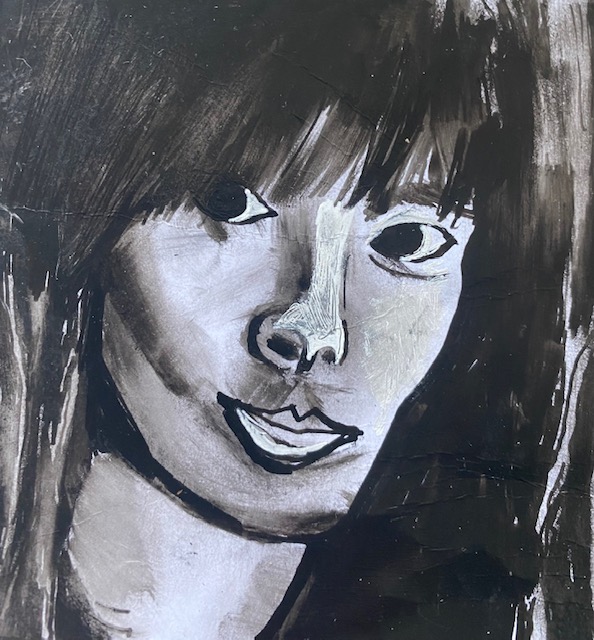
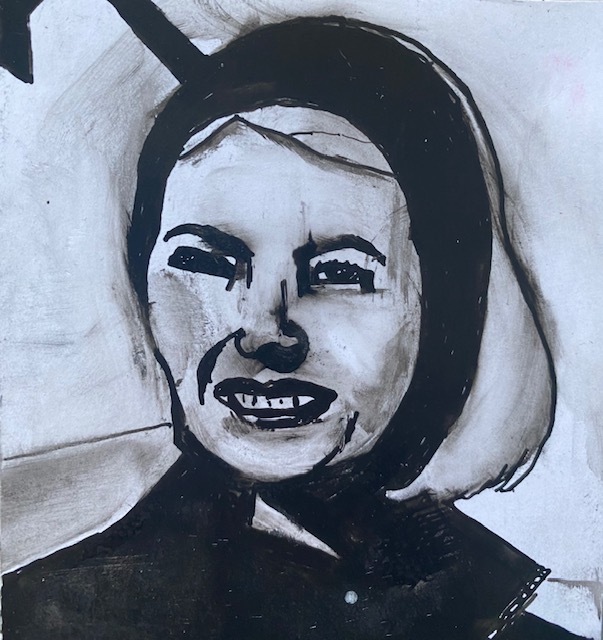
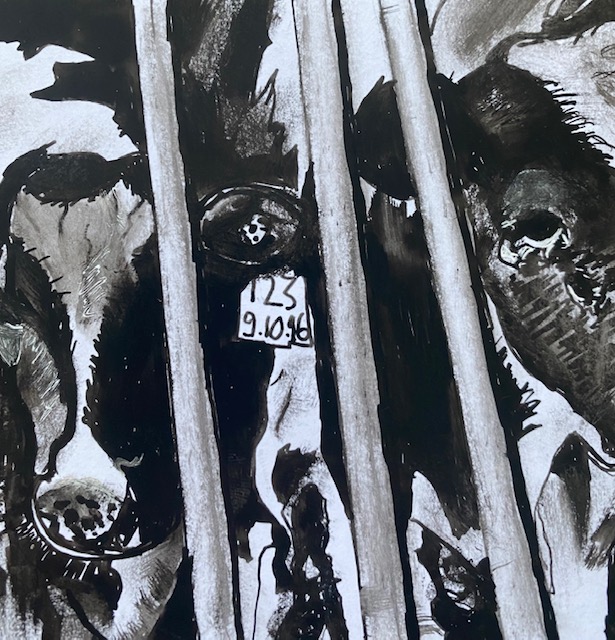
Again, I abandoned this line of enquiry. Most of the objections I raise above still apply.
I came across the work of Olufemi (2021), black feminist writer and author of ‘Experiments in Thinking Otherwise’. I decided to apply her ideas to making collages showing interactions between species that might be unusual. Crucially, at this time, three months into the MA, I was also thinking about my own experience growing up on a dairy and sheep farm in the North Yorkshire Dales. I wrote a long prose poem about that experience of a staggeringly beautiful environment in which so much cruelty occurred – it is a farming community and I do not speak here only of the practices on the farm on which I grew up. I have made many drawings of the area, and I repurposed those drawings along with the poem in the collages.
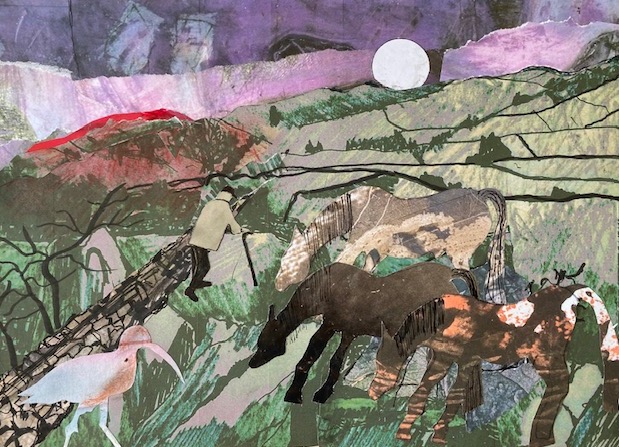
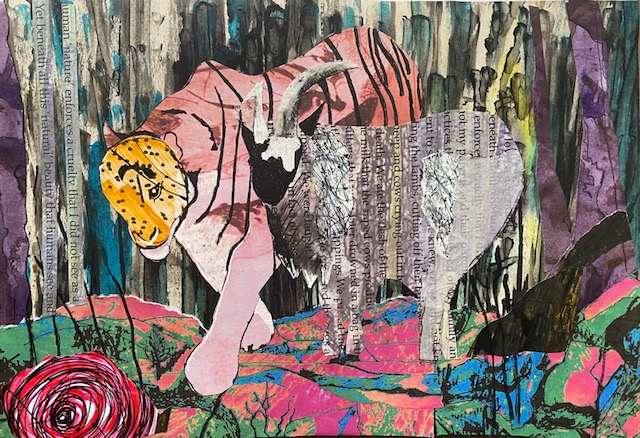
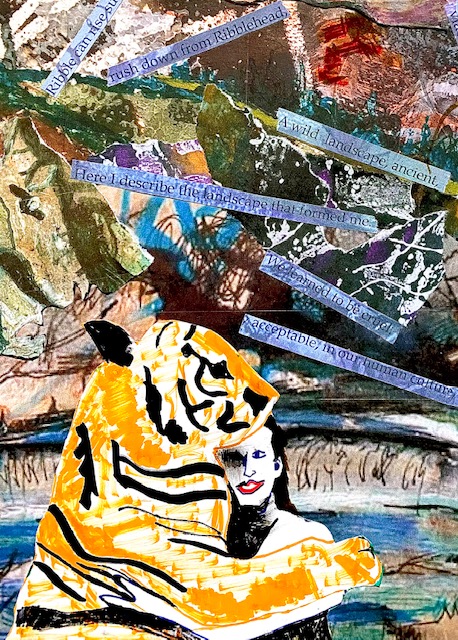
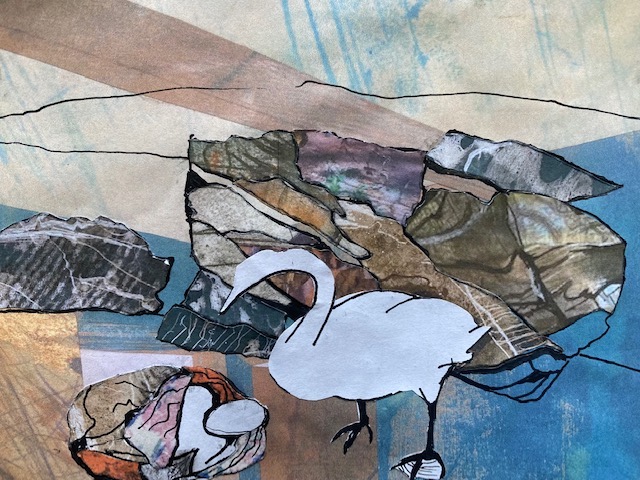
Again, these are experiments and I had in mind that I might make them much bigger. I made 30 of these collages in all:
And another 30 or so screen prints:
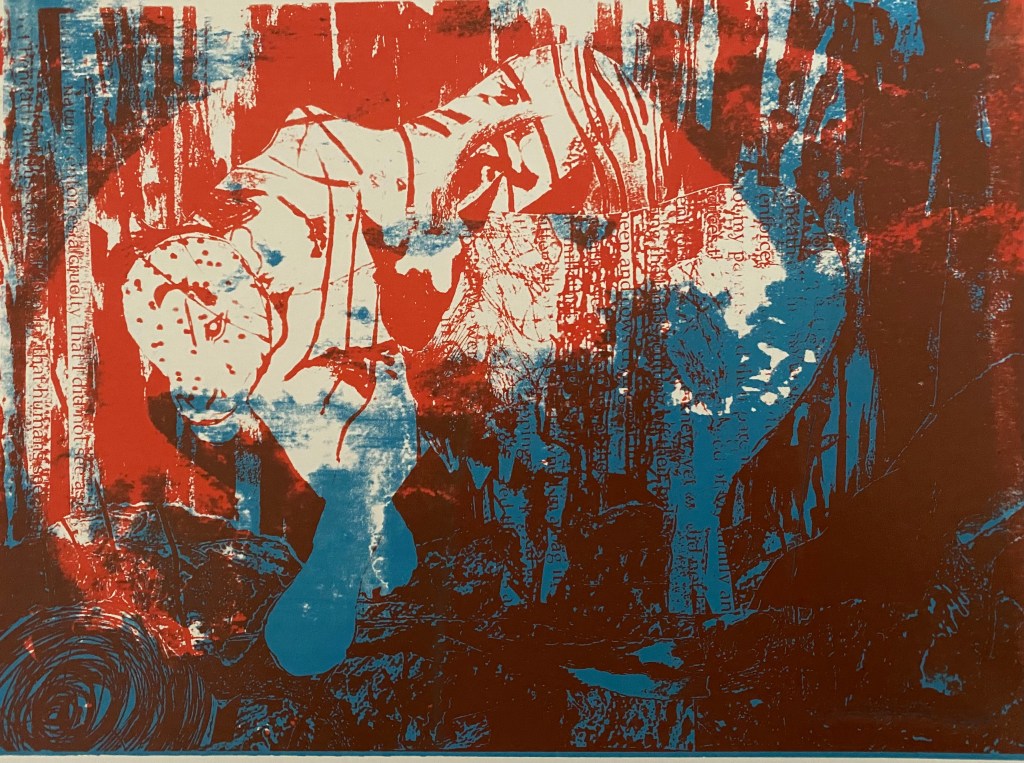
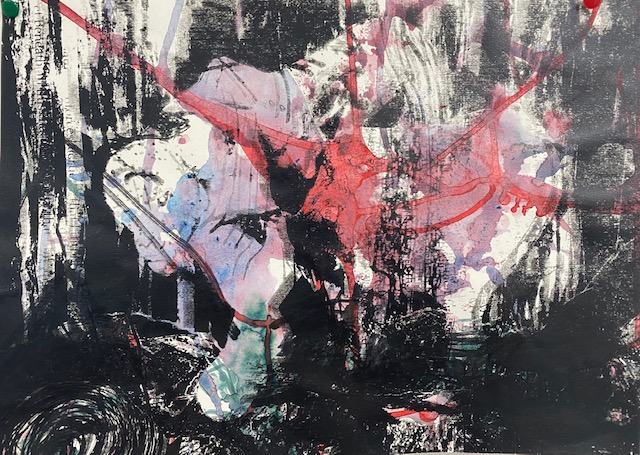
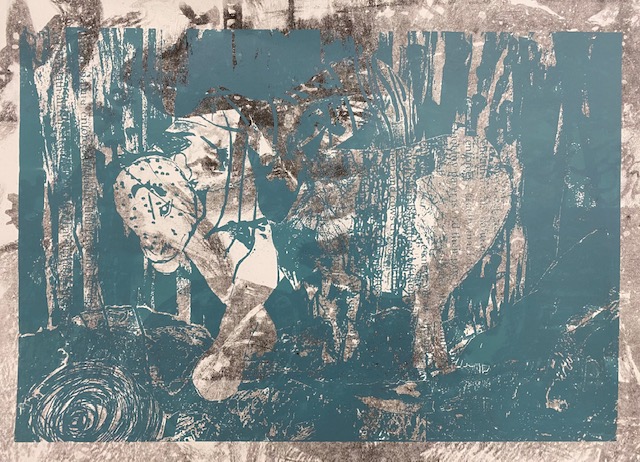
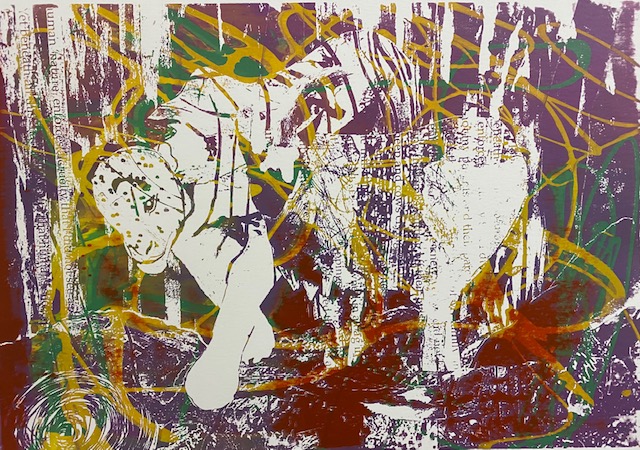
The main problem remained: my various approaches to trying to interrupt the objectification and violent discourse toward non-human animals was not working. The images I produce remained true to the perspective of art as individual, visual and sensory (Simonti, 2021).
Still, it is important to emphasise that this body of work was all the time teaching me about what would not work in a visual practice focused on a social justice issue. What does not work is almost as important as what does work. At the same time, I was reading about contemporary art and animal studies, Post humanist theory, and Critical Animal Studies. I was also looking at other artists and finding artistic methods that focused on other social justice issues, that I could learn from.
The turning point came half-way through the year when we exhibited at Bargehouse. Although I did not know at the start that Bargehouse was built by Liebig, the same company that built the OXO tower next door, I did assume a commercial/warehouse history, and decided to make a site-specific work. A little excavation brought up that it was built in the 1920s as a storage facility for Liebig/OXO’s ‘meat’ extract products, and I found evidence that animal carcasses were stored there.
I took this opportunity to make an installation, responding to the history of the building. The installation was made in a small, ‘distressed’ room on the top floor, and included, amongst other objects and drawings, a paper mache child holding a knitted cow, and a video of Stirks, made at an auction mart I visited as a child.
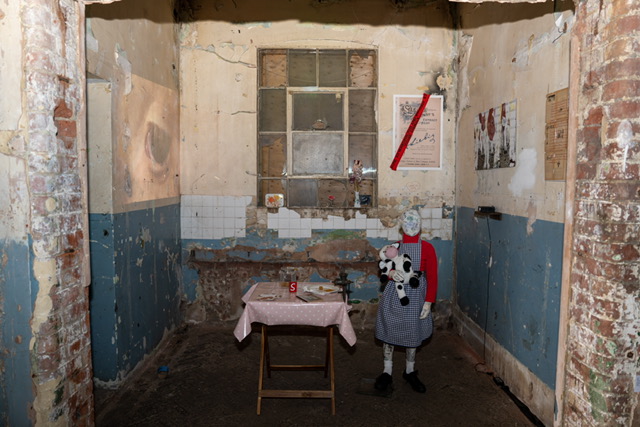
I would argue that, at this point, my extended drawing practice was becoming ‘Research’. Importantly the experience taught me that installation is an engaging method for building a discursive practice focused on social justice issues. Evidence for this came from the many conversations I had with visitors as well as observing/recording them having conversations with one another. Additionally, it was clear that many visitors engaged emotionally. I came to understand that everything in an installation is part of the installation, including the visitor: they have an experience in an installation that engages more than their visual senses – in this installation they could hear the Stirks, they could read about the history of the Bargehouse. Along with the artefacts in the space they could see the history of the building written in its walls.
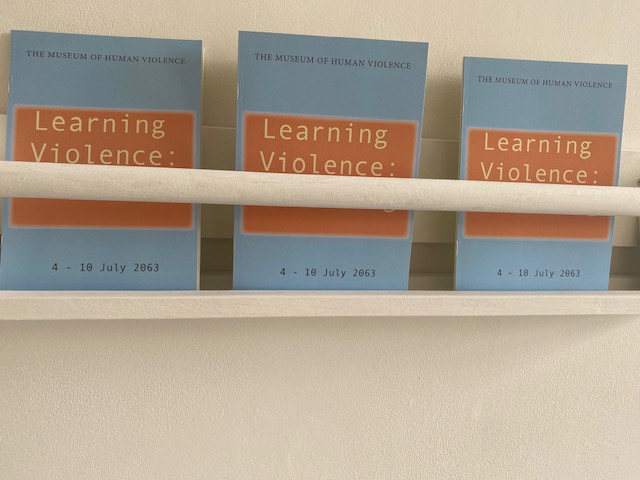
I decided to keep with installation as a method, and to add to it, to include the earlier experiments in imagining otherwise. I planned a Museum of Human Violence, opened in 2063 that looked back on the violence of today, after a Giant Rupture occurring around 2035. As I was developing this idea, I also came across the idea of ‘Fictioning’ (Burrows and O’Sullivan 2019), which is a similar concept to ‘Imagining Otherwise’ (Olufemi, 2021): both have a political commitment to change, and both imagine different future trajectories for the world to the one we seem to be on. In my fictioned world of 2063, violence has disappeared, and we are at peace.
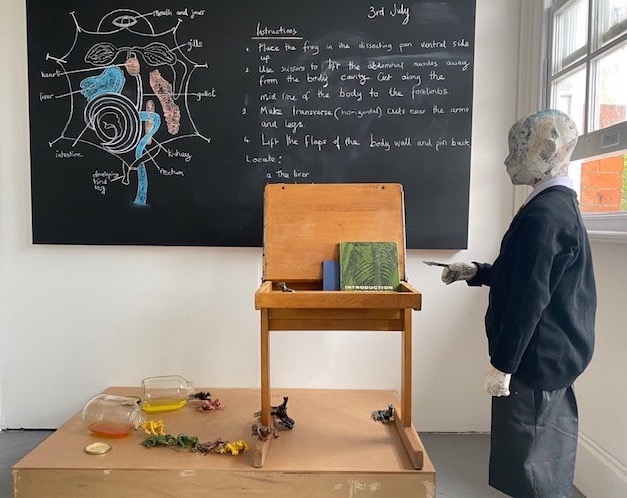
I imagined a museum with many galleries, and the particular gallery I developed was the one that focused on learning violence in school. I imagined a corner of this gallery called ‘Erasing’ and within that we stepped into a biology class where frogs were being dissected.
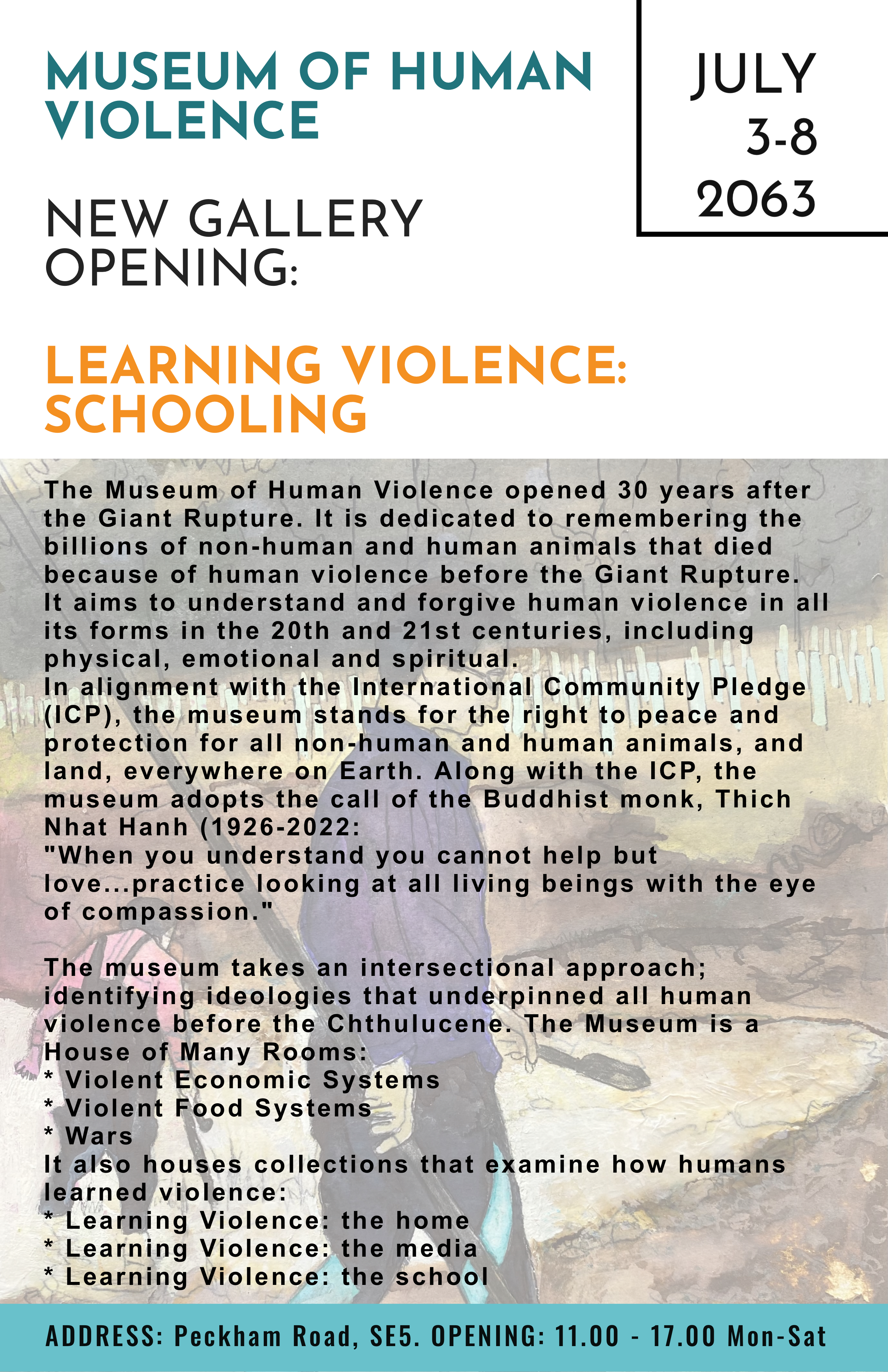
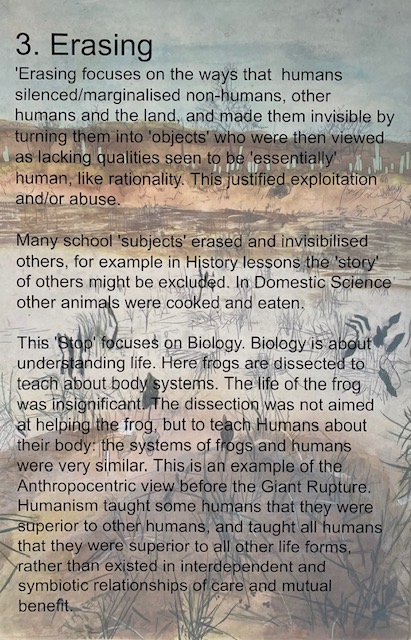
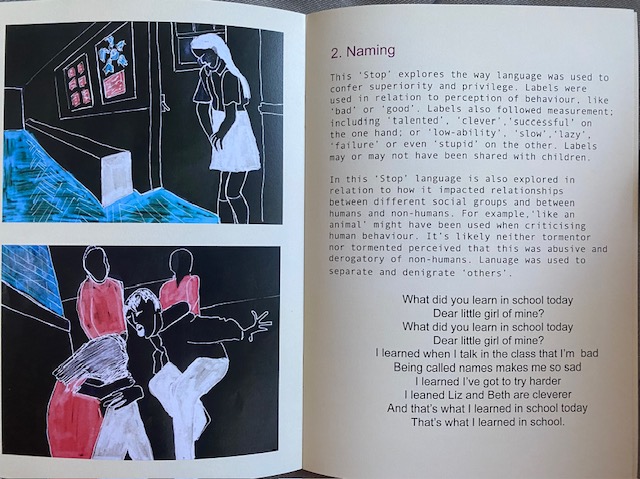
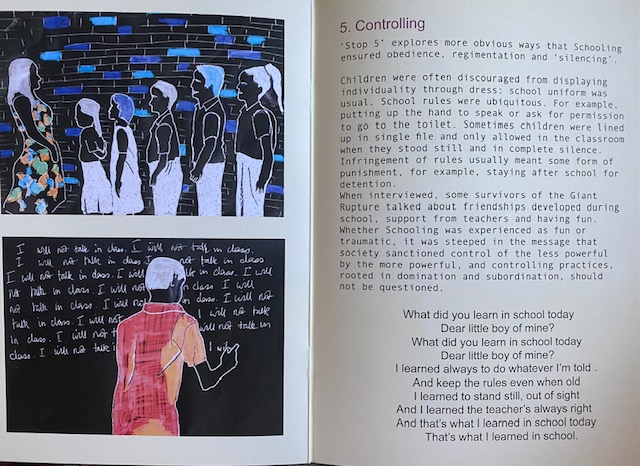
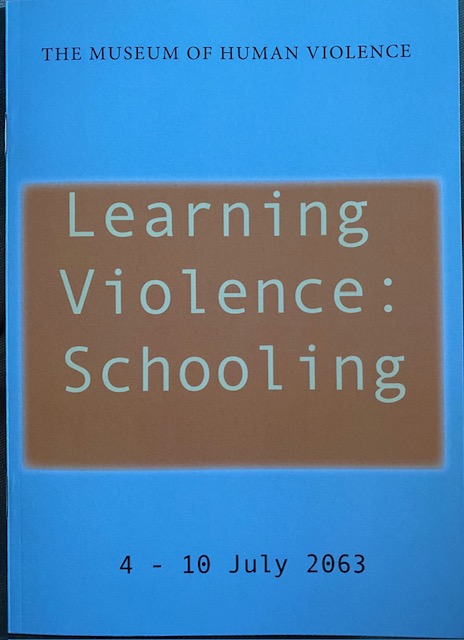
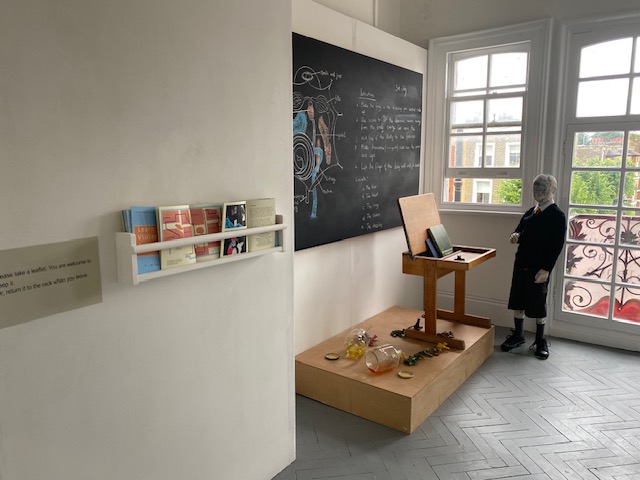
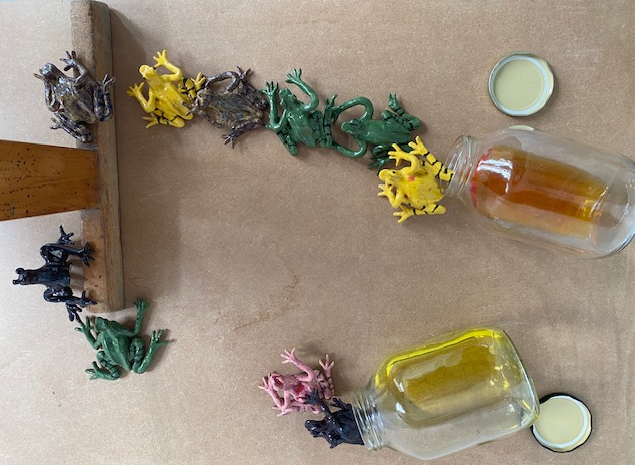
Importantly, in this lesson the frogs are not victims. 13 of them – an army of frogs – escape and challenge the boy who holds a scalpel.
As before the visitors were keen to discuss their experience of dissection in school – many of them had this experience. The 24-page booklet was a ‘take-away’ with drawings on each page and a poem in the style of Tom Paxton ‘What did you learn in school today’ but focusing on each of the concepts in the larger Gallery, for example, competition, division, privileging and so on. I also played an audio in which the AI curator talked about the gallery, this biology lesson specifically, and the beliefs that allowed this to happen. Some visitors picked up on the fact that they were invited to consider who they were – several asked, ‘Am I human or AI or cyborg?’ In this sense I consider the installation had a performative element which I will develop in future galleries.
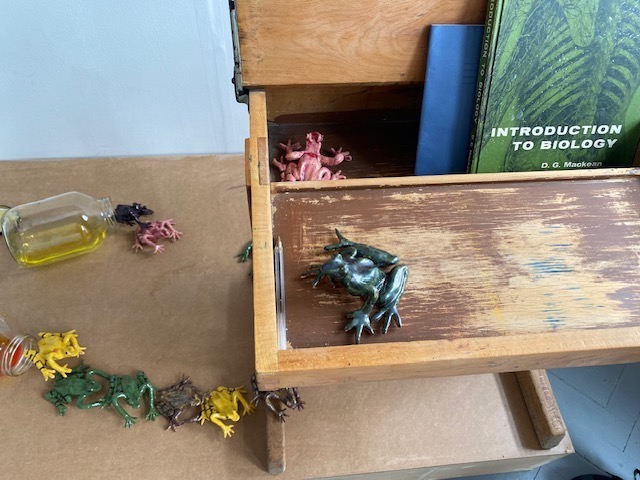
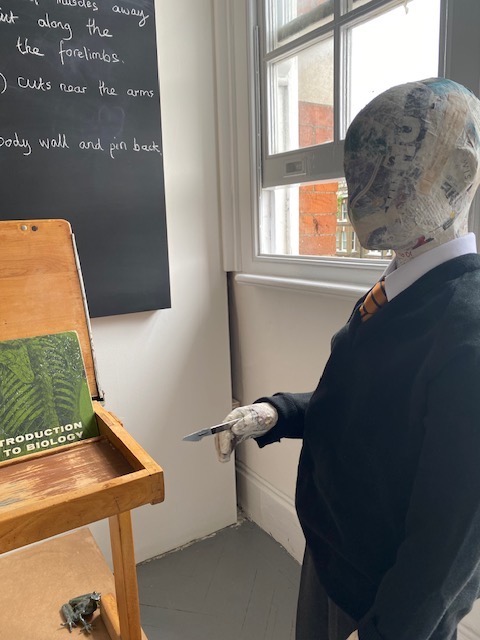

From this work I increased knowledge about installation for social justice and change, and also learned that the added element of fictioning is very useful for questioning dominant violent discourses that are made explicit in the installation. It does this by placing the installation at a future time where the discourses are no longer accepted, and by doing so challenges us to think about why we accept them now, and in whose interests they operate. Additionally, from my knowledge of education theory, I know that the analysis of violent schooling practices in the booklet, adds to understanding of ‘schooling’ as problematic (as compared to ‘education’).
My new work continues with installation and fictioning in The Museum of Human Violence: I narrow down the subject to examine violent discourses toward non-human and human animals in biocapitalism: the new form of capitalism that makes money from experimenting with, changing and controlling life itself. I plan to make an installation, with performance on xenotransplantation. hope to continue contributing knowledge about the expanded field of drawing, particularly installation and fictioning as methods to explore social justice issues, but in addition I hope to contribute knowledge about how non-human animals are exploited in biocapitalism itself.
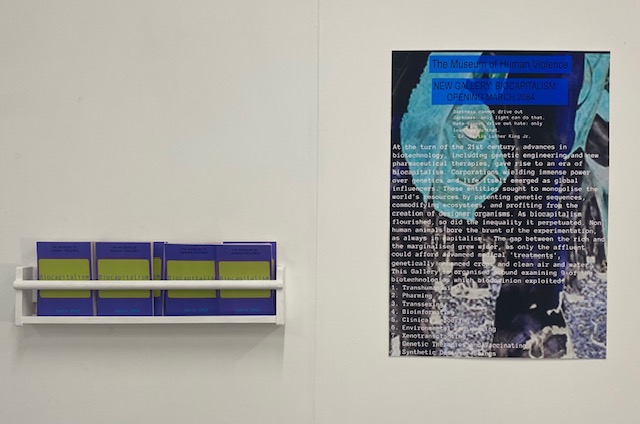

In conclusion Drawing is the centre around which my research-focused art practice revolves. Drawing is the initial method of analysis, prioritising, ordering, clarification. From drawing I become clearer about the focus of the work, and ideas for making work arise; the drawings themselves are often not the finished works, but are ideas, notes, aide memoires, possibilities, guesses, experiments. The ‘something else’ that has to happen before drawing becomes research includes: a research question must be identified (this can be refined later); drawing practice needs to be explored in relation to current knowledge on that specific practice, as well as any theory related to the theme; the methodology needs to be clear (how does the artist-researcher understand what they are doing as research); the outcomes must be analysed and theory needs to be developed and shared.
My current practice uses installation and ‘fictioning’ (looking back from a hopeful, peaceful, future perspective) as methods for engagement, social justice and change to human-animal relationships. I incorporate the initial drawings in booklets, maps, and posters, alongside found objects, in the final installation. I am confident that by continuing to use drawing and the expanded field of drawing as research methods, I will continue to develop my practice, and the research outcomes and knowledge will evolve, become more coherent and distinctive.
References
- Arribas-Ayllon, Michael; Walkerdine, Valerie (2008). Foucauldian Discourse Analysis. London: Sage.
- Burrows, D. and O’Sullivan, S. (2019). Fictioning. Edinburgh University Press.
- Lewandowska, K. Ochsner, M & Kulczycki, E. (2023) Research quality criteria in the Creative Arts, Studies in Higher Education, Studies in Higher Education, March. doi.org/10.1080/03075079.2023.2248174
- Olufemi, L. (2021). Experiments in Imagining Otherwise, London: Hajar Press.
- O’Sullivan, G. (2006). Research Acts in Art Practice. Studies in Art Education. Vol; 48, No 1. Arts-Based Research in Art Education (fall). Pp. 10-35)
- Simoniti, V. (2021) Art As Political discourse. British Journal of Aesthetics. Vol 61. Issue 4, October. pp 559-574.
- (https://www.qaa.ac.uk/docs/qaa/quality-code/qualifications-frameworks.pdf
 Drawing As Critique