(art is)…no longer grounded in traditional aesthetics but centered on significant ideas, topics and themes ranging from the everyday to the uncanny, the psychoanalytical to the political (Vishmidt, ed. 2021).
In this section I describe my choice of methodology, methods and ethical position.
I see methodology as the understanding of how research itself is viewed. What kind of research do I think I am doing? In what sense might I claim to be doing ‘research’? I see Method as the practices I adopt for conducting my research/making my work. The next pages briefly outline my methodological assumptions and the methods I am honing in on – installation and fictioning.
Methodology
I view my work generally as Visual Activism – that is I do not take a neutral stance on the cruelty to animals and I want to see it stop. Visual Activism is focused on raising awareness of social justice issues (see Hartle and White, 2022). However Visual Activism is not itself a research methodology (it does not set out to create new knowledge) – it is an aim for outcomes of the work, related to the hope that the work will raise questions, generate debate and bring about change.
In Art as research, Morgan (2001:7) writes:
…the artwork is (in a practice claiming to be research focused).. not a piece of preliminary fieldwork nor an experiment done in controlled conditions, but an intelligently constructed text that embodies meaning and knowledge.
My understanding of art as research was furthered by attending a research week at Konstfact university in Sweden in January 2023. Artist research was defined as follows:
Sometimes defined through its capacity to incorporate the intuitive, the pre-conceptual, and the non-linguistic, artistic research contributes to the production and dissemination of new knowledge in and through the practice of art, crafts and design…
Art is a fundamentally critical, exploratory practice, able to make visible the hidden threads driving everyday practices and events. Research projects in Art adopt a critical vision on our societies, their history, on prevailing norms and possible future forms of coexistence. Through these projects, new knowledge is made available on the artistic practice itself, as well as on its intimate relation to our daily experiences…
In Art, the methodological starting point is our own artistic practice. Research explores the untried; new working methods are tested, and new forms of dialogue and cooperation between fields of knowledge are established. In an open and interdisciplinary dialogue, Art interacts with the Crafts’ material tradition, but also with the humanities, social sciences and technological disciplines. (https://www.konstfack.se/en/Research/Fine-Art/)
Critical Discourse Analysis is my primary methodology for knowledge production.
Critical Discourse Analysis (CDA) does not lie in the traditional scientific, quantitative, objectivist view of knowledge that usually uses methods of experiment or observation and sees ‘knowledge’ as truth or fact. Nor does it lie in the other major tradition of research – the interpretivist or qualitative. The interpretivist or qualitative view of research is based on understanding of how ‘subjects’ make sense of their experiences; knowledge is viewed as relative or subjective and not generalisable. Qualitative methods usually involve collecting data through interview. Instead CDA involves identifying dominant narratives and what they contain. It asks what kind of ideas underpin the narrative/discourse, and also in whose interest it operates. In art it involves making an intervention that comments on these narratives (see Bell Hooks. Talking Back). (Arribas-Ayllon and Walkerdine, 2008)
I am developing a practice in which I use drawing, installation and fictioning to clarify the ideas underpinning dominant discourses and to comment on these narratives.
Method. 1. Installation
‘Installation art champions a shift in focus from what art visually represents to what it communicates. Installation artists are less focused on presenting an aesthetically pleasing object to viewers as they are enfolding that viewer into an environment or set of systems of their own creation. Tweaking the subjective perception of the viewer is the artist’s desired outcome. Pieces belonging to this movement resonate with our own human experiences – like us they exist within, and are always in conversation with, their lived environments.’
‘Pieces belonging to this category (visitor engagement) of Installation art shift the focus from art as a mere object to art as an instigator of dialogue. By occupying spaces so intentionally the artwork forces viewers into close interactions, so that viewing Installation art is more akin to an act of engagement than to one of contemplation. ‘
‘Installation art also overlaps with the Conceptual art movement, since they both prioritize the importance of ideas over the work’s technical merit. However, Conceptual art tends to be more understated and minimalist, whereas Installation art is often bold and more object-based.’
‘Initially, art critics focused solely on the site-specific and ephemeral nature of Installation artwork to define it, but this focus shifted as proponents of the genre began to make work referencing cultural contexts and social concerns.’
(All quotes from https://www.theartstory.org/movement/installation-art)
Groys (2009) raises the political implications of installation art, including the autonomy of the artist. He writes that ‘A conventional exhibition is conceived as an accumulation of art objects placed next to one another in an exhibition space to be viewed in succession….the exhibition space works as an extension of neutral, public urban space.’
The curator’s role is to safeguard the public character of the space, making art works accessible to the public..to publicize them ..’It is obvious that an individual artwork cannot assert its presence by itself, forcing the viewer to look at it. It lacks the vital energy and health to do so’ (the word curator is etymologically related to ‘cure’). However Groys argues that curation both cures, but at the same time further contributes to the artworks illness. Groys argues that installation art radically changes the role and function of the exhibition space. It symbolically privatises the public space of an exhibition, and is ‘designed according to the sovereign will of an indivdual artist’. While traditional art is defined by its material support – canvas, stone etc, the material of installation art is space itself.
‘the installation is material par excellence, since it is spatial – and being in the space is the most general definition of being material. The installation transforms the empty, neutral, public space into an individual artwork- and it invites the visitor to experience this space as the holistic, totalising space of an artwork. Anything included in such a space becomes a part of the artwork simply because it is placed inside this space’.
Groys, 2009
The point here is that the selection of what to include, where and how to place it, becomes the sovereign perogative of the artist alone: the focus on autonomy chimes with artwork that focus on questioning ‘power-over’ the ‘other’.
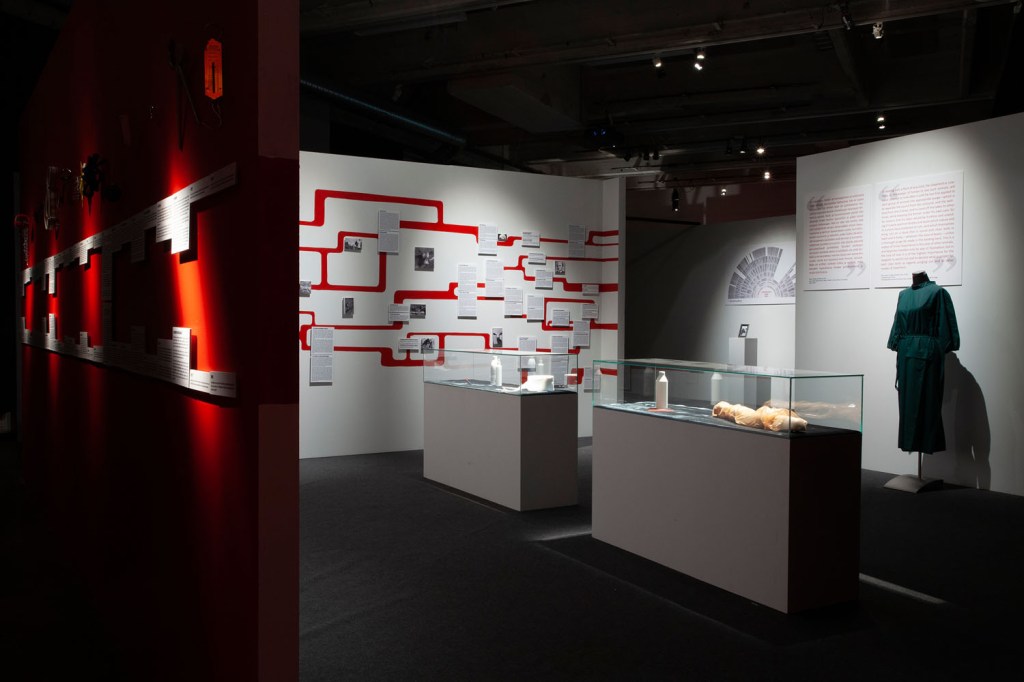
Artists who have been highly influential in relation to both installation and subject are Laura Gustafsson and Terike Haapoja whose installation ‘The Museum of the History of Cattle’ I saw in Bilbao at Science Frictions. See https://www.historyofcattle.org/exhibition/
Method. 2. Fictioning/Speculative fiction/Experiments in imagining otherwise (Olufemi, 2021).
The Museum of Human Violence, MHV, combined the methods of installation (non site specific) with fictioning (building on work started in Collages). The research question slightly developed:
‘What can I learn about how installation combined with fictioning, can interrupt objectification, invisibility (as, subjects) and discourses of violence in our culture; specifically toward the ‘other’ animal?
Crucially, the fiction in MHV is that by 2063 Human Violence has come to an end. By placing the museum in the future we can more easily identify and critique violent discourses of our own time, and distance from them so we are less likely to feel criticised, and can empathise. I chose to focus on schooling because it is an experience we share, but also because it is not an experience we generally associate with violence. In MHV I look at normalising discourses of violence explicitly, and am interested to trace these discourses to our treatment of other animals. The concept of the MHV, set in the future, gives many possibilities for ongoing work.
… it is possible to imagine ourselves differently. It is incumbent upon us as readers, citizens and authors to do so more often, in more ways, and including more kinds of people. Only through different imaginings will the world’s oppressive structures shift (Earle, 2019:3).
Braidotti (2022: pp 224-229) writes about Afrofuturist fiction, for example the work of Octavia Butler and N.K. Jemisin: ‘The authority and trans- formative energy that are missing from a traumatic past and the harsh conditions of the present can be borrowed from the future, defined as a site of empowerment to come.’ (p. 226).

The philosopher, Donna Haraway, goes beyond suggesting fictioning, to using it as a ‘method’ herself. For example, ‘Staying with the Trouble’ (2016) ends with the fictional story of five generations of Camilles who inhabit the devastated earth during the next 400 years. They are given monarch butterfly genetic patterning to enable them to make closer relationships with butterflies and work with them to make their continued existence a possibility.
Burrows and Sullivan (2019: 2) write that they use fictioning:
… as a verb to signal the marking out of trajectories different to those engendered by the current organisation of life, as well as fiction as intervention on, in, and augmentation of, existing reality. In this sense, they argue, fiction can take on a ‘critical’ power when it is set against, or foregrounded within, a given reality’.
Burrows and Sullivan agree with Statkiewicz (2009) that fictioning involves a collapse of any hierarchies between art and philosophy – and point out that philosophy has long been concerned with modes of narration and play that produce truth or unconcealment. They point out that this is increasingly a concern in the practices of contemporary art (often related to art as activism). The authors suggest that fictioning is most powerful in art when there is a play of fiction AS life and reality: in other words a blurring between ‘fact’ and fiction. I understand this in relation to my work: I present ‘The Museum of Human Violence’ (MHV), set in 2063, as FACT. The visitors are asked to imagine they are in a future space and world that is very different from the world we inhabit now. They are part of that world, and this might raise questions for them about whether they are still human or Cyborgs, or AI. I have been reflecting on how different this is from reading a science fiction novel or watching a science fiction film – here we know we are reading about the future, not in the future ourselves. The installation MHV is more similar to a game in which we enter a future world – but here again, we would make the choice to play the game, understanding its parameters. In MHV visitors do not know before they step inside that they are entering a future world.
O’Sullivan’s (2016) argues that an artist of any kind cannot escape from the dominant ideologies – pointing out problematic belief structures and behaviours that result in injustices merely compounds them. Describing them/showing them/pointing them out is, in itself not a critique. (I know this myself from early work on sexism. I learned that if I was the only woman in a group of males, and if I showed sexist images to them, this did not allow them to understand the images from the viewpoint of someone oppressed by the images. On the contrary, it reinforced and mirrored the very oppression I was critiquing). I learned instead that work to critique oppression always has to avoid such imagery and always has to start by building an empathetic relationship with the oppressor so that joint understanding can be the starting point.
Related to this, O’Sullivan’s makes the point that the artist cannot escape being ‘in-the-world’ – I have also struggled with this fact during my year on the MA – it is also why I have reached the conclusion that fictioning/speculative imaginaries might be a way forward. Sullivan’s suggestion is that, to counter this, Art should operate on the edges of the viewer’s understanding. He recognises that this might lead to responses ranging from frustration, boredom, annoyance or irritation – but I am not convinced these are helpful. They also push people away. I think, instead, that the artist must find a way to engage empathy and interest in the idea of future possibilities for a different world, and that they must understand the fictioned world presented .
In fact O’Sullivan 2016 writes that an important aspect of fictioning in contemporary art is that the audience must participate in the fiction. I think this is less likely if they are frustrated, or bored. And more likely if they can empathise with the fiction. However, I agree with O’Sullivan’s general point. It is something I did not have time to think very much about in the first installation of my ‘Museum of Human Violence’ , but I did recognise that the visitor WAS a participant whether or not they realised it. This broadens my awareness about everything within the space of an installation being part of the artwork – this extends to the viewer, who is also part of the artwork, whether they recognise it or not.
I have come across artists who use fiction alongside installation in their work, for example, Iris Haussler, Jameson Charles Banks, Allison Smith and Ilya and Emilia Kabakov (see separate entry on contexts) . However, I have not found any contemporary artists who use fictioning (rather than fiction) combined iwth installation, and I particularly have not found artists who use either fiction or fictioning to explore our relationships with other animals.
Ethics
My thinking about ethics is influenced by both ecofeminist ethics of care and posthumanist vital materialism. Leonard (2020) argues, from a new materialist perspective, Art is an act of environmental and cultural stewardship, ‘creating new possibilities and differences in the virtual that are merciful, graceful, and hopeful’.
To support this argument Leonard uses the ideas of Agential Realism (Barad, 2007) and Affirmative Ethics (Braidotti, 2019). Like other post humanist philosophers, he draws on a philosophy of immanence to counter the ‘circular perpetuation of violence.’ In my understanding, the theory of immanence, in the writing of Sinoza, holds that God is not outside of or separate from the material world, but part of it.
New materialism, in the work of Barad (2007) and Braidotti (2019) decenters human aims and goals. Both of their writings are ethically focused since they examine the dynamic relationships of matter to focus on what new relationships form. According to Barad matter does not possess inherent fixed properties but is a collection of atoms that exist in a relationship with other atoms, temporarily developing qualities until a new relation is formed. Leonard uses the example of a hammer which is not a hammer until it strikes something.
From this perspective subjects are always in the process of becoming something else: every action is an ethical action affecting and being affected by other matter. This way of thinking, Leonard proposes, means breaking away from dualist thought to immanent understanding of how entities are emerging and how they influence future becomings. It means that the world is constantly dynamic. Consequently Braidotti writes:
Post human thinking ‘…is the creation of concepts to assist with the complexities of the present with a focus on actualizing the virtual. Since our thinking and actions influence matter’s becoming in the virtual, all our thoughts and actions need ethical considerations since “we-are-all-in-this-together-but-we-are-not-one-and-the-same” (Braidotti, 2019: 157).
In other words, in the writing of Donna Haraway (2016), ‘it matters what thoughts think thoughts’. It is important to stress here that becoming does not produce a new ‘thing’ but a new relationship. The implications for art are that rather than reflecting binaries in artworks, new materialism would investigate how engaging with the artwork can produce new relational differences.
Art is not a binary statement but a provocation to change the becoming of the world. The ethics of new materialism go beyond describing the world as is, to describing how things ought to be in the world. I hope in my work to go beyond describing the binary exploitative relationship between human and non-human and instead, through setting it in the future in which these exploitative relationships no longer exist, provoke and challenge the visitor to think about what has to change in order for this to be the case.
Barad (2007) sees new materialism as inherently ethical since a person’s actions always influence others: Agential realism is a recognition that all our actions are entangled. For Braidotti Affirmative Ethics is about constructing horizons of hope in the face of injustices. This calls for a critical engagement with the present.
Leonard (2020) goes on to discuss mercy, grace and hope. In his reading, mercy relates to compassion – to witholding punishment that is rightly deserved to increase the chance of positive transformation. Grace is providing kindness when it is not deserved. Hope is to ‘desire, anticipate or expect fulfillment of a particular actualisation of the virtual which has yet to be actualised (Leonard, p.16). Leonard gives an example of hope in works of Speculative fiction.
(In future work I will return to the question of whether there is epistemological/ontological tension between my methodology (CDA), and supporting theory (Critical animal studies/post humanism/new materialism) . If so can they be reconciled? my initial thought is they can – both are explanations about how the world becomes. CDA theorises discourse/language as creating a constantly changing material reality. New materialism theorises ‘things’ coming together and creating material changes, i.e that ‘things’ have agency in themselves). Given a post-dualist understanding, is there any reason why both cannot work in tandem? See too the argument that language and material are not separate, as well as refutation of the argument that DA is itself Anthropocentric (because focused on language) Lundborg and Vaughan-Williams, 2015)
I attach a powerpoint presentation below that summarises both the gradual development of a ‘method’ over the year alongside the gradual refocusing and narrowing of my research question:
References
Arribas-Ayllon, M. and Walkerdine, V. Second Editon (2008) Foucauldi Discourse Analysis. in Willig, C et al. The Sage Handbook of Qualitative Research in Psychology. London: Sage. pp 91-108
Barad, K. 2003. Posthumanist performativity: Toward an understanding of how matter comes to matter. Signs: Journal of women in culture and society 28: 801–831. [CrossRef]
Barad, Karen. 2007. Meeting the Universe Halfway: Quantum Physics and the Entanglement of Matter and Meaning. Durham: Duke University Press.
bell hooks. (1989)Talking Back: thinking feminist, thinking black. Boston, MA: South End Press.
Berger, J. (1977, 2009) Why Look At Animals? London: Penguin.
Braidotti, R. 2019. Posthuman knowledge. Medford: Polity Press.
Braidotti, R. (2022) Posthuman Feminism. Cambridge: Polity Books.
Burrows, D. and O’Sullivan, S. (2019). Fictioning. Edinburgh University Press.
Earle, J. (2019) Imagining Otherwise: The Importance of Speculative Fiction to New Social Justice Imaginaries. page 3. in Catalyst: Feminism, theory, technoscience. No 5 (1).
Groys, B. (2009) Politics of Installation. E-flux journal. January. https://www.e-flux.com/journal/02/68504/politics-of-installation/(last accessed 10 August 2023).
Haraway, D. (2016) Staying with the Trouble: Making kin in the Chthulucene
Hartle, S. and White, D. (2022) Visual Activism in the 21st century: Art, Protest and Resistance in an Uncerertain World. London: Bloomsbury visual Arts. .
Leonard, N. (2020) The Arts and New Materialism: A Call to Stewardship through Mercy, Grace and Hope. in Humanities, 9, 84.
Lundborg, T. and Vaughan-Williams, N. (2015) New Materialism, discourse analysis and International Relations: a radical intertextual response. Review of International Studies. Vol 41, No 1, January. pp 3-25.
Morgan, S. J. (2001). A Terminal Degree : Fine Art and the PhD. Journal of visual art practice 1 (1), 6-15. Taylor and Francis. Online.
Olufemi, L. (2021). Experiments in Imagining Otherwise, London : Hajar Press.
O’Sullivan, S. (2016). Myth-Science and the Fictioning of Reality. in Paragrana. Volume 25. Issue 2.
Statkiewicz, M. (2009) Rhapsody of Philosophy (University Park, PA, The Pennsylvania State Uni-versity Press
Vishmidt, M. (2922) Speculation. Documents in Contemporary Art. Whitechapel Art Gallery. London: The MIT Press.
https://www.tate.org.uk/art/art-terms/s/site-specific
https://www.konstfack.se/en/Research/Fine-Art/
https://www.theartstory.org/movement/installation-art/
Footnote.1
I came across this interesting quote in a book edited by Kester (1998:8). In the introduction on page 8 Kester writes about the relationship between aesthetics and activist art, arguing that a broader definition of aesthetics is called for:
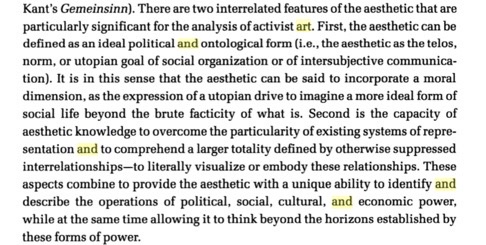
Kester, G. (1998). (ed). Intro. Art, Activism and Oppositionality. Durham and London: Duke Univeersity Press.
 Drawing As Critique